Choosing between a professional certification and a degree used to feel like a straightforward question with an obvious answer: get the degree, then worry about the rest later. That certainty has quietly disappeared. Career paths have multiplied, employers increasingly separate “qualified” from “credentialed,” and the fastest route to a promotion is not always the one that takes four years.
This shift matters because the professional certification vs degree decision is no longer purely academic. It shapes how much you spend, how quickly you can start earning at a higher level, and whether the qualification you choose is actually recognised where you plan to use it. Some careers still demand a degree as a non-negotiable entry ticket. Others reward specific, demonstrable skills far more than the institution named on a certificate. This article walks through both pathways honestly, compares them side by side, and helps you work out which one, or which combination, fits where you want to go.
Read More: Professional Certifications That Actually Pay Off: A 2026 Career Guide
What Is a University Degree?
A university degree is a formal academic qualification awarded after a structured programme of study, typically a bachelor’s degree lasting three to five years, or a master’s degree completed in one to two years afterwards. Degrees are built around breadth. Rather than teaching one narrow skill, they build a foundation across a subject area: economics, engineering, law, communications, or whatever discipline you choose, alongside research, critical thinking, and writing skills that transfer across many roles.
This breadth is precisely why degrees remain the standard entry requirement for regulated professions. Nigeria’s National Universities Commission sets and accredits the minimum academic standards that Nigerian universities must meet, and that accreditation is what makes a degree recognisable to employers, professional bodies, and government agencies. Fields such as medicine, law, engineering, and academia are structured around this credential; without it, entry is simply not possible, regardless of how skilled or self-taught a candidate might be. A degree also opens the door to postgraduate study, which matters if your long-term ambitions include research, specialised practice, or senior leadership roles that expect an advanced qualification on the CV.
What Is a Professional Certification?
A professional certification is a credential earned by demonstrating competence in a specific skill or practice area, usually through a shorter, focused programme followed by an assessment or examination. Where a degree asks “what do you understand broadly,” a certification asks “can you do this particular thing well?” Programmes range from a few weeks to under a year, making them considerably faster to complete than most academic qualifications.
Not all certifications carry equal weight, and it is worth being blunt about it. A certification issued by a globally recognised professional body, such as the Project Management Institute or a chartered accounting body, tends to carry substantial credibility because it is tied to an examination standard and often requires ongoing renewal or continuing education to keep it current. A certificate from an obscure or unaccredited provider, on the other hand, may add little beyond the knowledge gained. Before committing time and money, it is worth checking whether the issuing body is respected within the specific industry you are targeting, since that recognition is what determines whether the certification actually functions as career certification or simply sits unused on a CV. When people ask whether a certification is worth it, this recognition test is usually the real answer, more than the credential itself.
Weighed against a full academic programme, a professional certificate vs bachelor’s degree comparison also comes down to depth. A certificate teaches you to execute a specific task well; a bachelor’s degree teaches you to reason across a discipline, which is a different, broader kind of value.
Professional Certification vs Degree: Key Differences
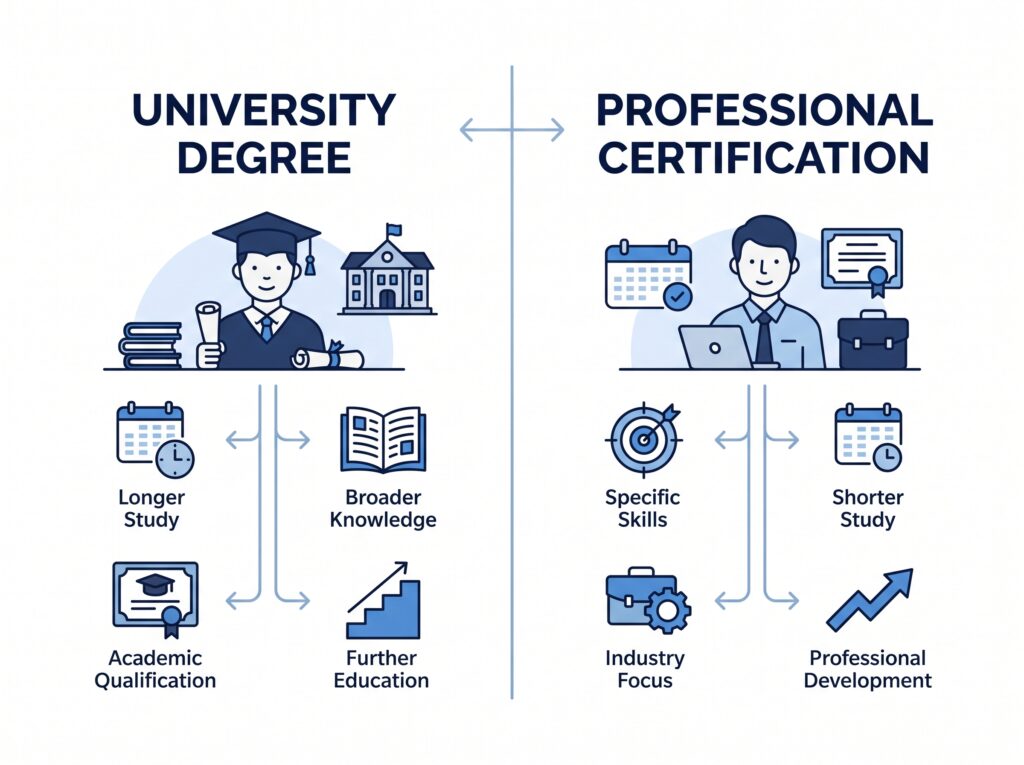
Rather than declaring one option superior, it helps to see how they compare across the factors that actually affect a career decision.
| Factor | University Degree | Professional Certificate |
| Duration | 3 to 5 years (longer for postgraduate study) | Weeks to under a year |
| Cost | Generally higher, includes tuition and, often, accommodation | Generally lower, often a single course fee |
| Focus | Broad academic foundation across a subject | Narrow, applied skill or practice area |
| Recognition | Widely recognised, often legally required for regulated professions | Recognised where the issuing body is respected in that industry |
| Flexibility | Fixed curriculum, though online formats now exist | Highly flexible, often self-paced |
| Renewal | Not typically required | Some require periodic renewal or continuing education |
| Best suited to | Long-term career building, regulated professions, leadership tracks | Fast upskilling, career specialisation, existing professionals |
This table captures the shape of the certificate vs degree career decision, but the right answer still depends on where you are starting from and where you are trying to go. Framed simply as degree vs certification, neither column in this table wins outright; each is built for a different kind of career problem.
Read More: Online Bachelor’s Degree: A Complete Guide for Working Adults
When a University Degree Makes More Sense
A degree tends to make sense when the career itself requires one as a baseline, or when your goals stretch well beyond a single skill set. Consider a degree seriously if you fall into one of the following situations:
- You are just starting out. School leavers and early-career students generally benefit from the broad foundation, critical thinking, and structured pace a degree provides, particularly before deciding on a specific direction.
- You are changing careers into a regulated field. Law, medicine, engineering, and several finance-adjacent roles require a recognised degree by law or professional body rule, and no certification can substitute for that requirement.
- You want long-term progression into leadership. Many organisations still use a degree, and increasingly a postgraduate qualification, as a filter for senior and executive-track roles, even when day-to-day performance depends far more on experience.
- You plan to pursue postgraduate study. A master’s degree or further academic research generally requires an undergraduate degree as the entry point, so skipping it can close doors later.
When a Professional Certification May Be the Better Choice
Among the clearest benefits of professional certification is speed: it often makes more sense for people who already have a foundation and need to move quickly. This is especially true across technology, business, project management, and finance, where employers increasingly hire and promote based on demonstrated capability. The World Economic Forum’s Future of Jobs Report 2025 found that a majority of employers now expect to prioritise evaluating actual work experience and applied skills over formal qualifications alone when assessing candidates, a trend that favours targeted, skills-based credentials and career certification routes over broad academic study alone in fast-moving fields.
Consider a certification if you recognise yourself here:
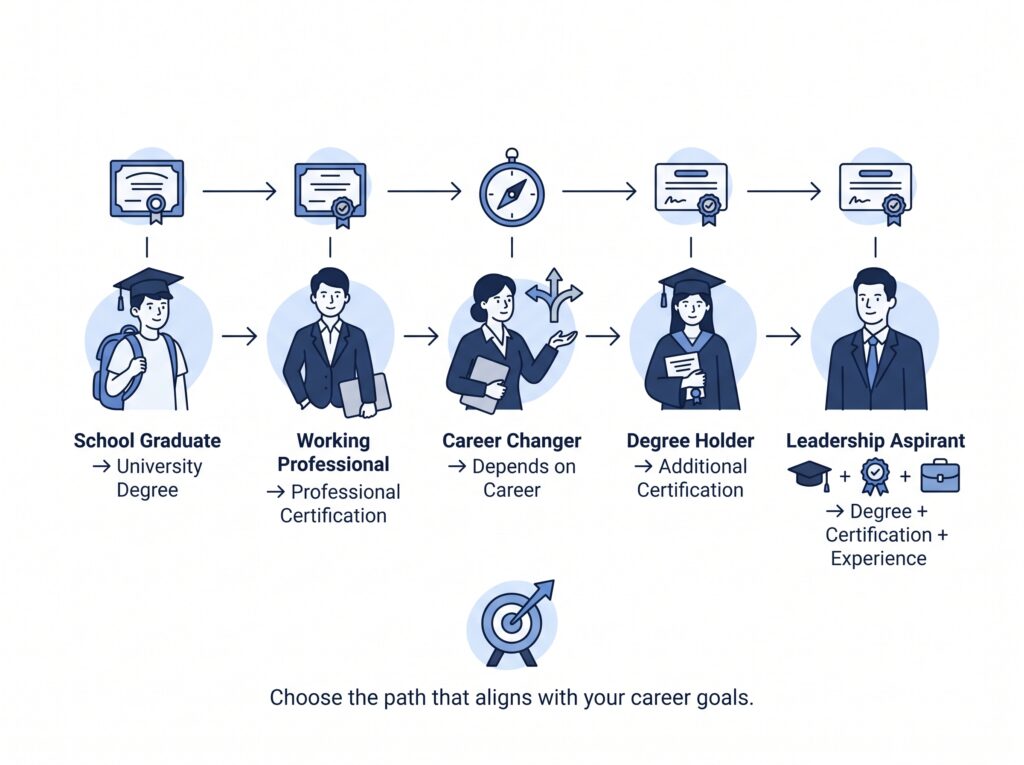
- You already hold a degree and need a specific skill. A marketing graduate pursuing a Google Analytics certification, or an engineer earning a project management certification, adds a precise, in-demand capability without repeating years of general study.
- You are closing a defined skill gap. Certifications in cloud computing, data analysis, digital marketing, or cybersecurity let professionals catch up with fast-moving fields where university curricula often lag behind industry practice.
- You need to move fast. If a job opportunity or promotion depends on a specific credential now, a certification’s shorter timeline is a genuine practical advantage over a multi-year degree.
- You are testing a new direction. Before committing years and significant tuition to a career change, a certification offers a lower-risk way to confirm genuine interest and aptitude.
Employer behaviour increasingly supports this path. According to LinkedIn’s Economic Graph research, shifting hiring searches from job titles to specific skills expands eligible candidate pools substantially, including strong gains among workers without a bachelor’s degree, evidence that professional certification benefits are becoming harder for employers to ignore, particularly in technical and fast-evolving roles.
Can You Combine a Degree and Professional Certification?
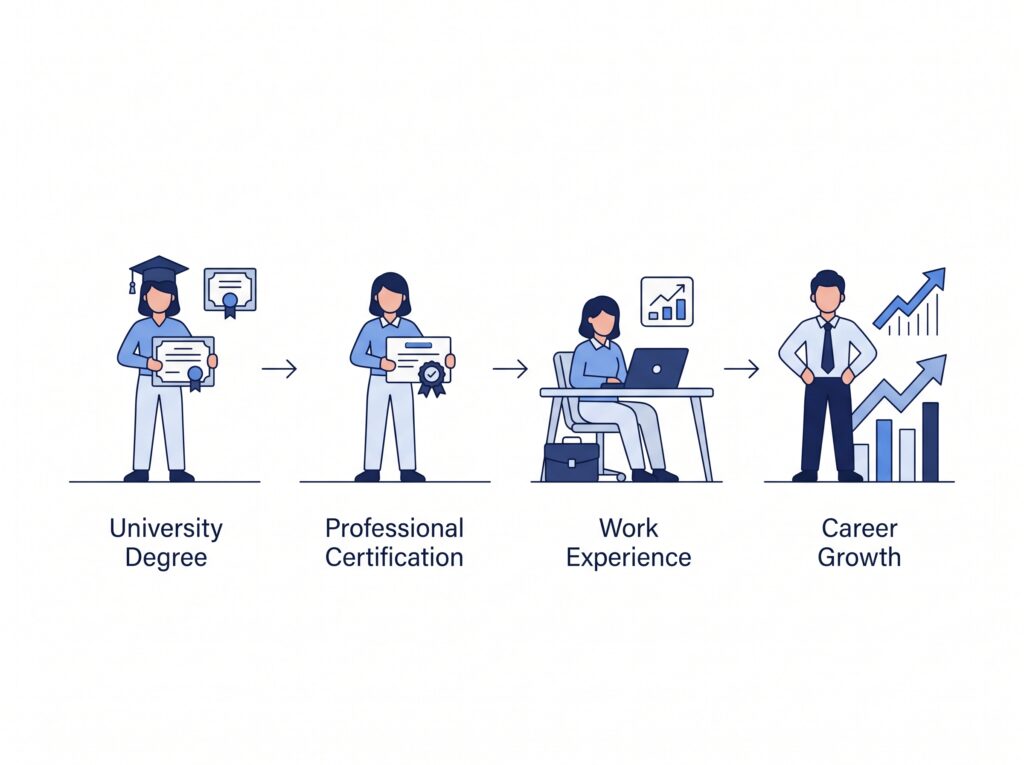
For many professionals, the strongest answer is not degree vs certification at all, but both, sequenced deliberately. A degree builds the broad foundation and, in regulated fields, the legal entry ticket. Certifications layered on afterwards sharpen that foundation into specific, marketable skills that keep pace with an industry that changes faster than most curricula can.
This combination, degree plus targeted certification plus real work experience, is increasingly what distinguishes strong candidates in competitive fields. A finance graduate with a chartered credential, or an IT graduate with a recognised cloud certification, presents a profile that satisfies both the formal recognition employers still expect and the applied competence they are actively testing for. Certifications do not need to replace a degree to be valuable; in most cases, they complement it, alongside other professional qualifications, and extend its shelf life.
How to Decide Which Path Is Right for You
Whether you are weighing a certificate vs degree career move or a straightforward professional certificate vs bachelor’s degree choice, work through these questions honestly, since the answers usually point clearly in one direction:
- What career do you actually want, and does it legally or practically require a degree?
- Do you need broad knowledge across a field, or one specific, applied skill?
- How quickly do you need the qualification in hand?
- What can you realistically afford in time and money right now?
- Do you already hold a degree that a certification could build on?
- Do you need a flexible, self-paced study format around a job or family?
- Is the specific qualification you are considering recognised by employers or professional bodies in your target industry?
Answering these honestly does more to resolve the professional certification vs degree question, and the broader degree vs certification debate, than any general ranking of one option over the other ever could.
Read More: Admission Without JAMB: Legitimate Ways Nigerian Students Can Get Into University
Education Pathways Available Through EduTech Business

Wherever you land on this decision, the practical next step is finding a programme that is properly accredited and genuinely fits your goals. EduTech Business works with a range of partner institutions to support both routes. For learners pursuing a full online bachelor’s degree while working, distance learning options through partners such as ABU DLC and Babcock BUCODeL allow study without stepping away from a job or income. For professionals seeking postgraduate business qualifications and skills-based programmes, partners including MSBM offer flexible routes suited to working schedules.
If you are still weighing a shorter, skills-focused route, our guide to choosing online courses for career growth in Nigeria is a useful next read, alongside our overview of the highest paying jobs in Nigeria and the best courses to study at university if a full degree still looks like the right foundation.
There is no universal winner in the professional certification vs degree debate, and any advice claiming otherwise is oversimplifying a genuinely personal decision. A degree, and the professional qualifications that often follow it, remains essential for regulated professions, early-career foundations, and long-term leadership ambitions. A certification is often the smarter, faster choice for professionals sharpening a specific skill, changing direction, or responding to an industry that is evolving faster than traditional curricula can keep up with. For a growing number of people, the most resilient career profile combines both: a solid academic foundation, reinforced by targeted, current, skills-based credentials.
Not sure whether you need a degree, a professional certification, or both? Speak with an EduTech Business advisor to compare university programmes and professional learning pathways based on your career goals, qualifications and preferred study format.
Frequently Asked Questions
Is a professional certification better than a degree? Neither is universally better. A degree suits regulated professions and long-term academic progression, while a certification suits fast, targeted skill-building, especially for professionals who already hold a degree.
Can a certification replace a university degree? In most regulated professions, no. Law, medicine, and engineering, among others, legally require a degree. In fast-moving technical and business fields, a strong, recognised certification can sometimes substitute for a degree, particularly when paired with demonstrable experience.
Is a professional certification worth it? Yes, provided it is issued by a respected body in your industry and addresses a genuine skill gap. Is a certification worth it largely depends on whether employers in your specific field recognise and value it.
Which is better for career growth? It depends on your stage. Early-career professionals often benefit more from a degree’s breadth, while established professionals typically see faster returns from targeted certifications.
Can I get a certification after my degree? Yes, and this is one of the most common and effective combinations. Many professionals complete a degree first, then pursue certifications to sharpen specific, in-demand skills.
Are professional certifications recognised by employers? Recognition varies by field and issuing body. Certifications from established, industry-respected organisations are generally well recognised; lesser-known providers may carry limited weight.