Learning how to choose a career does not require knowing your perfect job today. It requires a process: understanding yourself, exploring real options, testing a few of them, and gradually narrowing your direction.
If you feel stuck, you are not alone. OECD research based on PISA data found that while most teenagers already have a career in mind, one in three names one of just ten jobs, suggesting many young people are choosing from a narrow, familiar list rather than a genuinely informed range of options. Career uncertainty is not a personal failing. It is often a sign that nobody has shown you how to choose a career systematically. This article sets out exactly that: a practical, step-by-step approach to how to choose a career, moving from “I have no idea” to a direction you can act on.
Read More: Highest Paying Jobs in Nigeria: Top Careers and the Degrees That Can Get You There
Start With Yourself: Interests, Strengths and Values

Before comparing career options, it helps to understand what you are actually working with. Three things matter here, and they are not the same thing.
- Interests. What subjects, activities or problems genuinely hold your attention, even outside school or work?
- Strengths. What do you do more easily or more consistently well than the people around you?
- Values. What do you need from work to feel it is worthwhile: stability, autonomy, creativity, impact, income, or something else?
It is worth being direct here: interests alone should not determine a career. You might enjoy something without being particularly good at it, or without it offering realistic opportunities. Working out how to choose a career, or a profession, that actually fits you means weighing interests, strengths and values together, not treating any one of them as a single deciding factor.
Identify the Skills You Already Have
Many people underestimate how many transferable skills they already hold, simply because those skills were not learned in a classroom labelled “career skills.” Consider what you have built through school, part-time work, volunteering, hobbies or personal projects:
- Communication and writing
- Problem-solving and analysis
- Organisation and planning
- Leadership or coordination
- Creativity and design thinking
- Basic digital or technical literacy
These skills often transfer across very different careers. A student who has organised a fundraiser has demonstrated project management. Someone who has run a small social media page has demonstrated marketing and content skills. Naming these accurately gives you a genuine starting point, rather than a blank page.
Think About the Kind of Work You Want to Do
Job titles change constantly, but the underlying nature of work does not. Before researching specific roles, ask yourself a few grounding questions:
- Do you prefer working with people, information, technology, or physical environments?
- Do you want structure and routine, or variety and flexibility?
- Do you enjoy solving problems, or do you prefer executing a known process well?
- Do you work best independently or as part of a team?
- Do you want a predictable environment or a fast-changing one?
Answering these honestly is often more useful for finding your career direction than scrolling through job titles, because it filters entire categories of work in or out before you have researched a single role. This step alone does more for choosing a profession that suits you than any list of “top careers” ever could.
Read More: Tech Career Without a Degree: What You Actually Need to Get Hired
Explore Different Career Options

With some self-understanding in place, it is time for genuine career exploration for students, graduates and working professionals alike. This is where how to choose a career stops being abstract and starts becoming a research exercise. For each career option under consideration, research:
- Typical responsibilities and daily tasks
- Required skills and qualifications
- Career progression and long-term prospects
- Industry trends and demand
- Entry-level opportunities and how people typically get in
Resist the urge to commit to the first appealing option. Comparing several career options, even briefly, reveals trade-offs that are invisible when you only examine one path in isolation.
Use a Career Path Quiz or Assessment Carefully
A career path quiz or career assessment can be a genuinely useful starting point, generating ideas you might not have considered. Recognised frameworks, such as the US Department of Labour’s O*NET Interest Profiler, are built on established occupational research rather than guesswork.
That said, no assessment can identify a single “perfect” career for you. Treat results as a shortlist to investigate further, not a verdict. Combine what a quiz suggests with your own research, conversations and, ideally, some direct exposure to the work itself.
Research the Reality Behind a Career
Job titles can be misleading, and glossy descriptions rarely capture daily reality. Before narrowing further, dig into what a role actually involves: entry requirements, typical challenges, career progression, demand in your region, and opportunities to specialise later. A role that sounds appealing on paper may involve far more routine administrative work, or far more pressure, than the title suggests. Looking beyond the label is one of the most reliable ways to avoid choosing the wrong career.
Talk to People Who Actually Work in the Field
Part of genuine career exploration for students and career changers alike is talking to people, not just reading about roles. Informational interviews, mentors and professional communities can reveal information no job description will give you. Ask people currently in a role what a typical week looks like, what they wish they had known earlier, and what actually makes the job difficult. These conversations often surface details, both encouraging and cautionary, that reshape a decision faster than weeks of independent research.
Test a Career Before Committing

Where possible, experiment before committing years to a single path. Low-risk ways to test interest include short courses, micro-credentials, internships, volunteering, freelance projects, job shadowing or small personal projects. Each gives you direct exposure to the actual work, which is the fastest way to learn whether an appealing idea holds up in practice.
Read More: Professional Certification vs Degree: Which One Actually Advances Your Career?
Choosing a Career Path: Passion vs Skills vs Opportunity
It is tempting to simplify how to choose a career into “follow your passion,” but that advice ignores reality: not everyone has a single pre-existing passion, and passion alone rarely accounts for rent. A more workable approach weighs several factors together: what you enjoy, what you are genuinely good at, what employers actually need, what you can realistically learn, and your personal circumstances. Choosing a career path, or a profession more broadly, is a balancing exercise between personal fit and real-world opportunity, not a search for one overriding signal.
How to Choose the Right Education Path
Once a direction becomes clearer, the next question is which education route supports it. Depending on the field, that might be a degree, a professional certification, a micro-credential, a short course or an apprenticeship. Before committing, ask:
- Is a formal qualification legally or practically required?
- Which specific skills does the role demand?
- Does the industry value certification, and from which bodies?
- Does the programme offer practical, applied experience?
- Does it fit your budget, timeline and schedule?
What If You Still Don’t Know What Career You Want?
If you are still uncertain about how to choose a career, a structured approach still works better than waiting for clarity to arrive on its own:
- Choose two or three broad career areas that interest you.
- Research each one properly.
- Identify skills that overlap across them.
- Try an introductory course or short project in each.
- Speak with people working in those fields.
- Narrow to one direction based on what you learn.
Career direction is allowed to evolve. Very few people choose one career at eighteen and follow it unchanged for forty years, and treating this decision as reversible removes much of its pressure.
Common Career-Choice Mistakes to Avoid
A few patterns consistently lead people astray: choosing based on salary alone, following friends or family expectations without personal reflection, selecting a degree before understanding the career it leads to, relying entirely on online quizzes, and assuming a first career choice is permanent. Awareness of these patterns alone can prevent much of the regret that follows a rushed decision.
Read More: Professional Certifications That Actually Pay Off: A 2026 Career Guide
How EduTech Business Supports Career Planning
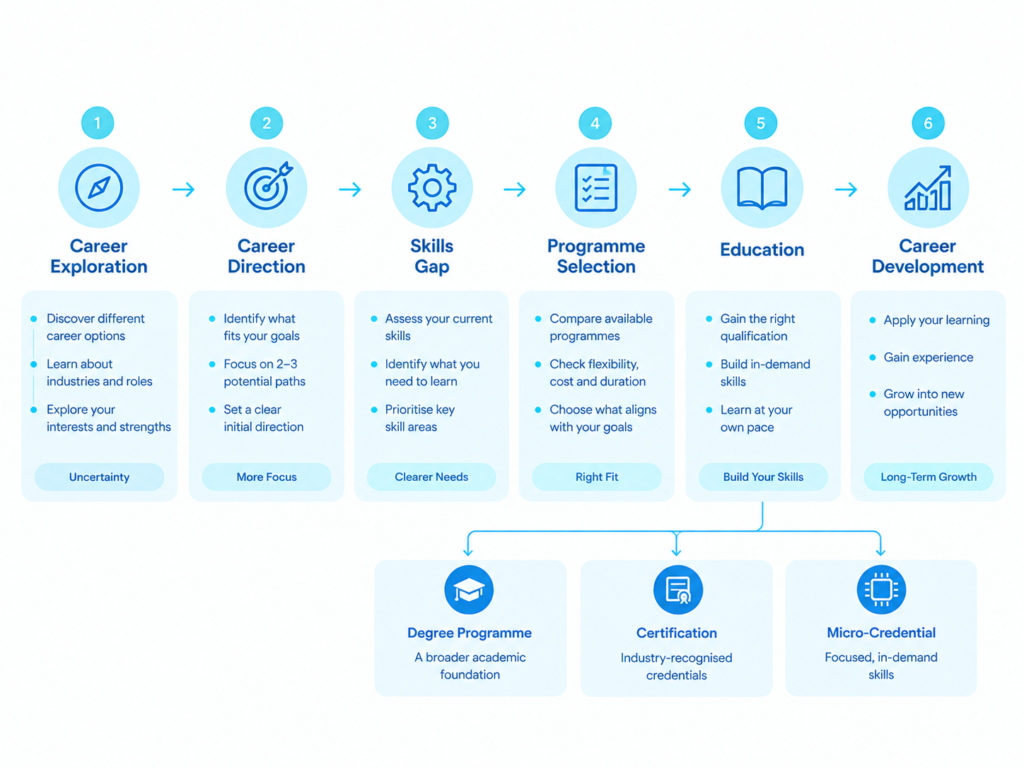
At EduTech Business, we help learners move from career uncertainty towards a concrete education plan, comparing online bachelor’s degrees, professional certifications and career-focused programmes against real goals. We cannot determine the perfect career for every learner, but we can help you compare pathways once a direction starts to take shape, including guidance for those going back to school as an adult. Explore our blog for more career planning resources.
Your Career Exploration Checklist
- Identify your interests, strengths and values
- Research three to five career options
- Compare daily responsibilities, not just job titles
- Check education and skill requirements
- Speak with people working in the field
- Try a short course or small project
- Identify your remaining skill gaps
- Compare relevant education pathways
- Choose your next concrete step
Frequently Asked Questions
How do I choose a career if I don’t know what I want to do? Start with self-understanding, research several options, test a few through short courses or projects, then narrow gradually rather than deciding all at once.
Should I choose a career based on passion? Passion helps, but skills, values and realistic opportunity matter just as much. Relying on passion alone is not a reliable strategy.
Is there a career quiz that can help? Yes, a career assessment can generate useful starting ideas, but it should never be treated as a final answer.
Is it normal to change career paths? Yes. Career direction commonly evolves as skills, interests and circumstances change over time.
Ultimately, how to choose a career comes down to a repeatable process rather than a single flash of clarity. You do not need your entire career path figured out today. Understand your strengths, explore your options honestly, and identify the skills and education needed for the direction that is emerging. Explore career-focused programmes through EduTech Business, or contact us for guidance on finding a pathway that fits your goals.