So you have started asking the question that quietly sits behind most career decisions in Nigeria today: what are the highest paying jobs in Nigeria, and what should you study to get there? It is a fair question, especially with living costs rising and the labour market shifting fast. But salary is only one part of the picture.
The highest-paying jobs in Nigeria rarely come from luck or a single “hot” course. They come from a combination of scarce skills, relevant qualifications, real experience and, increasingly, the ability to work across borders. This article walks through the careers currently commanding strong salaries, the degrees and skills behind them, and how to think about your own education choices so they actually lead somewhere.
Read More: The Real Cost of a University Degree in Nigeria: What No One Tells You Before You Enrol
What Makes a Job High-Paying?
Before ranking anything, it helps to understand why certain roles pay more than others in the first place. A handful of factors tend to matter most.
- Skills scarcity. When few people can do a job well, employers pay more to secure and retain that talent. This is why software engineers and cybersecurity specialists often out-earn roles with a larger talent pool.
- Education and certification. Some of the highest paying jobs in Nigeria, particularly in medicine, law and engineering, require lengthy, regulated training that limits supply and justifies higher pay.
- Industry demand. Sectors such as technology, oil and gas, and finance consistently offer some of the best-paying careers Nigeria has to offer, largely because they generate more revenue per employee.
- Experience and responsibility. Entry-level pay in any field is modest. It is the accumulation of experience, leadership and measurable results that pushes salaries upward.
- Location. Roles based in Lagos, Abuja or Port Harcourt tend to pay more than the same role elsewhere, reflecting cost of living and where head offices are concentrated, according to salary benchmarking data from HeadHunter.ng, which shows Lagos and Abuja offering the strongest pay, especially in tech, finance and oil and gas.
It is worth being honest here: a degree alone does not guarantee a well-paid role. National Bureau of Statistics data shows unemployment among Nigerians with post-secondary education has consistently run higher than the national average, underlining why aligning your study choice with real market demand matters as much as the qualification itself. Salary ranges also vary by employer, so treat figures below as indicative, not guaranteed.
Highest Paying Jobs in Nigeria and the Degrees Behind Them
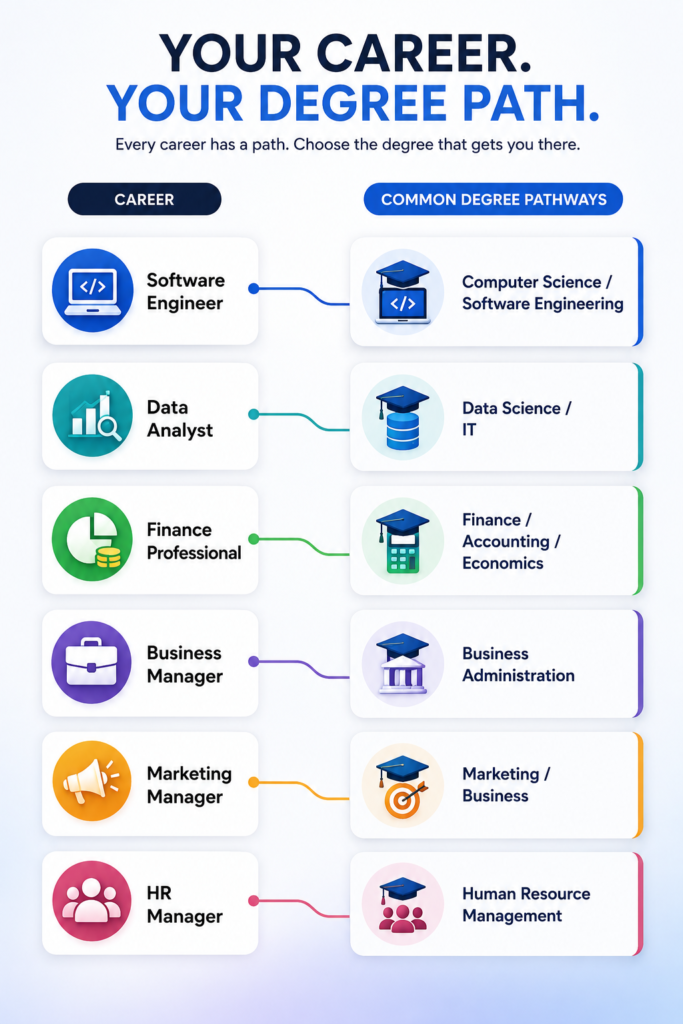
This is the part most people came for, but the goal is not simply to rank jobs by income. It is to show you the pathway: the career, the skills it demands, the degree that gets you there, and roughly how people progress into it.
| Career | Relevant Degree | Key Skills | Career Path |
| Software Engineer | Computer Science, Software Engineering | Programming languages, systems design, problem-solving | Junior developer to senior engineer or tech lead |
| Data Scientist / Data Analyst | Data Science, Statistics, Computer Science | Python or R, SQL, data visualisation, statistical modelling | Analyst to data scientist or analytics manager |
| Cybersecurity Specialist | Computer Science, Information Technology | Network security, ethical hacking, risk assessment | Security analyst to security architect or CISO |
| Medical Professional | Medicine and Surgery (MBBS), Nursing Science | Clinical diagnosis, patient care, specialisation | House officer to resident, then consultant |
| Finance/Investment Professional | Finance, Accounting, Economics | Financial modelling, analysis, regulatory knowledge | Analyst to portfolio manager or finance director |
| Business Manager/Consultant | Business Administration, MBA | Strategy, operations, stakeholder management | Associate to manager, then partner or director |
| Project Manager | Business Administration, Engineering | Planning, budgeting, cross-team coordination | Coordinator to PMP-certified project manager |
| Engineer (Petroleum, Civil, Mechanical) | Engineering (relevant discipline) | Technical design, COREN certification, site management | Graduate engineer to chartered engineer |
| Marketing Manager | Marketing, Business Administration | Brand strategy, digital marketing, analytics | Executive to brand manager or CMO |
| Human Resources Manager | Human Resource Management, Business Administration | Recruitment, policy, employee relations, CIPM certification | HR officer to HR business partner or director |
Several independent salary aggregators, including figures compiled by MyJobMag from sources such as PayScale, Glassdoor and WorldSalaries, consistently place medical specialists, petroleum engineers, senior software developers and finance professionals among the highest earners in the country. What stands out across these best-paying careers Nigeria offers is not the job title alone, but the layering of a relevant degree with certification, experience and, in many cases, exposure to international clients or employers.
Read More: How to Work Out If a Degree or Course Is Actually Worth Your Money
Technology Careers With Strong Earning Potential

Technology has quietly become one of the most reliable routes into high-income jobs in Nigeria, partly because it does not depend solely on the local economy. A Nigerian-trained developer, data analyst or cybersecurity specialist can work for a company anywhere in the world.
The relevant study pathways here include Computer Science, Information Technology, Software Engineering and, increasingly, dedicated Data Science degrees. Within this cluster, a few roles are worth watching closely:
- Software development, still the most in-demand technical skill, with strong prospects across fintech, e-commerce and enterprise software.
- Cybersecurity, growing as more Nigerian businesses digitise and face rising cyber risk.
- Data analytics and data science, sitting at the intersection of business and technology.
- Cloud computing and AI-related roles, newer but expanding quickly as companies adopt automation.
This aligns with global evidence too. The World Economic Forum’s Future of Jobs Report 2025 found that big data specialists, fintech engineers and AI and machine learning specialists are among the fastest-growing roles worldwide, with AI and big data skills topping the list of technological skills employers expect to grow fastest, followed by networks and cybersecurity. Professional certifications such as AWS, CompTIA Security+ or Google’s data analytics certificate can meaningfully strengthen a degree in this space, particularly for graduates trying to stand out in a crowded early-career market.
Business, Finance and Management Careers
Away from tech, a different set of degrees with good career prospects continues to anchor Nigeria’s job market: Business Administration, Accounting, Finance and Economics.
These degrees feed into stable, high-demand jobs in Nigeria, including financial management, accounting, consulting, business management, project management and entrepreneurship. Accounting graduates who pursue ICAN or ACCA certification tend to see a meaningful jump in responsibility and pay once qualified. Project managers who add a PMP certification to a business or engineering degree often move into higher-paying roles faster than peers without it.
An MBA tends to matter less at entry level and more as a career accelerant later on, particularly for professionals aiming at management or director-level roles. It rarely substitutes for early hands-on experience, but it can compress the time it takes to reach senior positions once that experience exists.
Which Degree Should You Choose for a High-Paying Career?
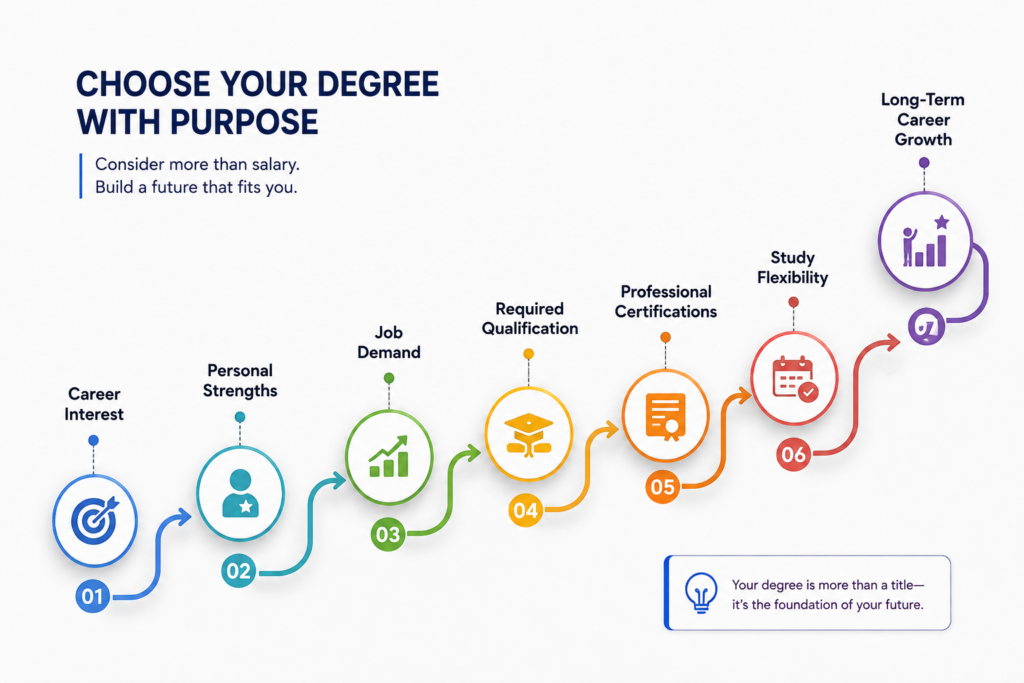
It is tempting to simply pick whichever degree tops a highest-paying professions list. Resist that urge. A degree chosen purely for its salary ceiling, without genuine interest or aptitude, is far more likely to be abandoned or under-performed in.
Instead, weigh these factors together:
- Career interests. What kind of problems do you actually enjoy solving?
- Employment demand. Is this field growing or shrinking, locally and globally?
- Personal strengths. Are you more analytical, technical, interpersonal or creative?
- Degree requirements. Some careers, particularly medicine and law, have long, fixed pathways with little flexibility.
- Certification requirements. Does the field reward or require additional professional exams after graduation?
- Programme flexibility. Can you study while working, or does it demand full-time attendance?
- Long-term progression. Where does this career realistically lead in ten or fifteen years?
Career fit, not just salary, is what sustains people through the early, lower-paying years of any profession long enough to reach the well-paid stage.
Can Online and Distance Degrees Lead to High-Paying Careers?

This question matters enormously for many EduTech Business readers, particularly working adults or those managing family responsibilities alongside study. The honest answer is yes, provided the programme is properly accredited, and the graduate builds real, demonstrable skills alongside the certificate.
A few things determine whether an online or distance degree translates into genuine career opportunities Nigeria employers respect:
- Accreditation, ideally from the National Universities Commission, which oversees quality assurance for Nigerian degree-awarding institutions.
- Employer recognition of the awarding university, which matters more than the delivery mode itself.
- Demonstrated skills, built through coursework, projects or internships, not just attendance.
- Work experience gained alongside study, which often carries more weight with employers than the mode of delivery.
- Professional certifications and a portfolio that give tangible proof of competence.
Established distance learning centres attached to recognised universities, such as the ABU Distance Learning Centre, which offers NUC-accredited undergraduate programmes including Computer Science, Business Administration, Accounting and Economics, and Babcock University’s BUCODeL, give students a credible route into these careers without requiring full-time campus attendance. The degree itself is simply the entry ticket; what you do with the flexibility it offers, in terms of internships, freelance projects or certifications, is often what actually shapes your earning potential afterwards.
How EduTech Business Helps You Choose the Right Programme
Choosing among the highest paying jobs in Nigeria and their matching degrees is rarely a one-conversation decision. EduTech Business works alongside prospective students to compare programmes, weigh flexible study options against traditional ones, and understand admission requirements before committing time and money to a course.
This includes career guidance, side-by-side programme comparisons across partner universities, support with university selection, and practical help with the application process. The goal is not to promise a specific salary or guaranteed employment outcome; nobody honestly can. It is to make sure your choice of university and programme genuinely supports the career you are trying to build.
There is no single answer to which job pays the most in Nigeria, because pay depends on skills, location, experience and employer as much as job title. What is consistent is the pattern: the highest paying jobs in Nigeria sit at the intersection of scarce skills, relevant education and real-world experience, whether in technology, healthcare, finance, engineering or management.
If you are choosing a degree right now, start with genuine interest and aptitude, then check that the field has real demand and a credible path to certification or specialisation. Whether you study full-time or through a flexible distance programme, what ultimately determines your income is the depth of skill and experience you build once you are qualified.
Your degree should support the career you want to build. Speak with an EduTech Business advisor to compare university programmes, flexible study options and career-focused qualifications that match your interests and long-term goals.
Read More: How to Choose the Right Career Before Choosing a Degree
Frequently Asked Questions
What are the highest paying jobs in Nigeria? Medical specialists, petroleum engineers, senior software developers, cybersecurity specialists and finance professionals are consistently among the highest earners, though pay varies by employer, location and experience.
Which degree has the highest salary potential? No single degree guarantees the highest salary. Computer Science, Medicine, Engineering, Finance and Data Science tend to lead to the strongest earning potential, especially when paired with relevant certifications.
What jobs are currently in high demand? Technology roles such as software development, data analytics and cybersecurity are among the fastest-growing globally, alongside consistent demand for finance, healthcare and engineering professionals in Nigeria.
Can an online degree lead to a high-paying job? Yes, provided the programme is accredited by the National Universities Commission and the graduate builds practical skills, work experience and, where relevant, professional certifications alongside the degree.
Which degree is best for technology careers? Computer Science, Information Technology, Software Engineering and Data Science are the most direct routes, though professional certifications add significant value on top of any of these degrees.
Should salary determine which course I study? Salary should be one factor among several. Career interest, personal strengths, market demand and long-term progression matter just as much for a sustainable, well-paid career.