Every year, thousands of Nigerian students watch their admission plans stall, not because they lack ability, but because of a single exam. Perhaps you missed the JAMB registration window, sat the exam and scored below your desired course’s cut-off mark, or simply couldn’t afford another round of preparation classes. Whatever the reason, it can feel as though your academic journey has quietly ended before it truly began, and that fear stops many capable students from even looking for another way in.
It hasn’t ended, and there is another way in. Admission without JAMB is real, and it has quietly helped working professionals, career changers, parents returning to school, and students who missed the traditional route get into university for years. The challenge isn’t that these pathways don’t exist; it’s that most students have never heard of them properly, or have only encountered vague, unverifiable claims about “guaranteed admission” from agents who cannot be trusted. This article sets the record straight. We’ll walk through every legitimate way to study without JAMB, name the accredited institutions offering each route, and show you how to tell a genuine opportunity apart from a scam before you spend a single naira.
Read More: Common University Admission Mistakes and How to Avoid Them
Is Admission Without JAMB Really Possible?
Yes, admission without JAMB is genuinely possible in Nigeria, but only through routes recognised by the National Universities Commission (NUC), the body responsible for accrediting universities and approving the specific programmes they run. This distinction matters enormously, because it separates a legal alternative admission pathway in Nigeria from an empty promise. NUC-approved distance learning centres, open universities, and diploma-to-degree arrangements operate entirely within university regulations, and the certificates they award carry the same academic weight as those earned through the conventional UTME route.
What is not legitimate is the flood of social media adverts promising instant admission with no documentation, no screening, and suspiciously low fees. These schemes rely on desperation, and they tend to target students who don’t yet know that a genuine alternative admission route in Nigeria even exists. The safest way to tell the two apart is simple: a genuine institution will always appear on the NUC’s official register, will require verifiable O’Level results before anything else, and will never ask you to pay an unofficial agent outside its own portal.
Legitimate Ways to Get Admission Without JAMB
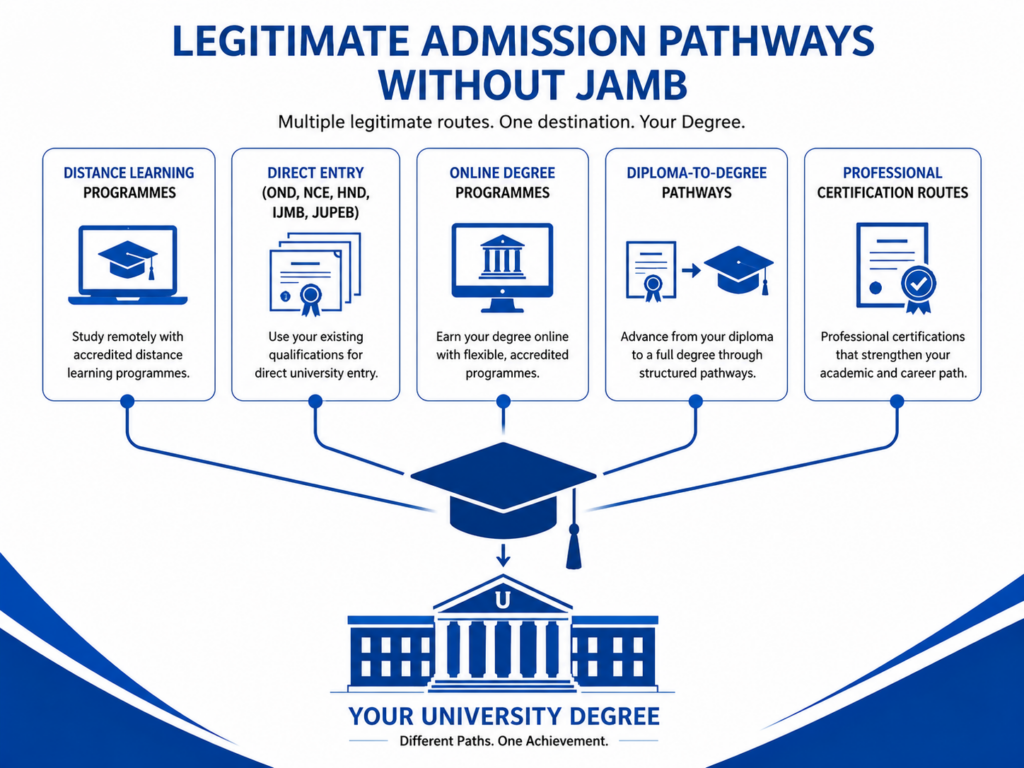
There isn’t one single alternative to JAMB. There are several, each suited to a different kind of student, and understanding the differences between them is the first step to choosing correctly.
Distance Learning Programmes. The NUC has approved a growing list of NUC-approved universities to run dedicated distance learning centres, which means you can study without JAMB while still earning a fully recognised degree. Three names come up most often for students exploring distance learning Nigeria has to offer:
- ABU Distance Learning Centre, run by Ahmadu Bello University, Zaria, offers self-paced online study for a federal university credential, and remains one of the longest-running public university options in this space.
- Babcock University online, delivered through its Centre for Open Distance and E-Learning (BUCODeL), pairs structured online lectures with the university’s established academic reputation and student support systems.
- The National Open University of Nigeria (NOUN), the country’s only dedicated open university, confirms directly that its admission process does not require a JAMB form, relying instead on O’Level results, a birth certificate or age declaration, and passport photographs.
These programmes suit working professionals and parents who cannot pause their income for a four-year residential course, while still producing graduates who complete the same modules and sit examinations of the same standard as full-time students on campus.
Direct Entry. This is the pathway most often confused with a total bypass of JAMB, so it’s worth being precise. Direct Entry Nigeria still runs through JAMB’s official Direct Entry registration; what it skips is the UTME examination itself. If you hold an OND, HND, NCE, IJMB, JUPEB result, or an equivalent qualification with the required grade, typically Upper Credit for diploma holders or Merit for NCE holders, you can register directly for admission into 200 level rather than starting from year one. You’ll still need five O’Level credits, including English and Mathematics, and your existing qualifications must come from institutions that JAMB and the Federal Ministry of Education recognise.
Diploma-to-Degree Pathways. Many universities run National Diploma or foundation programmes that feed directly into their degree courses through formal progression agreements. A student who completes an accredited diploma with the required grade can move into 200 level without ever sitting UTME, provided the diploma-awarding institution and the receiving university have a recognised partnership in place. This route is particularly useful for students who left secondary school some years ago and want a structured, staged path back into a full degree.
Professional Certification Routes. Institutions such as Ingryd Academy and I-CON Universal Polytechnic, which run OND and HND programmes, allow students to build employable, practical skills and formal qualifications while working towards further academic progression. These routes suit students who want to strengthen their CV immediately, gain income-earning skills sooner, and still keep a clear route open toward a full degree later.
Universities and Institutions Offering Alternative Admission Routes

| University | Admission | Study Mode | Best For |
| ABU Distance Learning Centre | Distance learning application, no UTME required | Online, self-paced | Students wanting a federal university credential remotely |
| Babcock University (BUCODeL | Distance learning application, no UTME required | Online with structured lecture schedule | Students who want strong academic support alongside flexibility |
| National Open University of Nigeria (NOUN) | Direct portal application, no JAMB form required | Fully open and distance learning | Working professionals, parents, and adult learners nationwide |
This is not an exhaustive list. The NUC periodically updates its register of approved distance learning centres, so it’s worth confirming a university’s current accreditation status before you apply to it.
Read More: Direct Entry Admission: How It Works for Students
Are These Alternative Routes Officially Recognised?

This is the fear that keeps many students away from these pathways altogether, and it deserves a direct answer: yes, when the programme is NUC-accredited, the certificate is fully recognised for employment, postgraduate study, and NYSC mobilisation where applicable. Employers and postgraduate admissions offices verify credentials directly with the issuing university, not with JAMB, so a degree earned through NOUN, ABU DLC, or Babcock’s distance learning centre carries identical standing to one earned on campus.
The myth that online or distance-learning degrees are somehow “lesser” qualifications persists mainly because verification and quality assurance in this space used to be inconsistent years ago. Today, with clearer NUC oversight and better digital record-keeping, that gap has largely closed, though it remains sensible to check a specific programme’s current accreditation before you enrol and pay any fees.
Who Should Consider These Pathways?

- Fresh secondary school graduates who missed JAMB registration or fell just short of a cut-off mark and don’t want to lose an entire academic year waiting.
- Working professionals who need a recognised degree to progress in their careers without leaving employment.
- Parents returning to education after a career break or years spent focused on family responsibilities.
- Business owners and entrepreneurs seeking formal qualifications to complement the practical experience they’ve already built.
- Career changers moving into a new field who need a relevant, accredited credential to be taken seriously.
- IJMB, JUPEB, OND, HND, and NCE holders who already qualify for Direct Entry into 200 level and simply haven’t explored it yet.
Flexible education is growing across Nigeria precisely because these groups have expanded. Fewer students today follow the old, single track of secondary school straight into a four-year residential degree, and universities have adapted their admission systems accordingly.
Common Mistakes Students Make
- Believing social media rumours about “instant” or “guaranteed” admission without any documentation.
- Enrolling in unaccredited schools without first checking the NUC’s official register.
- Paying agents outside a university’s own application portal.
- Ignoring accreditation status entirely because a website looks polished and professional.
- Waiting an entire extra year when a legitimate alternative was available all along.
- Failing to compare admission pathways properly before committing to one.
How EduTech Business Helps Students Secure Admission
Navigating these options alone can be overwhelming, particularly when so much misinformation circulates online. EduTech Business works directly with verified university partners, including ABU DLC, Babcock University, NOUN, Ingryd Academy, and I-CON Universal Polytechnic, to guide students through career counselling, programme selection, document preparation, and application tracking from start to finish.
Rather than pushing every student toward a single option, the focus is on helping each applicant understand which legitimate pathway genuinely fits their existing qualifications and long-term goals, and making sure every step happens through official, accredited channels rather than an unverified middleman.
Missing JAMB doesn’t have to delay your education. Whether you’re exploring distance learning, Direct Entry, or a flexible online university Nigeria has to offer, EduTech Business can help you choose the right pathway through accredited university partners. Book a free consultation with an admissions advisor today and discover the fastest route to your degree without unnecessary delays.
Read More: The Real Cost of a University Degree in Nigeria: What No One Tells You Before You Enrol
Frequently Asked Questions
Can I get admission without JAMB in Nigeria? Yes. NUC-approved distance learning centres, open universities like NOUN, and Direct Entry routes for diploma and NCE holders all allow legitimate admission without going through the standard JAMB process, provided you apply through official, accredited channels and meet each institution’s own academic requirements.
Which universities accept students without JAMB? NOUN, ABU Distance Learning Centre, and Babcock University’s BUCODeL are among the most established NUC-approved options. Always confirm current accreditation on the NUC website before applying, since the list of approved centres is updated periodically.
Is admission without JAMB legal? Yes, when pursued through NUC-accredited institutions and their official portals. It only becomes illegitimate when students use unapproved agents or unaccredited schools that promise to bypass regulatory requirements entirely.
Can I study online without writing JAMB? Yes. NOUN explicitly confirms that its admission process does not require a JAMB form, relying instead on O’Level results and standard documentation. Several other online university Nigeria programmes follow similarly accredited processes.
Is Direct Entry different from admission without JAMB? Direct Entry still involves JAMB registration, but it skips the UTME exam for qualified diploma, NCE, IJMB, or JUPEB holders, allowing entry into 200 level. It sits within the broader category of alternatives to the standard route, rather than being an entirely separate system.
Are online degrees recognised in Nigeria? Yes, provided the awarding university and specific programme are NUC-accredited. Employers and postgraduate institutions verify credentials directly with the issuing university, so a genuine online degree holds the same standing as one earned on campus.
Which option is best for working professionals? Distance learning through NOUN, ABU DLC, or Babcock’s BUCODeL tends to suit working professionals best, since coursework is largely self-paced or scheduled around existing commitments, without requiring a break from employment.