A decade ago, building a new skill or changing career direction usually meant enrolling in a physical classroom, rearranging your work schedule around lecture times, and hoping the investment paid off eventually. That’s no longer the only route. Online courses have reshaped how Nigerians study, retrain, and grow professionally. It reflects a genuine change in how employers view flexible, self-directed learning, and how quickly digital skills demand has grown across nearly every industry.
Is this kind of study actually worth taking, though? For the right learner choosing the right programme, yes, but the term covers an enormous range of options, from free hour-long tutorials to full accredited degrees, and treating them interchangeable is where many learners go wrong. This guide explains what these programmes are, breaks down the different formats available, and gives you a practical framework for choosing one that genuinely moves your career forward rather than simply adding another certificate to a folder nobody checks.
Read More: How Employers View Online Degrees in 2026
What Are Online Courses?
An online course is any structured programme of study delivered primarily or entirely through a digital platform rather than a physical classroom, ranging from short skills tutorials to full postgraduate degrees. What varies enormously is depth, accreditation, and the outcome you can expect from completing one.
Broadly, online learning falls into five formats. Short courses introduce a specific skill or topic over a few hours or weeks, often with no formal assessment. Professional certifications validate a defined competency, frequently tied to an industry body’s own examination. Diploma programmes sit between certifications and full degrees, usually requiring a longer commitment and more structured assessment. Undergraduate degrees and postgraduate degrees represent the most substantial commitment, awarded by an accredited university and carrying full academic weight.
Not every course offers the same career value, and that’s precisely the point worth understanding before you enrol. A free two-hour tutorial and an NUC-accredited online degree programme might both get lumped together in casual conversation, but they serve entirely different purposes and carry entirely different weights with employers.
The Different Types of Online Courses
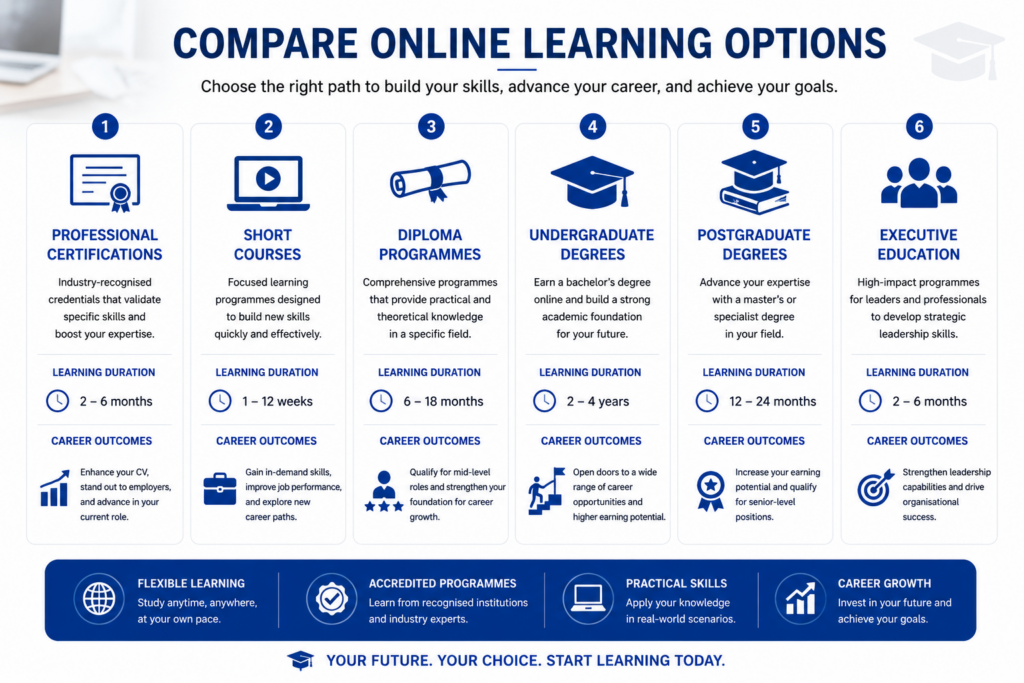
Professional Certifications: These validate specific, in-demand skills, often through recognised industry bodies. Common examples include project management certifications, digital marketing credentials, and data analytics qualifications. Online professional courses like these tend to be shorter than a degree and are especially useful for professionals adding a specific competency to an existing career rather than starting from scratch, making them a popular category of career development courses for people already in employment.
University Degree Programmes: Full online degree programs, including bachelor’s degrees, MBAs, and other master’s qualifications, are delivered by accredited universities and carry the same academic standing as their campus-based equivalents when the awarding institution is properly recognised. Much of the growth in distance learning Nigeria has seen over the past decade sits in this category, as more universities open accredited routes for working professionals. These represent the highest level of commitment among online learning options, both in duration and in the depth of assessment involved.
Technical Skills Programmes: Software development, cybersecurity, and cloud computing courses fall into this category, often combining structured coursework with hands-on practical projects rather than pure theory. Given how quickly technology roles evolve, these programmes tend to have a shorter shelf life of relevance than a traditional degree, which makes ongoing learning part of the deal rather than a one-time investment. Many learners in this category also pursue recognised industry certifications alongside their core coursework, since employers in technical fields often weigh a certification as heavily as, or more heavily than, a general degree.
Business and Leadership Programmes: Executive education, management training, and entrepreneurship courses suit professionals looking to sharpen strategic or leadership capability rather than learn a technical skill from the ground up. These often carry more weight when the provider is a recognised university or business school rather than an independent platform, since leadership content is harder to standardise and verify than a technical skills test with a clear right or wrong answer.
Read More: How to Beat Procrastination and Complete Your Online Course
How to Choose the Right Online Course

Rather than picking whatever’s trending, work through a short set of questions first:
- What’s your actual career goal? A course chosen to fix a specific gap in your CV serves you better than one chosen because it’s popular.
- What’s your current experience level? A foundational course wastes time for someone already established in a field, while an advanced programme can overwhelm a genuine beginner.
- Is there real industry demand for this skill? A quick look at job listings in your target field tells you more than a course provider’s marketing copy ever will.
- What’s your realistic budget? Costs vary enormously between a short certification and a full online degree programme, so weigh the investment against the expected return.
- How much time can you genuinely commit each week? Flexible learning still requires consistency; be honest about what your schedule allows.
- Is the provider accredited or industry-recognised? This single factor determines whether a certificate holds weight with employers or simply looks decorative on a CV.
- What’s the long-term value? A credential that opens doors five years from now is worth more than one that only feels impressive today.
Are These Programmes Recognised by Employers?
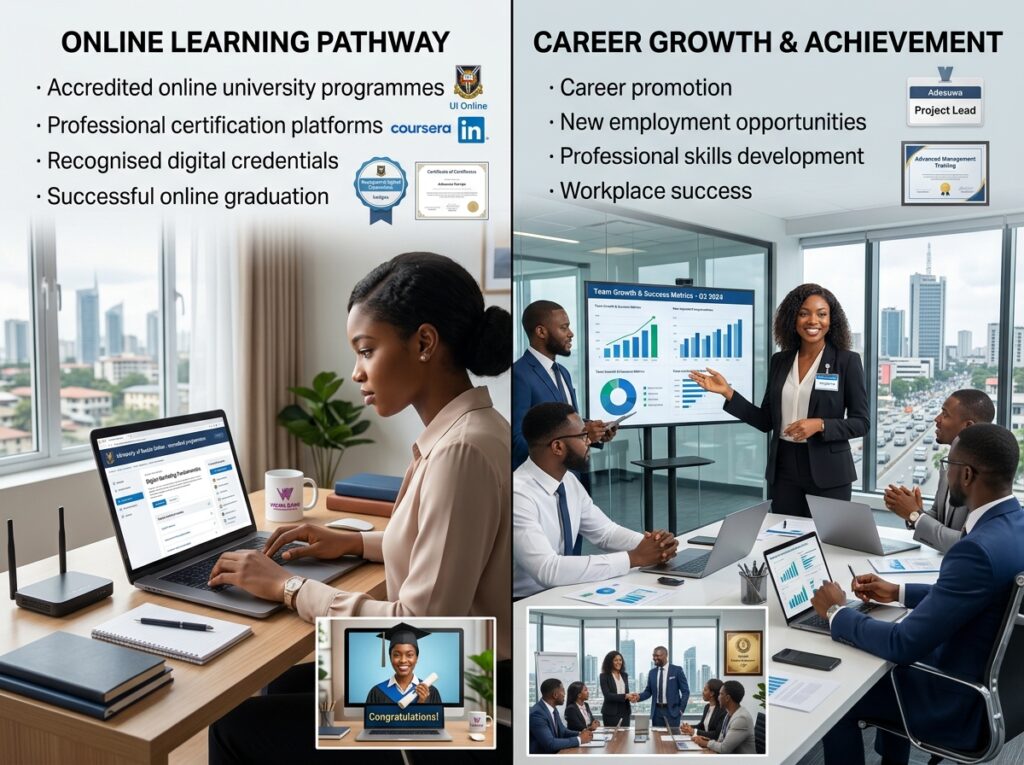
This depends almost entirely on accreditation and provider reputation, not on the fact that a course was delivered online. A degree from an NUC-accredited institution’s online programme carries identical recognition to its campus equivalent, since the accrediting body evaluates the curriculum and awarding university, not the delivery format. Professional certifications from recognised industry bodies are similarly well regarded, particularly in technical fields where the certifying body exam is the real credential, not the course itself.
Short, unaccredited courses sit differently. Platforms such as Coursera, edX, and FutureLearn offer genuinely useful skills content, often from reputable universities, but a completion certificate from a short course is not equivalent to a degree and shouldn’t be marketed or understood as one. Accredited certifications and degrees from a recognised university or certifying body sit in a different category entirely, since the accreditation itself is what an employer or licensing body checks. The practical experience gained often matters as much as the paper credential itself, particularly in technical fields where employers test skills directly during interviews. Knowing which category, a course falls into and being honest about what it can realistically do for your career, is what separates useful online education Nigeria learners benefit from, from a certificate that adds little beyond personal satisfaction.
Partner Programmes Worth Considering

Four accredited providers illustrate the range of legitimate online learning available to Nigerian learners; each suited to a different profile.
- ABU Distance Learning Centre offers flexible undergraduate and postgraduate degrees among the most established accredited online courses available to Nigerian learners, without requiring relocation or leaving employment.
- Babcock University’s BUCODeL delivers an online MBA and other professional degrees, suited to working professionals seeking postgraduate credentials alongside strong academic support.
- Ingryd Academy focuses on technology and digital skills, including recognised information security and IT governance certifications, ideal for professionals building specific technical credentials.
- I-CON Universal Polytechnic runs National Diploma programmes across fields including computer science, accounting, business administration, and mass communication, well suited to learners starting a structured diploma-to-degree pathway.
Common Mistakes Students Make
Even motivated learners end up disappointed, usually because of a handful of avoidable decisions made before enrolment rather than any lack of effort during the course itself:
- Choosing unaccredited providers without checking their standing first.
- Ignoring career outcomes and focusing purely on course completion.
- Never verifying whether an employer or industry body actually recognises the credential.
- Selecting a course without a clear goal in mind, then abandoning it halfway.
- Choosing based on price alone, rather than weighing cost against long-term value.
- Skipping research into course quality, instructor credibility, or genuine student outcomes.
Read More: Online MBA in Nigeria: How to Choose the Right Program for Your Career
How EduTech Business Helps You Choose the Right Program
Comparing accredited certifications, degree programmes, and technical courses across multiple providers takes time most people don’t have, particularly while juggling a job or existing studies. EduTech Business offers career guidance based on your specific goals, compares programmes across accredited partner universities, and supports the practical side of admission, from documentation through to application tracking. Rather than pushing a single provider, the focus stays on long-term education planning, matching each learner to the pathway that genuinely fits their career stage and ambitions. For related reading, see our guides on the online MBA in Nigeria, student grants in Nigeria, and admission without JAMB.
Frequently Asked Questions
Are online courses recognised in Nigeria? Yes, when delivered by an NUC-accredited institution or a recognised industry certified body. Recognition depends on the awarding organisation, not the fact that a course was delivered online, so always verify accreditation before enrolling.
Which online courses lead to high-paying jobs? Technical skills programmes in software development, cybersecurity, and data analytics, along with accredited business degrees such as an MBA, tend to align most closely with well-paying roles, provided the credential is genuinely recognised in your target industry.
What’s the difference between a certificate and a degree? A certificate validates a specific skill or competency, usually after a shorter course, while a degree represents a full academic qualification awarded by an accredited university after a much longer, more rigorous programme of study.
Can I study online while working full-time? Yes. Flexible learning is specifically designed around working schedules, with most accredited online certification courses and degree programmes allowing self-paced or evening study rather than requiring you to leave employment.
How do I know if an online course is accredited? Check whether the awarding institution appears on the NUC’s official register for degrees, or whether the certifying body is a recognised name within that specific industry for professional certifications.
Which online course should I choose for career growth? It depends on your goals: a professional certification suits a specific skill gap, a technical programme suits a career pivot into tech, and an accredited degree suits long-term qualification building. Match the course to the outcome you actually need.