A postgraduate diploma can be a useful option for graduates who want specialised postgraduate knowledge without immediately committing to a master’s degree. It can also provide a structured route for professionals changing fields, strengthening their qualifications, or preparing for further study.
But a PGD is not simply a shorter master’s degree. Its academic level, admission requirements, duration, curriculum and progression opportunities depend on the institution and programme. Understanding those differences is important before applying, particularly if your long-term plan involves a master’s degree.
Read More: Micro-Credentials: What They Are and How They Boost Your Career
What Is a Postgraduate Diploma?
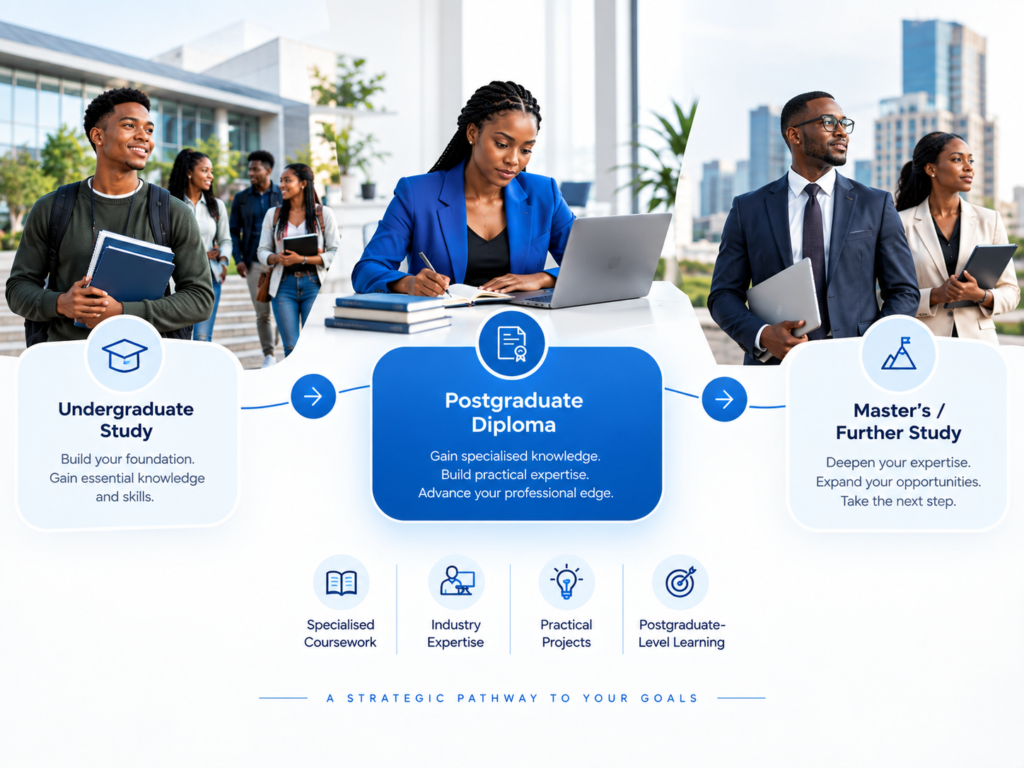
A postgraduate diploma, commonly called a PGD, is a qualification undertaken after undergraduate study or an equivalent qualification. It generally provides specialised study in a particular discipline and sits within postgraduate education, although its structure and recognition vary across education systems.
In Nigeria, universities offer PGD programmes across areas including education, management, science, technology and other disciplines. The University of Lagos, for example, lists PGD programmes alongside master’s, professional master’s, MPhil and PhD programmes within its postgraduate offerings.
A PGD may appeal to someone who wants to deepen their knowledge without immediately undertaking a longer postgraduate degree. It can also be relevant to a graduate whose academic background does not provide a straightforward route into a particular master’s programme.
The important distinction is that completing a PGD does not automatically make someone equivalent to a master’s graduate. They are different qualifications with different structures, requirements and purposes.
Who Is a Postgraduate Diploma For?
There is no single type of PGD student. Common candidates include:
- Recent graduates who want specialised postgraduate knowledge.
- Working professionals seeking additional expertise in their field.
- Career changers entering a new discipline.
- Graduates considering further postgraduate study who need an alternative academic route.
- Professionals seeking structured learning without immediately committing to a full master’s degree.
Read More: Going Back to School as an Adult: A Complete Guide to Returning to Education
The right choice depends heavily on the programme. A PGD in education may have very different entry requirements and career applications from one in computing, business or engineering.
This is why applicants should assess the actual programme rather than assuming that every PGD follows the same rules.
UNESCO increasingly frames higher education as part of lifelong learning, highlighting flexible pathways, online learning and opportunities for adult learners to reskill and upskill.
What Are the Typical PGD Requirements?
PGD requirements vary considerably between universities and disciplines. A common starting point is a bachelor’s degree or an equivalent qualification, but some programmes also accept relevant Higher National Diploma (HND) holders.
For example, LASUED’s published requirements include a relevant bachelor’s degree with at least Second Class Lower Division or an HND with a minimum of Lower Credit, alongside specified O-Level requirements. The University of Port Harcourt similarly states that its PGD programmes generally require a relevant bachelor’s degree, while HND requirements vary by programme.
Depending on the programme, applicants may need to provide:
| Requirement | What to check |
| Previous qualification | Required degree, diploma or equivalent |
| Academic performance | Minimum grade or classification |
| Subject background | Whether your previous discipline is relevant |
| Work experience | Whether professional experience is required |
| Documents | Certificates, transcripts and identification |
| Application | Deadline, screening and application procedure |
Do not rely on a generic eligibility statement found online. The official admission page for the specific university and programme should be the final reference.
Read More: Professional Certification vs Degree: Which One Actually Advances Your Career?
How Long Does a Postgraduate Diploma Take?
There is no universal PGD duration.
Some programmes are structured as a one-year postgraduate programme, while others take longer, particularly when offered part-time. The University of Port Harcourt, for instance, states that its full-time PGD programmes run for a minimum of 12 and a maximum of 24 calendar months, while part-time study has a longer minimum duration.
The University of Ilorin similarly gives its Educational Management PGD a full-time minimum of 12 months and a part-time minimum of 24 months. By contrast, LASUED’s published structure specifies a minimum of two academic sessions and four semesters.
That difference illustrates why applicants should not assume that every PGD takes one year.
Delivery can also vary. Depending on the provider, students may study:
- Full-time on campus
- Part-time
- Online
- Through hybrid delivery
- During evenings or weekends
For professionals, the timetable can be just as important as the headline duration. A programme advertised as one year may still involve substantial coursework, examinations and independent study.
Postgraduate Diploma vs Certificate: What’s the Difference?
The distinction in postgraduate diploma vs certificate can be confusing because institutions use qualification names differently.
Broadly, a postgraduate diploma tends to involve more extensive postgraduate study, while a postgraduate certificate is often shorter and more focused. However, the exact academic status of either qualification depends on the education system and awarding institution.
| Factor | Postgraduate Diploma | Postgraduate Certificate |
| Academic depth | Generally broader or deeper | Usually more focused |
| Duration | Usually longer | Usually shorter |
| Coursework | More extensive | More Limited |
| Purpose | Specialised postgraduate study | Targeted professional or academic development |
| Further study | May support progression depending on institution | Depends on programme |
The safest approach is to examine the curriculum, credits, assessment and formal qualification awarded rather than relying on the title alone.
Postgraduate Diploma vs Master’s Degree
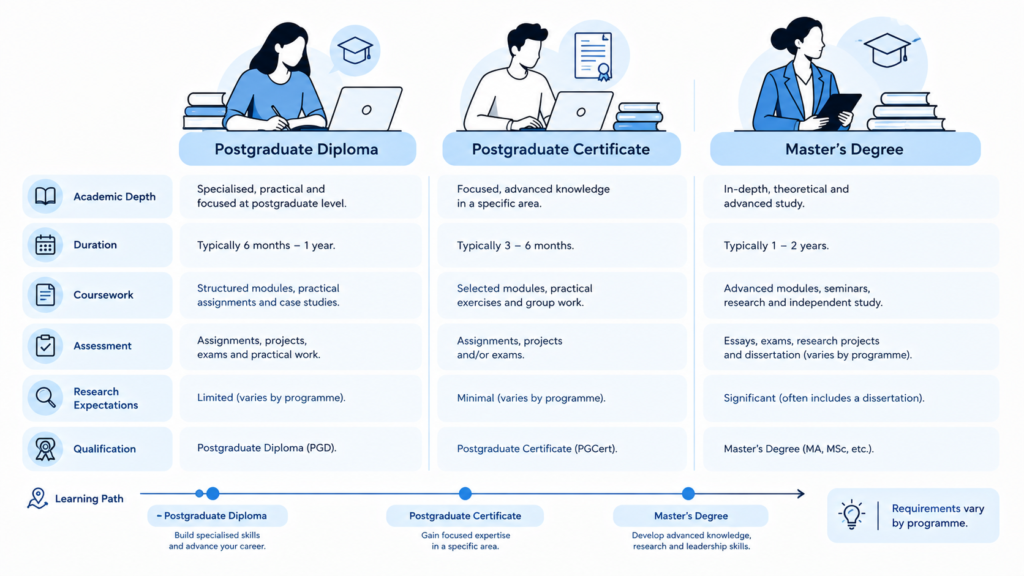
A PGD and master’s degree are distinct qualifications.
A master’s normally involves deeper and more extensive postgraduate study. Depending on the discipline, it may include substantial research, a dissertation or project, and more advanced academic requirements. A PGD is generally narrower and shorter, although its exact structure varies.
The differences may involve:
- Qualification level and formal award
- Programme duration
- Number and depth of modules
- Assessment requirements
- Research expectations
- Cost
- Career purpose
- Opportunities for further study
Neither qualification should automatically be described as better. The appropriate choice depends on what the student is trying to accomplish.
If your objective is to obtain a recognised master’s qualification, a PGD should not be treated as an informal substitute. If your objective is specialised postgraduate learning or a potential route into further study, a PGD may be relevant.
Read More: MBA in Nigeria: Online vs. Part-Time vs. Executive, Which Route Is Right for You?
Can a PGD Lead to a Master’s Degree?
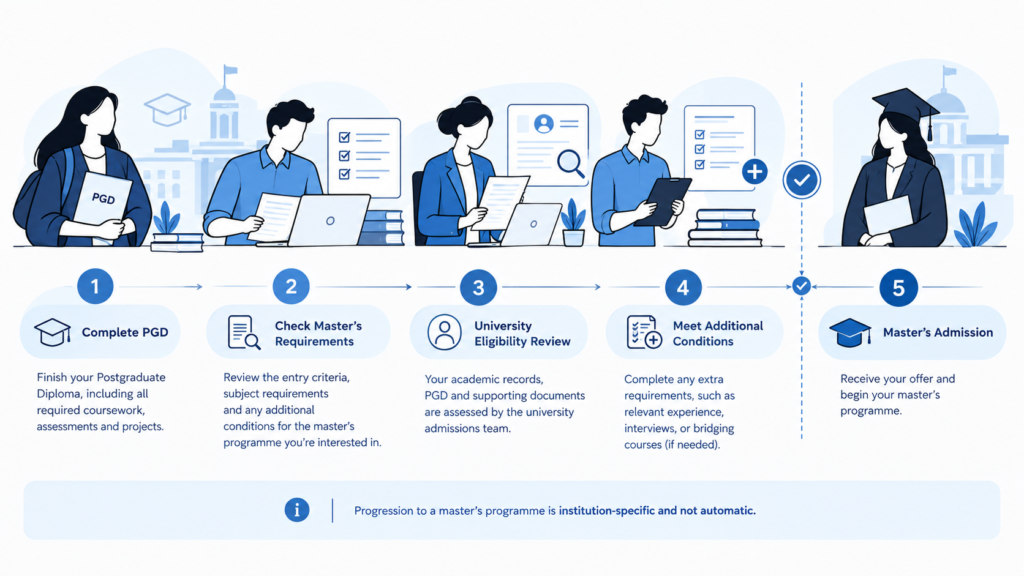
This is one of the most important questions prospective students ask.
A PGD to masters pathway can exist, but it is not automatic. Universities determine their own admission requirements, and completing a PGD does not guarantee admission into a master’s programme.
The pathway may look like this:
- Complete a relevant PGD.
- Check the master’s programme’s progression requirements.
- Submit the required application and documents.
- Allow the receiving university to assess your eligibility.
- Meet any additional academic or programme-specific conditions.
- Receive an admission decision from the institution.
For example, the University of Nigeria’s postgraduate regulations state that candidates with a PGD may seek master’s admission in departments that offer the relevant PGD, illustrating how progression can be tied to specific departments and programmes. The University of Port Harcourt also specifies a particular CGPA requirement for PGD holders seeking master’s admission in relevant fields.
The receiving institution may consider:
- The field of the PGD
- Academic performance
- Recognition of the awarding institution
- The applicant’s bachelor’s degree
- Relevant work experience
- The master’s programme’s own requirements
Therefore, if a master’s degree is your eventual goal, investigate the progression rules before enrolling in the PGD.
What Is the Career Value of a Postgraduate Diploma?
A PGD can provide specialised knowledge, demonstrate continued education and help develop skills relevant to a particular profession. For someone changing direction, it can also provide structured exposure to a new academic or professional field.
Its value, however, should not be measured simply by having another qualification on a CV.
Consider whether the programme gives you knowledge that employers in your field actually use. Curriculum quality, faculty expertise, assessment, institutional recognition and the ability to apply what you learn can all affect its practical value.
A PGD may support professional advancement, but it does not guarantee employment, promotion or a higher salary. Those outcomes depend on the individual’s experience, performance, industry, employer and the wider labour market.
For Nigerian applicants, institutional recognition is particularly important. The National Universities Commission (NUC) coordinates accreditation of academic programmes at undergraduate and postgraduate levels and maintains information on approved programmes.
How to Choose the Right PGD Programme
Before submitting an application, ask:
1. Does the programme match my career goal?
Do not enrol simply because the qualification sounds useful. Identify what you want the programme to help you achieve.
2. Do I meet the entry requirements?
Check the official requirements for your exact programme, including degree classification, discipline and work experience.
3. Is the institution recognised?
For Nigerian university programmes, investigate the institution and relevant programme recognition through appropriate official sources.
4. What will I actually study?
Read the module list. The curriculum should match the skills and knowledge you want to develop.
5. How long will it really take?
Consider both advertised duration and the workload.
6. What assessment is involved?
Find out whether the programme involves examinations, assignments, projects, research or other forms of assessment.
7. What qualification will I receive?
Understand exactly what the institution awards upon completion.
8. Does it support my future plans?
If you intend to pursue a master’s, confirm whether the PGD can contribute to that pathway and under what conditions.
Read More: Why Your Degree Doesn’t Matter as Much as Your Skills (And How to Get Both)
Making the Decision
A PGD makes the most sense when it solves a specific problem. Perhaps you need knowledge in a new discipline, want to strengthen your professional foundation, or are exploring a route towards further postgraduate study.
The mistake is choosing the qualification first and asking what it is for afterwards.
Start with your destination. Then examine the programme’s entry requirements, curriculum, duration, delivery format, assessment, recognition and progression options. If a PGD to master’s pathway matters to you, verify that route directly with the university rather than assuming it exists.
For graduates and professionals considering their next academic step, the range of postgraduate options can be difficult to navigate. Resources from EduTech Business can help you explore higher education and professional learning options, while the EduTech Business blog provides further guidance as you compare programmes and plan your next move.
The right qualification is ultimately the one that fits both where you are now and where you intend to go next.
Frequently Asked Questions About Postgraduate Diplomas
- Is a postgraduate diploma equivalent to a master’s degree?
No. A postgraduate diploma and a master’s degree are different qualifications. A PGD is generally shorter and more specialised, while a master’s normally involves deeper postgraduate study and may include substantial research.
- Can I study for a PGD while working?
Often, yes. Part-time, online, evening and other flexible formats can make postgraduate study more manageable for professionals. However, the workload and timetable vary by programme.
- Can I do a PGD without a bachelor’s degree?
It depends on the institution and programme. Some programmes accept relevant HND or equivalent qualifications, while others have stricter degree requirements. Applicants should check the official admission criteria.
- Is a postgraduate diploma worth it?
Its value depends on your objective. A relevant, well-structured programme can provide specialised knowledge or support a longer-term academic pathway. The qualification should be evaluated in the context of your field, career plans, the provider and the programme’s recognition.