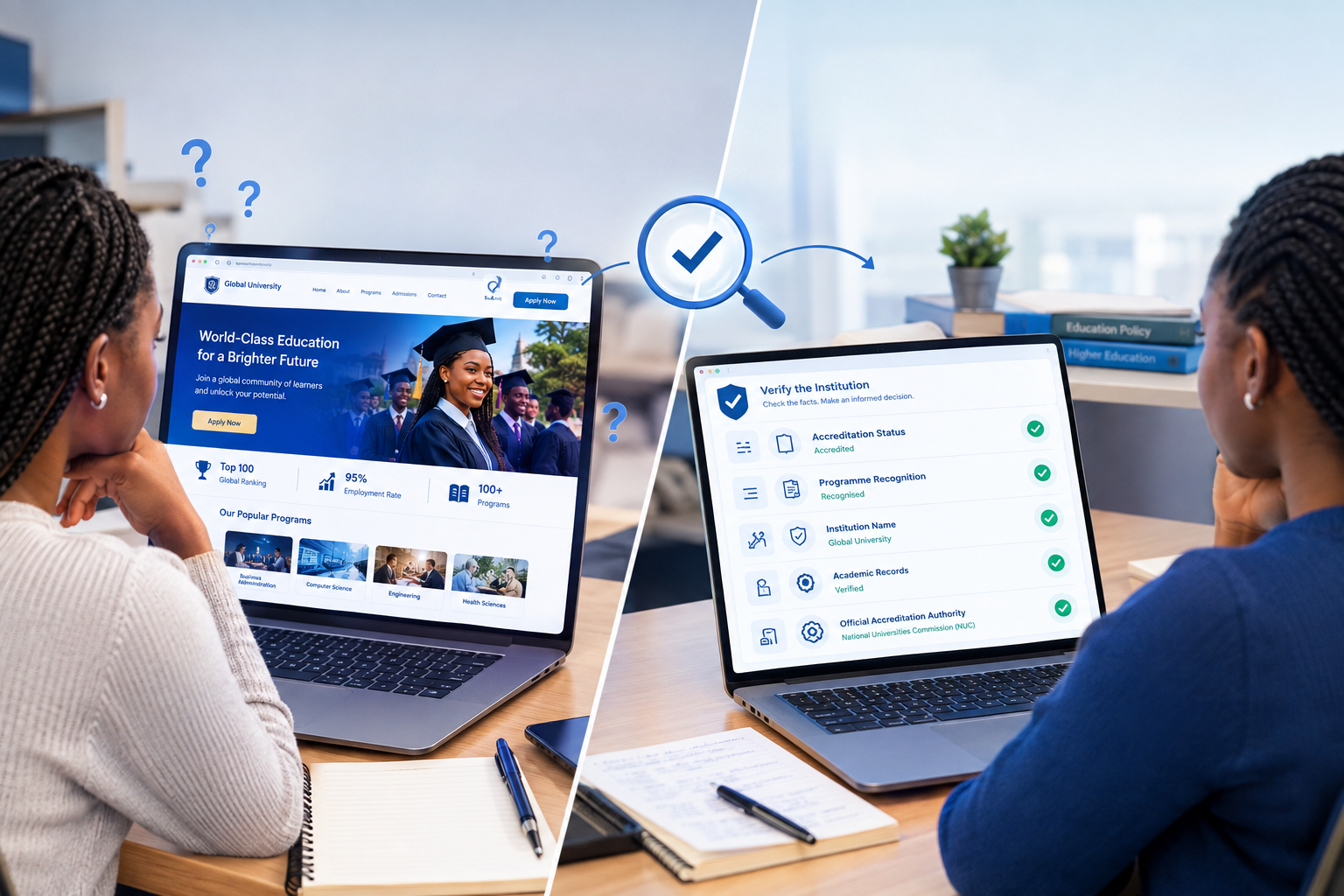
Choosing an online university is more than finding a programme that fits your schedule or a tuition fee you can afford. Before you enrol, you need to know that the university is recognised by the appropriate authorities and that the qualification you are working towards will be valid where you intend to use it.
That can be harder to establish than it sounds. A university can have a polished website, active social media pages, impressive testimonials and a long list of programmes, yet still lack the accreditation or recognition needed to award legitimate qualifications. Some institutions also use names, branding, or claims that make them appear affiliated with established universities when no such relationship exists.
So, how do you tell the difference? This guide breaks down what accreditation and recognition mean, where to find reliable information about an online university, and the checks you should carry out before paying an application or tuition fee. Whether you are considering a degree from a university in Nigeria or looking at an institution abroad, these steps can help you verify its legitimacy before you enrol.
Read More: Professional Certification vs Degree: Which One Actually Advances Your Career?
What Does It Mean for an Online University to Be Legitimate?
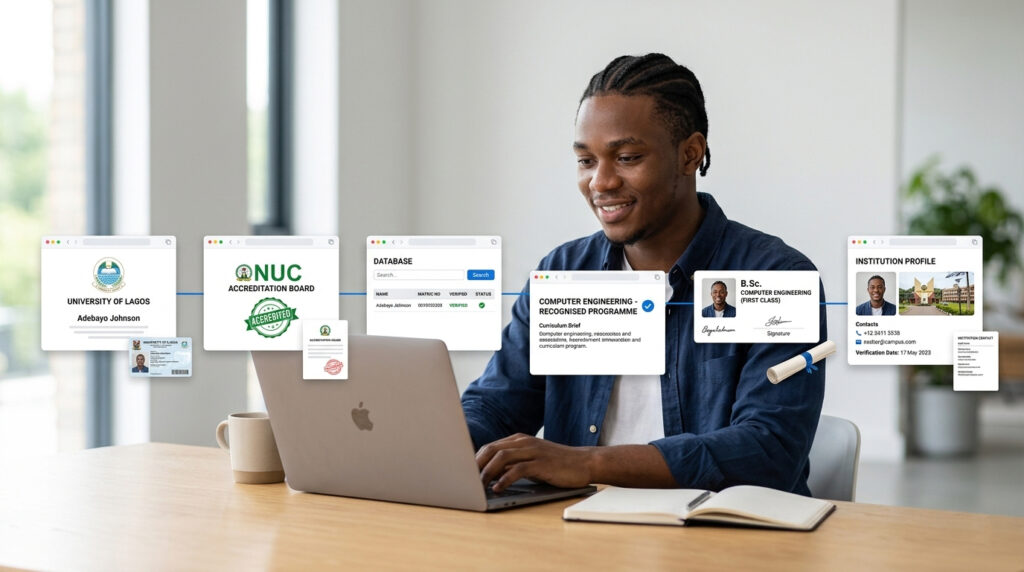
A legitimate online university has been formally recognised by a competent national or regional authority to award its qualifications, and delivers them through a genuine academic process. In practical terms:
- It is a recognised university under its home country’s higher education framework, not simply a registered business.
- It holds appropriate accreditation from a body with the legal authority to grant it.
- Its individual programmes, not just the institution as a whole, carry the recognition employers expect.
- It employs qualified, identifiable faculty.
- It publishes transparent information about fees, admission criteria and academic policies.
- It keeps verifiable academic records that a third party can confirm.
- It has a genuine administrative presence, even where teaching is entirely online.
None of this is visible from a homepage. A polished site with a stock graduation photo proves someone paid a web designer, not that any accreditation body has reviewed the institution.
What Is University Accreditation?
Accreditation is a formal quality assurance process carried out by a recognised authority to confirm that an institution, or a specific programme, meets defined academic standards. It exists to protect students and employers from institutions that would otherwise self-declare their own credibility, and it sits at the heart of online education accreditation generally.
Institutional accreditation evaluates the university as a whole: governance, faculty qualifications, financial stability and academic infrastructure. Programme accreditation looks at a specific course of study, which matters because a university being accredited does not automatically mean every programme it runs carries the same status. An accredited online university might offer one flagship accredited programme alongside a newer, unaccredited pilot course.
Recognition also operates on different scales. Some accreditation is purely national, some regional, and frameworks such as the UNESCO Global Convention on the Recognition of Higher Education Qualifications aim to make academic mobility easier across borders. Because the accreditation authority in Nigeria differs from the one in the UK or the US, there is no single global checklist. What matters is identifying the correct authority for the country where the university is registered, then confirming its status directly with that body.
How to Verify If a University Is Accredited
This is the practical core of the process, worth working through methodically rather than trusting a single search result.
Step 1: Identify the university’s official name. Fraudulent institutions often use names almost identical to established universities, with a word changed or added. Find the exact legal name as it appears on official records.
Step 2: Find the relevant accreditation authority. Every country has a designated regulator. In Nigeria, this is the National Universities Commission, under the Federal Ministry of Education. In the US, recognised accreditors are listed by the Council for Higher Education Accreditation. In the UK, degree-awarding powers sit with institutions listed as Recognised Bodies.
Step 3: Search the official accreditation database, not just the university’s own website. This is the step most people skip, and the one that actually protects you. For Nigerian universities, check the National Universities Commission’s Nigerian University System platform. Internationally, the World Higher Education Database, developed with UNESCO, lists around 22,000 accredited or recognised institutions across 196 countries and is a widely trusted reference for degree verification.
Step 4: Verify the specific programme. Regulated professions such as medicine, law, engineering or accountancy often require programme-level recognition on top of institutional accreditation. Check with the relevant professional body separately.
Read More: Highest Paying Jobs in Nigeria: Top Careers and the Degrees That Can Get You There
Step 5: Check the qualification itself. Confirm the exact credential type, its level, and whether it aligns with recognised national qualifications frameworks.
Step 6: Verify contact and institutional information. Cross-check the physical address, phone numbers and staff listings against independent sources. A “campus” address that turns out to be a residential building is a meaningful warning sign.
Working through these six steps consistently is, in essence, how to verify if a university is accredited in any country, regardless of how the institution markets itself.
Diploma Mills: What They Are and How They Operate
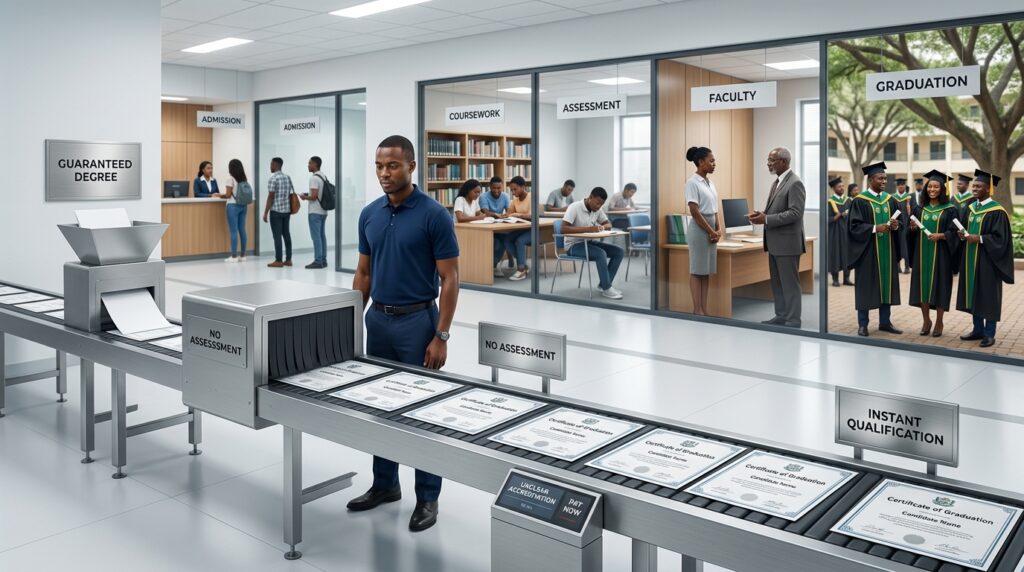
A diploma mill is an organisation that awards degrees with substandard or no academic study, without approval from a recognised accrediting body, usually in exchange for a fee rather than genuine coursework. Some diploma mills go further and claim accreditation from bodies that are themselves unrecognised, set up purely to give a veneer of authenticity.
Common warning signs include degrees awarded in days or weeks, minimal or no academic assessment, “life experience” credited as equivalent to years of study, vague accreditation claims, pressure to pay immediately, and an address that does not correspond to any genuine campus. One warning sign alone does not automatically confirm a diploma mill; what matters is the combination of signs, particularly around accreditation and assessment.
Online Degree Scam Warning Signs
Beyond diploma mills specifically, here are the online degree scam warning signs worth watching for:
- A guaranteed degree, regardless of prior qualifications.
- No meaningful admission requirements.
- An unrealistically short programme duration for the credential offered.
- Accreditation claims that cannot be confirmed independently.
- Rankings or endorsements that cannot be traced to a credible source.
- No identifiable faculty information.
- A curriculum that is vague or missing from the site.
- Pressure-based sales tactics rather than an admissions process.
- Requests for payment through informal or unusual channels.
If you find yourself asking “is my degree legit” partway through a programme, most of these signs were already present at enrolment. Catching them early is far less costly than discovering them after paying tuition.
How to Check Whether an Online Degree Will Be Recognised
Recognition depends on who is reviewing the qualification: an employer, a professional regulator, a government department, or another university considering you for further study. A degree accredited at home is not automatically treated the same way everywhere. If you are entering a regulated profession, or plan to use the qualification internationally, check recognition requirements with the relevant employer, regulator or receiving institution before you enrol, not after. In the UK, UK ENIC is the designated body for comparing international qualifications against the UK system.
How to Verify an Online University Beyond Accreditation
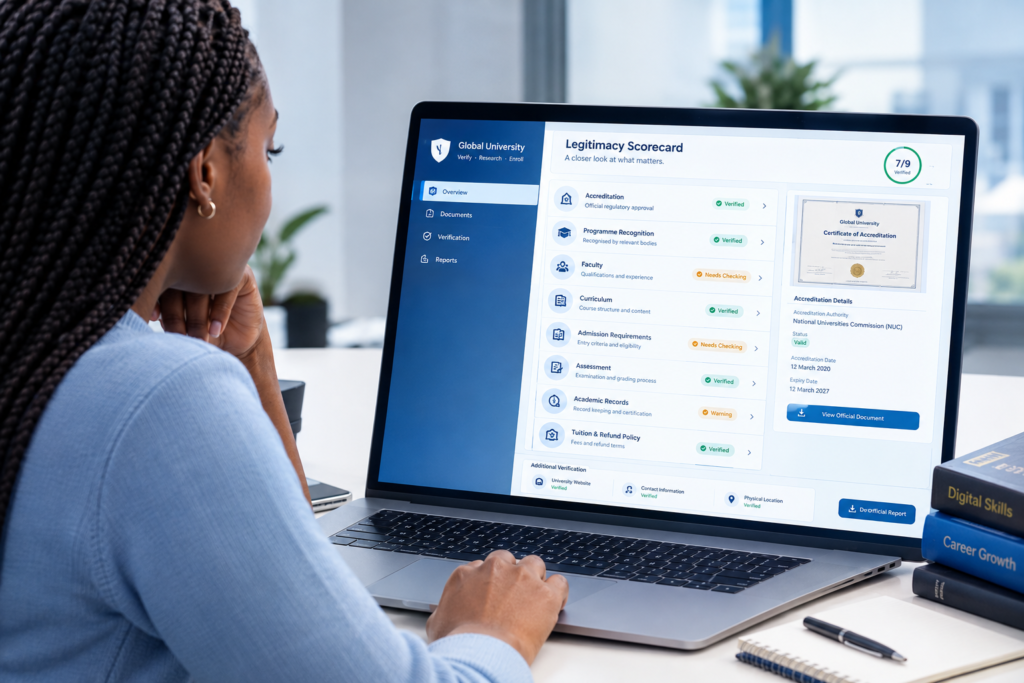
Once you know how to verify if a university is accredited, treat that as the starting point, not the finish line. A fuller due-diligence checklist covers the programme curriculum, faculty qualifications, student support, the learning platform, how assessments are conducted, graduation requirements, how academic records are issued, tuition and refund policy, and, where available, graduate outcomes. An accredited institution with poor support or an opaque refund policy can still cost you time and money you did not plan to lose.
Online University vs Diploma Mill
| Legitimate Online University | Diploma Mill |
| Recognised/accredited where applicable | Accreditation unclear or misleading |
| Defined admission requirements | Little or no academic entry process |
| Structured, published curriculum | Minimal academic content |
| Genuine assessments | Little meaningful assessment |
| Qualified, identifiable academic staff | Faculty information unclear or absent |
| Verifiable academic records | Credential verification is difficult |
| Transparent policies | Limited institutional transparency |
How EduTech Business Helps Students Find Trusted Education Options
EduTech Business exists as an education discovery and guidance layer for students weighing exactly these decisions. Through the platform, students can compare partner university programmes, explore flexible learning formats and get direct support from education advisers while narrowing down options such as ABU Distance Learning Centre and Babcock BUCODeL, among the currently active partner institutions. Browse the full list on the EduTech Business partner institutions page.
Working with a guidance platform does not remove the need for your own due diligence. Institutions and programmes change over time, so it remains worth confirming current accreditation status directly with the relevant authority before you enrol in anything, including programmes discovered through EduTech Business.
A Pre-Enrolment Checklist for Online Students

- Confirm the university’s official name
- Identify the relevant accreditation authority
- Verify institutional accreditation directly with that authority
- Check programme-level recognition
- Review admission requirements and realistic programme duration
- Review tuition and refund policies
- Check assessment requirements
- Confirm how academic records are issued, for straightforward degree verification later
- Check whether the qualification meets your career or further-study goals
- Keep copies of all official admissions and payment documents
For the wider application process, our university admission requirements checklist covers what to prepare before you apply.
Read More: How to Pay School Fees in Instalments: A Complete Guide for Students and Parents
Frequently Asked Questions
How do I verify if an online university is accredited? Identify its official name, find the accreditation authority in its home country, and check the institution’s status on that authority’s official database rather than relying on the university’s own claims.
How can I tell if an online university is legitimate? Look beyond accreditation to admission requirements, published curriculum, identifiable faculty, transparent policies and verifiable academic records.
What is a diploma mill? An organisation that awards degrees with little or no genuine academic study and without recognised accreditation, usually in exchange for payment.
How can I spot an online degree scam? Watch for guaranteed degrees, unrealistic programme lengths, unverifiable accreditation claims and pressure-based sales tactics.
Are all online universities accredited? No. Accreditation status varies by institution and even by programme, which is why an accredited online university still needs individual verification.
Does accreditation apply to individual programmes? Often, yes. Institutional accreditation does not guarantee every programme carries the same recognition, particularly for regulated professions.
How can I check whether an online degree is recognised? Confirm recognition requirements with the specific employer, professional regulator or receiving institution you have in mind, as expectations vary.
Can an online university be legitimate without being accredited? Some providers operate outside formal degree accreditation, such as certificate or professional training bodies, but any institution claiming to award recognised degrees should hold appropriate online university accreditation.
Where can I verify university accreditation? Through the official accreditation or regulatory authority in the university’s home country, alongside international references such as the World Higher Education Database.
Before You Enrol
Choosing an online university is a significant investment of time and money, and it deserves the same scrutiny as any major decision. Verify the institution, its accreditation and its programme recognition before you pay a single instalment of tuition, then choose a recognised university pathway that genuinely fits your career goals. Explore trusted online degree and professional education options through EduTech Business.