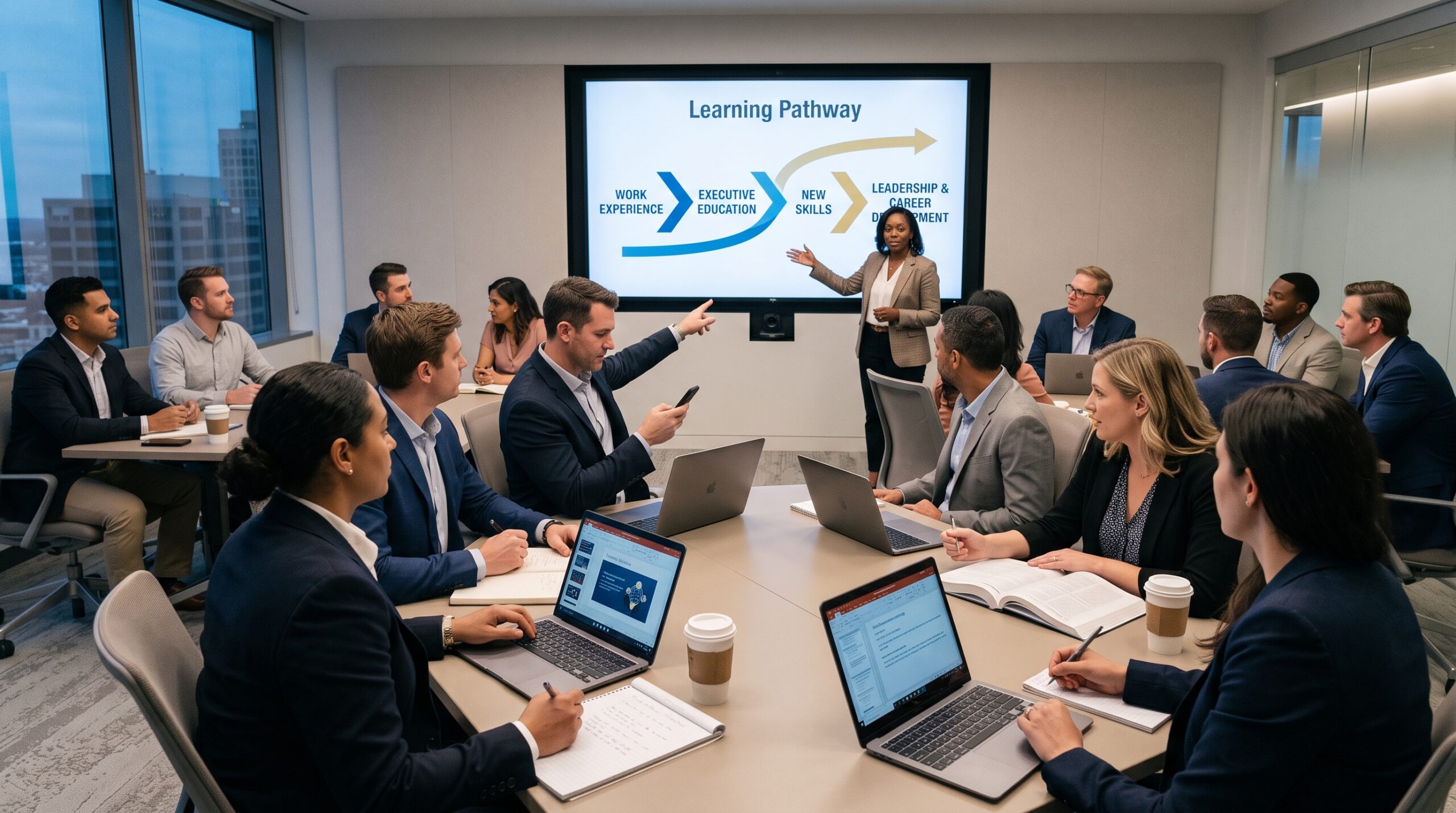
You May Have Been Learning the Wrong Way Your Entire Life
Most students assume that poor grades mean they are not smart enough. It is a conclusion that arrives quietly, settles in, and starts to shape how a person sees themselves in relation to education. But here is a more useful question: what if the problem is not your ability, but the way you have been trying to learn?
Across classrooms and lecture halls, the dominant model of teaching has remained largely unchanged for decades: a teacher speaks, students listen, everyone reads from the same textbook and sits the same exam. That method works brilliantly for some students and poorly for others, not because of intelligence, but because people absorb and retain information in fundamentally different ways. If you have ever wondered, “What type of learner am I?”, that question matters more than you may realise.
Research published in the International Journal of Social Sciences and Educational Studies found that students with visual, auditory, and kinesthetic learning preferences each showed distinct patterns of academic performance, and that teaching approaches aligned to a student’s style could support stronger outcomes. The VARK model, developed by Fleming and Mills in 1992, remains one of the most widely used frameworks for identifying learning preferences across Visual, Aural, Reading/Writing, and Kinesthetic dimensions. Understanding where you sit within that spectrum is not just an academic exercise. It is one of the most practical things you can do before choosing a degree programme, a study format, or an institution.
Read More: How to Write a Strong Personal Statement for University Applications
Why Understanding Your Learning Personality Matters
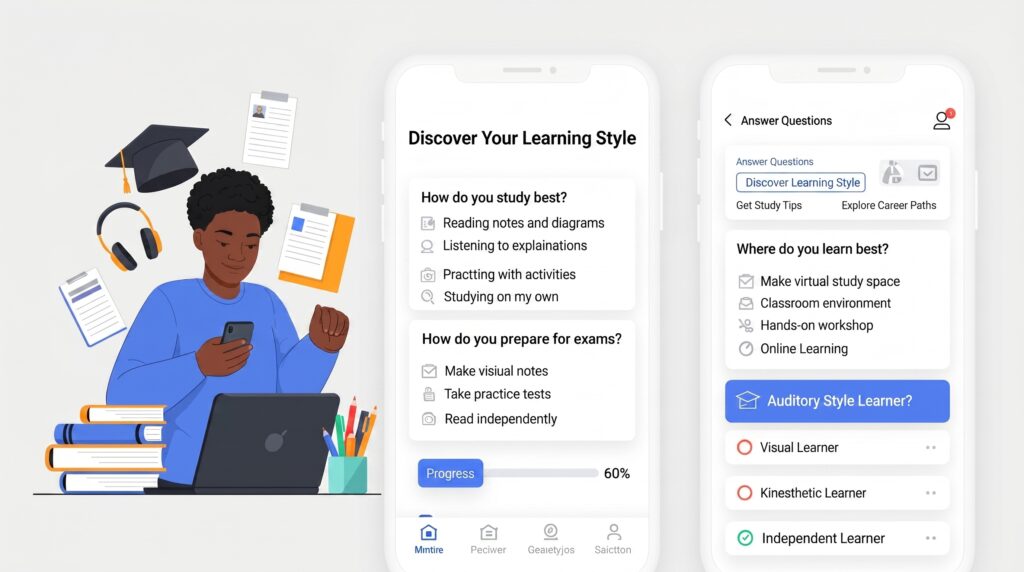
Your learning style shapes far more than how you revise before an exam. It influences your attention span, how deeply you retain new information, how motivated you feel during study sessions, and how well you perform under pressure. A student who processes information best through listening will quietly disengage from a module built entirely around dense reading lists. A student who learns by doing will find a passive lecture format draining and ineffective.
The implications extend into career development, too. According to a 2024 LinkedIn Learning Report, 40% of organisations now prioritise online learning as part of career development. The format of that learning matters for how much employees actually absorb and apply. Knowing ‘what type of learner am I’ early gives you a genuine advantage: you can seek out programmes, platforms, and study environments that work with you rather than against you.
Recognising your learning personality also helps you make smarter education choices. Whether you are deciding between a distance learning degree and a structured campus programme, or weighing up a professional certification against a postgraduate qualification, your natural learning preferences should be part of that calculation.
The Learning Personality Quiz: What Type of Learner Am I?
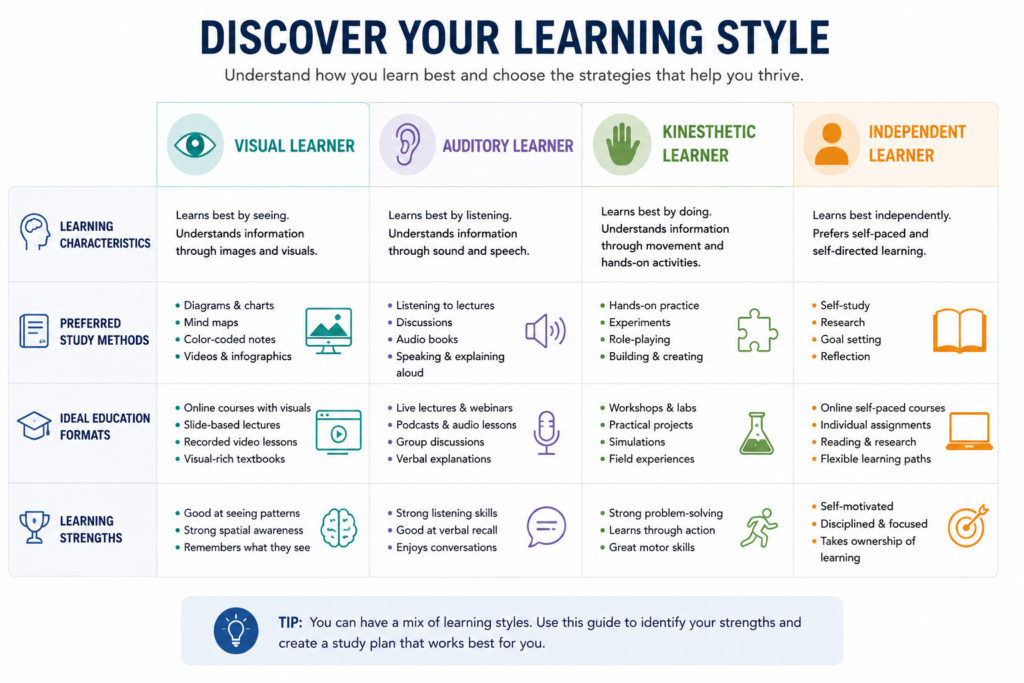
Answer each question honestly. There are no right or wrong choices. Select the option that feels most natural to you, not the one you think you should choose.
Question 1: When you are learning something completely new, you prefer to:
- A. Watch a video or see it demonstrated visually
- B. Listen to someone explain it out loud
- C. Jump in and try it for yourself
- D. Read through the instructions at your own pace
Question 2: Before an important exam, you typically:
- A. Create diagrams, colour-coded notes, or mind maps
- B. Read your notes out loud or record yourself
- C. Work through practice problems and exercises repeatedly
- D. Go back over textbooks and written materials independently
Question 3: When you are given new information during a lecture or meeting, you remember it best when:
- A. There are slides, charts, or images to support the explanation
- B. The speaker is engaging and you can follow the spoken flow
- C. You can take notes or interact with the material in some way
- D. You have time to read through a summary or transcript afterwards
Question 4: Your ideal study environment looks like:
- A. A space with whiteboards, visual tools, or video access nearby
- B. Somewhere quiet enough to speak your thoughts aloud or listen to audio
- C. A practical setting where you can move around and work on tasks
- D. A quiet, independent space where you can work through material alone
Question 5: When you get lost following complex instructions, you:
- A. Search for a diagram or demonstration video online
- B. Ask someone to walk you through it verbally
- C. Try a few options yourself until something clicks
- D. Reread the instructions more carefully from the beginning
Question 6: In group work, your most natural role tends to be:
- A. The one who presents ideas using visuals or slides
- B. The one who talks through the problem and drives discussion
- C. The one who gets things built or tested practically
- D. The one who researches independently and brings findings to the group
Question 7: When you recall something you learned months ago, you tend to remember:
- A. Images, layouts, diagrams, or colour schemes associated with the content
- B. Something someone said, a phrase, or a tone of voice
- C. Something you did, built, or practised
- D. Something you read or a structure you worked through on your own
Question 8: Your most productive learning sessions happen when:
- A. You can use visual tools: flashcards, infographics, maps
- B. You are talking it through with someone or listening to a podcast or lecture
- C. You are building something, completing a task, or doing a simulation
- D. You are working independently at your own pace without interruption
Question 9: When choosing a course or programme, the feature that appeals most is:
- A. Video content, interactive graphics, and well-designed modules
- B. Live webinars, discussion forums, or recorded lectures
- C. Practical projects, simulations, or work-integrated components
- D. Flexible, self-paced structure you can manage yourself
Question 10: After completing a topic, you feel most confident when:
- A. You can visualise how everything connects, as a map or flowchart
- B. You can explain it clearly to someone else out loud
- C. You have applied it to a real situation or completed a hands-on task
- D. You have reviewed it thoroughly on your own and feel ready
Mostly A? You are likely a Visual Learner.
Mostly B? You lean Auditory.
Mostly C? You are a Kinesthetic Learner.
Mostly D? You are an Independent Learner.
Read More: Why Your Degree Doesn’t Matter as Much as Your Skills (And How to Get Both)
Quiz Results: Which Type of Learner Are You?
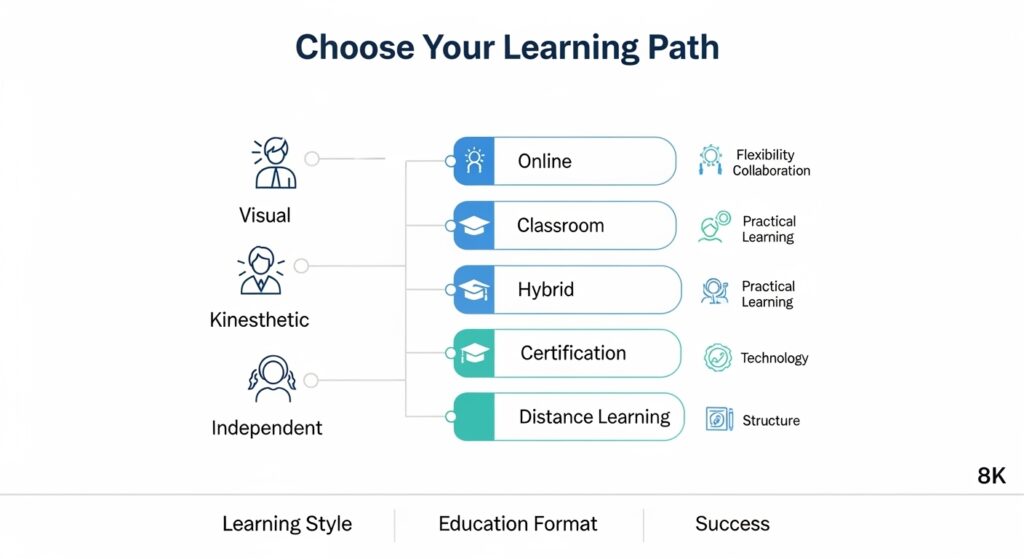
The Visual Learner
Visual learners process information most effectively through images, diagrams, colour, and spatial organisation. You gravitate towards mind maps, infographics, and well-structured slides. A wall of unformatted text can feel overwhelming, but a well-designed diagram unlocks understanding almost immediately.
Best study methods: mind maps, colour-coded notes, video lessons, visual summaries, flowcharts.
Ideal learning environments: online platforms with rich multimedia content, video-based modules, and visually designed course materials.
The Auditory Learner
Auditory learners absorb information most effectively through listening and discussion. You may find yourself remembering conversations more clearly than written notes, or understanding a concept fully only after hearing it explained out loud.
Best study methods: recorded lectures, study group discussions, reading notes aloud, and educational podcasts.
Ideal learning environments: live virtual classes, webinars, discussion-led programmes, and interactive group learning.
The Kinesthetic Learner
Kinesthetic learners need to engage with material through doing. Passive instruction can feel like a barrier rather than a gateway. You learn through practical tasks, hands-on projects, and real-world applications. Sitting still through long theoretical sessions can feel actively counterproductive.
Best study methods: simulations, practical assignments, project-based work, case studies, internships.
Ideal learning environments: career-focused programmes, skills training, work-integrated learning, experiential courses.
The Independent Learner
Independent learners are self-directed, curious, and most effective when they control the pace and sequence of their learning. You enjoy exploring topics in depth, designing your own study structure, and working without the interruptions of group dynamics.
Best study methods: self-paced online courses, personal research projects, independent reading, structured reflection.
Ideal learning environments: flexible distance learning programmes, online degrees, open learning platforms.
What Your Learning Style Says About Your Education Choices
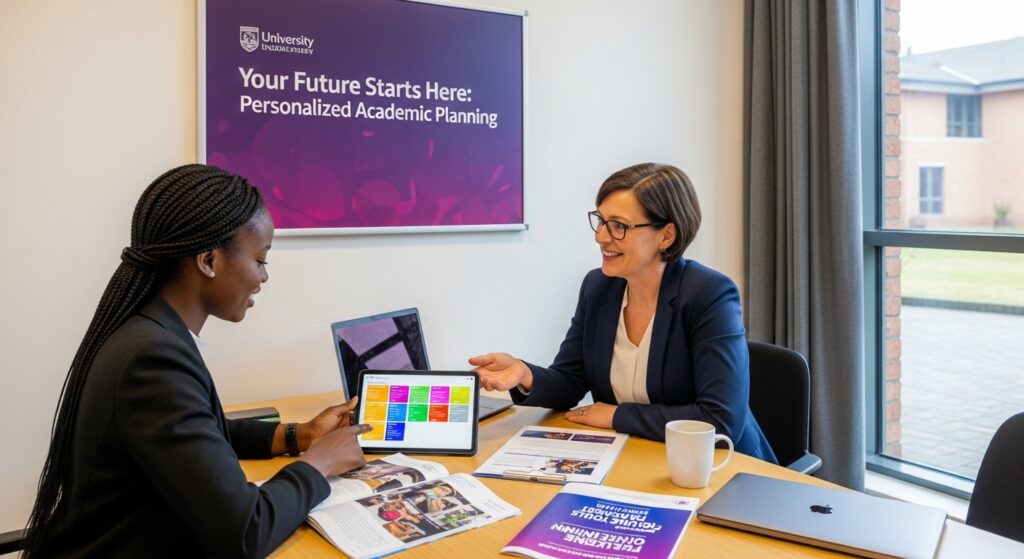
Knowing ‘what type of learner I am’ should directly inform how you choose your degree or certification pathway. This is not about finding a “better” learning style; research consistently shows that all four styles can produce strong academic outcomes when matched to the right environment. The variable is fit, not type.
- Visual learners tend to thrive in online programmes with high-quality multimedia design, video-rich modules, and interactive content.
- Auditory learners benefit from live or synchronous virtual classes, discussion-based modules, and access to recorded lectures.
- Kinesthetic learners perform best in practically oriented programmes with built-in internship components, simulations, or project assessments.
- Independent learners are often the ideal candidates for flexible distance learning degrees, where self-management and autonomous study are features rather than challenges.
Online Learning vs Traditional Learning: Which Fits Each Learner Best?
Online learning has grown substantially as an education format. Research suggests that students in online programmes retain between 25% and 60% more of what they learn compared to traditional classroom settings. Online learning also requires 40% to 60% less time to cover the same material, making it highly efficient for self-directed and independent learners. As of 2024, approximately 49% of students globally had completed some form of online learning, and that number continues to grow.
Traditional learning still holds real value, particularly for auditory and kinesthetic learners who benefit from real-time discussion, structured timetables, and face-to-face peer interaction. Hybrid formats, which blend online flexibility with in-person touchpoints, often deliver the best results for students who move between learning styles depending on the subject.
The question ‘what type of learner am I’ is most useful here, not as a box to tick but as a starting point. If you know you need interactivity to stay engaged, a fully asynchronous online programme may frustrate you. If you know you work best independently, a rigid campus schedule may feel constraining. Match the format to the person.
How Successful Students Adapt Their Learning Style Over Time
Learning styles are preferences, not fixed limits. High-performing students tend to combine methods across styles rather than relying exclusively on one. A visual learner might join a study group to pressure-test their understanding through conversation. A kinesthetic learner might watch tutorials before a practical session to build conceptual grounding first. An independent learner might actively seek a mentor to interrogate their thinking.
According to Edutopia, the most effective learners are those who develop metacognitive awareness: the ability to observe how they learn, identify what is and is not working, and adjust accordingly. That kind of self-knowledge is more valuable than any single study technique.
Read More: How to Beat Procrastination and Complete Your Online Course
How EduTech Business Helps Students Find the Right Learning Path
At EduTech Business, the goal is simple: help students make education decisions that actually fit who they are. Whether you are an independent learner exploring distance degree options, a kinesthetic learner looking for practically structured professional certifications, or an auditory learner who needs a live and interactive study environment, the right pathway exists.
EduTech Business works with partner institutions, including ABU Distance Learning Centre and Babcock University’s BUCODEL programme, to connect students with flexible, accredited degree formats designed to accommodate different learning preferences. The team can help you compare programme structures, understand entry requirements, and identify formats that match how you naturally learn best.
Not sure where to start? Speak with an EduTech Business advisor and get personalised guidance on degree and certification pathways built around your strengths, your goals, and your learning personality.
Frequently Asked Questions
What type of learner am I? Your dominant learning style is the format through which you absorb and retain information most effectively. Use the quiz above to identify whether you are primarily a visual, auditory, kinesthetic, or independent learner, based on how you naturally engage with new material.
How can I discover my learning style? A structured quiz like the one above is a good starting point. Pay attention to when you feel most engaged during study, which formats help information stick, and what kinds of revision strategies have actually worked for you in the past.
Do learning styles affect academic success? Yes, though the relationship is nuanced. Research published in peer-reviewed journals confirms that significant differences in academic performance exist between students with different learning style preferences. The key factor is not which style you have, but whether your learning environment and methods are aligned with it.
Which learning style works best for online education? Independent and visual learners often adapt to online education most readily due to its self-paced, multimedia-rich nature. However, well-designed online programmes now incorporate live sessions, practical components, and community features that support auditory and kinesthetic learners too.
Can learning styles change over time? Yes. Learning preferences can evolve with age, experience, and subject matter. Many people develop broader learning flexibility over time, drawing on multiple styles depending on the context. What matters most is that you stay aware of what works for you.
How do I choose a degree programme that matches my learning personality? Consider the delivery format, the proportion of practical vs theoretical content, whether live interaction is built in, and how much flexibility the programme allows. EduTech Business advisors can help you map your learning personality to specific programmes and institutions.