Building a tech career without a degree Nigeria is possible, but it is not the same as building one without education or training. Every developer, designer or analyst working without a university certificate today still had to learn something, practise it repeatedly, and prove it to someone willing to take a chance on them. That distinction matters: the goal is not to skip preparation, but to replace one kind with another that employers can verify.
Some roles still expect a degree, particularly in larger, more conservative organisations or regulated environments. Others, especially in fast-growing areas like web development, data and digital marketing, increasingly hire on demonstrable skill rather than a transcript. This article walks through which technology jobs Nigeria employers are opening to skills-first candidates, what tech skills and proof they actually check for, and how to build a credible path into the industry step by step.
Read More: Highest Paying Jobs in Nigeria: Top Careers and the Degrees That Can Get You There
Can You Actually Get a Tech Job Without a Degree in Nigeria?
The honest, direct answer is: it depends, mostly on role, employer, seniority, industry and location, rather than on ambition alone. A junior front-end developer role at a fast-moving startup may care far more about a working portfolio than a transcript. A software engineering role inside a bank or telecoms company, by contrast, may still require a degree as baseline eligibility, often for regulatory reasons.
Seniority matters too. Entry-level tech jobs are generally the most open to skills-first hiring, since employers are testing potential and foundational competence rather than years of specialised judgement. As roles get more senior, expectations often widen again, sometimes including formal qualifications, sometimes a longer track record of shipped work instead. The practical takeaway is that a tech career without a degree Nigeria offers is realistic for a growing share of roles, but it requires being selective about where you aim first and building proof that makes the missing certificate less relevant.
Tech Jobs No Degree Nigeria Employers Are Actually Hiring For

Several tech jobs no degree Nigeria applicants pursue are genuinely open to skills-first candidates. A few worth considering, each with a different entry bar:
- Web development: front-end and back-end roles reward a strong portfolio of live, working projects more than any single credential, and coding without a degree is increasingly the norm here.
- Software development: broader programming roles increasingly hire on coding tests and project history rather than a computer science degree alone.
- UI/UX design: a polished design portfolio, ideally solving real or simulated client problems, often matters more than formal design education.
- Data analysis: comfort with spreadsheets, SQL and visualisation tools, backed by sample dashboards, can open entry-level analyst roles.
- Digital marketing: performance on live campaigns, certifications and measurable results carry real weight.
- Technical and cloud support: structured certification plus hands-on troubleshooting practice can substitute for a degree in many support-tier roles.
- QA testing: attention to detail and familiarity with testing tools is often assessed through practical exercises rather than credentials.
- Cybersecurity: a genuine growth area, since Nigeria has only around 25,760 cybersecurity professionals against a workforce gap of 90.6%, though many roles still expect recognised certification given the sensitivity of the work.
Not every role fits this pattern. Highly specialised, research-heavy or strictly regulated positions may still require a degree, so check specific listings rather than assuming a blanket rule.
Read More: Professional Certification vs Degree: Which One Actually Advances Your Career?
What Skills Do You Need to Get Hired?
Employers assessing a candidate without a degree look for two categories of skill working together, since technical ability alone rarely closes a hire. Tech skills vary by role and might include programming languages, data tools, cloud platforms or cybersecurity fundamentals. What matters more than the list is depth: employers want to see that you can apply a skill to a real problem, not just that a course exposed you to it.
Professional skills matter just as much, and are often where self-taught candidates lose ground unintentionally:

- Communication, especially explaining technical decisions to non-technical colleagues or clients.
- Problem-solving, demonstrated through how you approached a difficult project, not just its final result.
- Teamwork, since most tech work happens through collaboration and shared documentation.
- Basic project management, including estimating timelines and scope on your own projects.
- Client communication, particularly for freelance or contract-based entry points.
Employers rarely take a claimed skill at face value. They want evidence: a test, a work sample, a portfolio, a certification, or a reference from someone who has seen the work firsthand.
Technology Certifications: A Practical Alternative to Traditional Credentials
Technology certifications cannot fully replace a degree where one is genuinely required, but for many entry-level and mid-level roles, they offer credible, verifiable proof of specific knowledge. A certification demonstrates structured learning, exposure to industry-standard tools, and a visible commitment to a chosen path, which matters to an employer weighing an unfamiliar CV.
Nigeria’s certification landscape has grown considerably. INGRYD Academy is recognised as the official ISACA Centre of Excellence for Nigeria and offers globally recognised technology certifications across software engineering, cybersecurity, cloud computing and data science, at a significant discount through its ISACA partnership. Programmes like this typically combine instructor-led training with hands-on labs, which matters more than the certificate for becoming job-ready. Other EduTech Business partners, including the Metropolitan School of Business and Management, offer complementary business certifications that add commercial context for candidates aiming at product or client-facing roles.
Certifications make the most sense when a role values them, when you need structured learning rather than self-study, or when transitioning from an unrelated career and needing a recognised marker of new competence. A degree remains the better route where a profession is formally regulated, and no certification changes that.
Build a Portfolio Before You Apply for Jobs

A portfolio is the single most persuasive proof available to someone pursuing a tech career without a degree Nigeria employers will consider, because it lets them evaluate actual work rather than a claim. For coding roles, this usually means live projects, a public GitHub repository with readable commit history, and one or two projects solving a real, specific problem rather than a generic tutorial clone.
Non-coding roles can build equally credible portfolios. A UI/UX designer can present redesign case studies of existing apps. A data analyst can publish a dashboard built from public datasets. A cybersecurity learner can document work from practice labs. A digital marketer can show real or simulated campaign results with clear metrics. In every case, the portfolio should explain not just what was built, but why, since employers assess judgement as much as output.
Read More: How Nigerian Students Can Build an Academic Portfolio to Win Scholarships and Fellowships
How to Learn Tech Skills and Get Your First Experience
Knowing how to learn tech skills is only half the challenge; converting that learning into experience is the harder part, since most listings ask for experience before anyone will grant it. A few realistic routes:
- Freelancing, even at modest rates initially, for real clients with real constraints and deadlines.
- Open-source contributions, which give you a public, verifiable record of collaborative work.
- Small business projects, such as building a website for a local business in exchange for a fee or reference.
- Volunteer projects, particularly for NGOs that need technical help but cannot pay market rates.
- Internships and apprenticeships, including structured ones run through training academies with employer placement partnerships.
- Personal projects, provided they are genuinely finished, documented and shared rather than left half-built.
The goal is the same across all of these: convert small, unpaid or low-paid work into something you can point to, describe in detail, and defend in an interview.
A Step-by-Step Path Into Tech
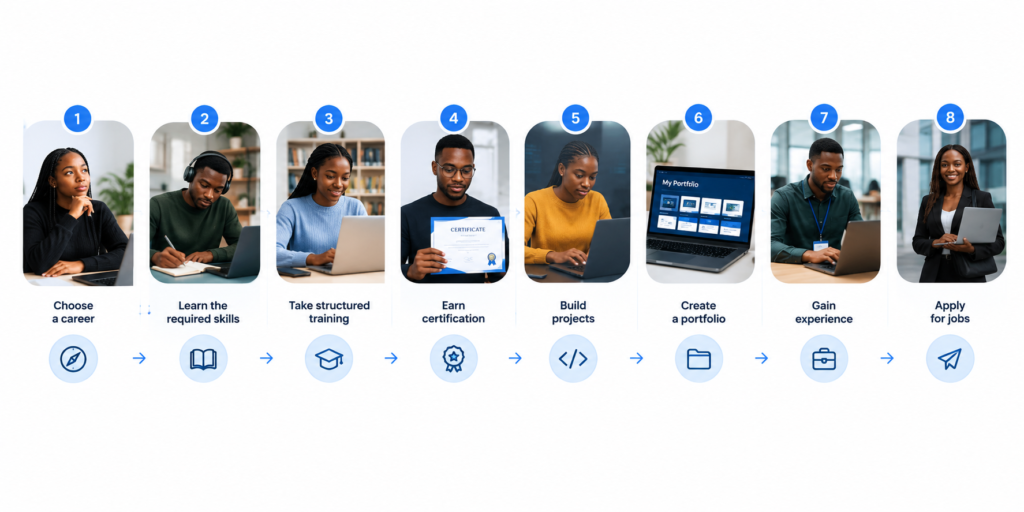
- Choose a career direction based on genuine interest and realistic market demand.
- Identify the specific skills required for entry-level tech jobs in that direction.
- Take structured training, whether through a bootcamp, certification programme or rigorous self-study curriculum.
- Earn a relevant certification where one exists and is respected in that field.
- Build projects that apply what you have learned to real or realistic problems.
- Assemble a portfolio that presents that work clearly.
- Gain practical experience through freelancing, internships or volunteer work.
- Apply for roles, tailoring your CV and portfolio to each one.
- Keep upskilling, since tools and employer expectations continue to shift.
How Long Does It Take to Become Job-Ready?
There is no honest fixed answer here. Timelines depend on the career chosen, prior experience, weekly study hours, training quality, technical complexity, and how long it takes to build a portfolio strong enough to survive scrutiny. A structured, full-time programme with clear milestones will typically move faster than unstructured self-study, but both can work. The more reliable measure of progress is not a calendar date but whether your projects, certification and portfolio would genuinely convince a stranger to hire you.
Degree vs Skills-Based Tech Career Path
Neither path is universally better, and the two can also work together. A traditional degree offers structured academic education and a broader theoretical foundation, and is sometimes required for regulated or research-heavy roles, though it takes considerably longer to complete. A skills-based path offers focused, narrower training aimed directly at one outcome, can start with shorter programmes measured in months, and suits roles where employers prioritise a strong portfolio over a qualification. Many people combine both: starting with focused skills training to enter the industry, then pursuing a degree later, part-time, once income and direction are established. A tech career transition Nigeria professionals attempt later in life often follows exactly this blended pattern. Choosing between the two is less about which is objectively superior and more about matching it to your goal, timeline and budget.
Building a Tech Career Through EduTech Business
Navigating certifications, training and university pathways alone can be overwhelming, which is where a platform like EduTech Business becomes genuinely useful. It connects learners to relevant technology training, technology certifications and flexible learning options suited to today’s technology jobs Nigeria market, alongside partner institutions covering both technical skills and the business context around them. For readers still weighing which route fits best, EduTech Business has also published a dedicated comparison of professional certification versus a degree, worth reading alongside this guide.
A tech career without a degree Nigeria offers is achievable, but it rewards deliberate preparation over shortcuts. The strongest candidates combine structured learning, relevant certification, a genuine portfolio and real, if modest, experience, then keep building on all four as the industry moves. That combination, rather than the absence of a certificate, is what ultimately gets someone hired.
Read More: How to Apply for International Scholarships: A Step-by-Step Guide
Frequently Asked Questions
Can I get a tech job without a degree in Nigeria? Yes, for many entry-level and skills-first roles, particularly in web development, design and data. Some employers and regulated roles still require a degree, so it depends on the specific position.
Which tech jobs don’t require a degree? Web development, UI/UX design, data analysis, digital marketing, technical support and QA testing are among the roles most open to skills-first hiring in Nigeria.
What tech skills should I learn first? Start with one focused technical track, such as web development or data analysis, alongside foundational professional skills like communication and problem-solving.
Can coding be learned without a degree? Yes. Coding without a degree is common through structured bootcamps, certification programmes and self-directed study, provided the learning is applied to real projects.
Are tech certifications worth it? They are valuable where recognised in your target field and combined with hands-on practice, though they work best alongside a portfolio rather than as a replacement for one.
How do I get tech experience without a job? Through freelancing, open-source contributions, volunteer projects, small business work and well-documented personal projects.
How long does it take to become job-ready? It varies by career path, study intensity and training quality, so it is best measured by the strength of your skills and portfolio rather than a fixed timeframe.
Can I switch to tech from another career? Yes. A tech career transition Nigeria professionals make is common, and certifications combined with a focused portfolio often shorten the path considerably.
Do Nigerian tech companies hire people without degrees? Many do, especially startups and skills-first employers, though larger or more regulated organisations may still require formal qualifications for certain roles.