How long does it take to get a degree online? It is usually the first question prospective students ask, and understandably so, because the answer shapes everything else: your budget, your work schedule, and how soon you can put a new qualification to use. The honest answer is that there is no single number, since duration depends on the programme, the pace, and the learner.
That variability can feel frustrating when you just want a straight timeline, especially if you are trying to plan around a job, a family, or a specific career deadline. Some students assume that studying online automatically means finishing faster than a traditional degree, while others worry the opposite: that a lack of fixed classroom hours will drag their studies out indefinitely. Neither assumption holds up consistently, which is exactly why this guide exists. This guide sets realistic expectations by walking through typical durations for different qualification types, the factors that speed things up or slow them down, and how to plan a schedule that actually fits your life rather than someone else’s.
Read More: Online Bachelor’s Degree: A Complete Guide for Working Adults
How Long Does an Online Degree Usually Take?
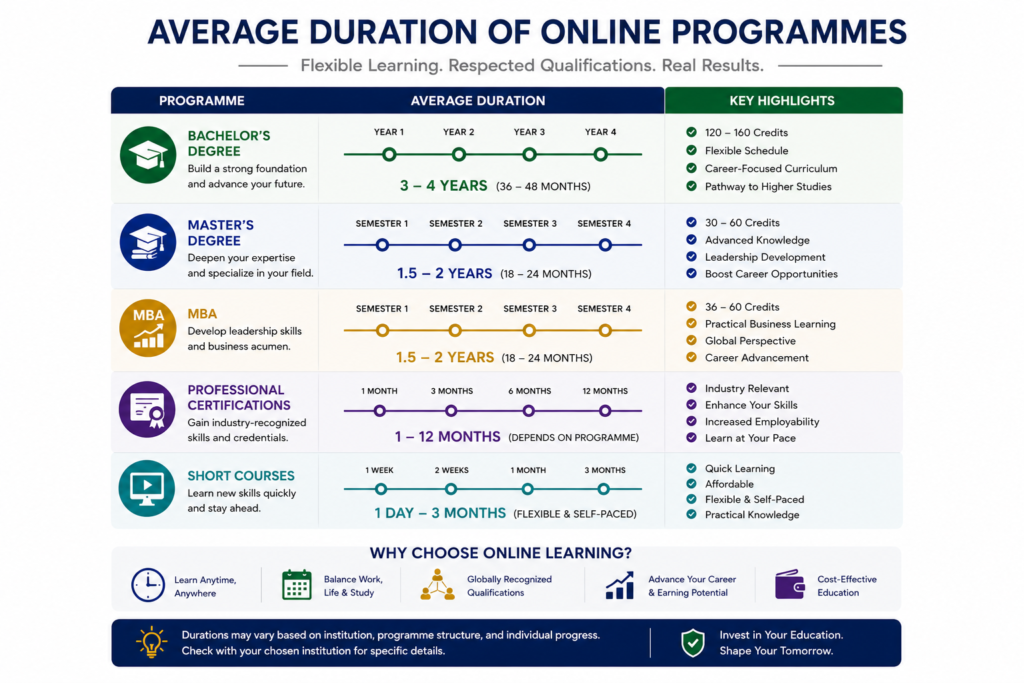
Programme type is the biggest starting point for how long it takes to get a degree online, since a bachelor’s, a master’s, and a professional certificate follow very different structures.
- Bachelor’s degrees typically run for four years of full-time study in Nigeria’s NUC-regulated system, though direct entry candidates admitted with prior qualifications such as an ND or NCE can complete a three-year programme instead of starting from year one.
- Master’s degrees generally take one to two years of full-time study, with part-time learners often needing three to five years depending on credit load and course availability each term.
- MBA programmes commonly follow a similar pattern to other master’s degrees, often completing in about one to two years full-time, though some accelerated formats run in as little as 12 months of continuous enrolment.
- Professional certifications are the most flexible, ranging from a few weeks to several months, since platforms like Coursera and edX structure many of their courses around self-paced, modular content rather than academic terms.
Programme structure matters as much as programme type. A course-based master’s tends to move faster than one requiring a dissertation or extended practicum, and a bachelor’s built around fixed semesters progresses differently to one using continuous, modular enrolment. This is why comparing two programmes purely by their advertised length can be misleading: two “two-year master’s” listings might involve very different weekly workloads once you factor in coursework, research components, and assessment style.
What Factors Affect Online Degree Duration?
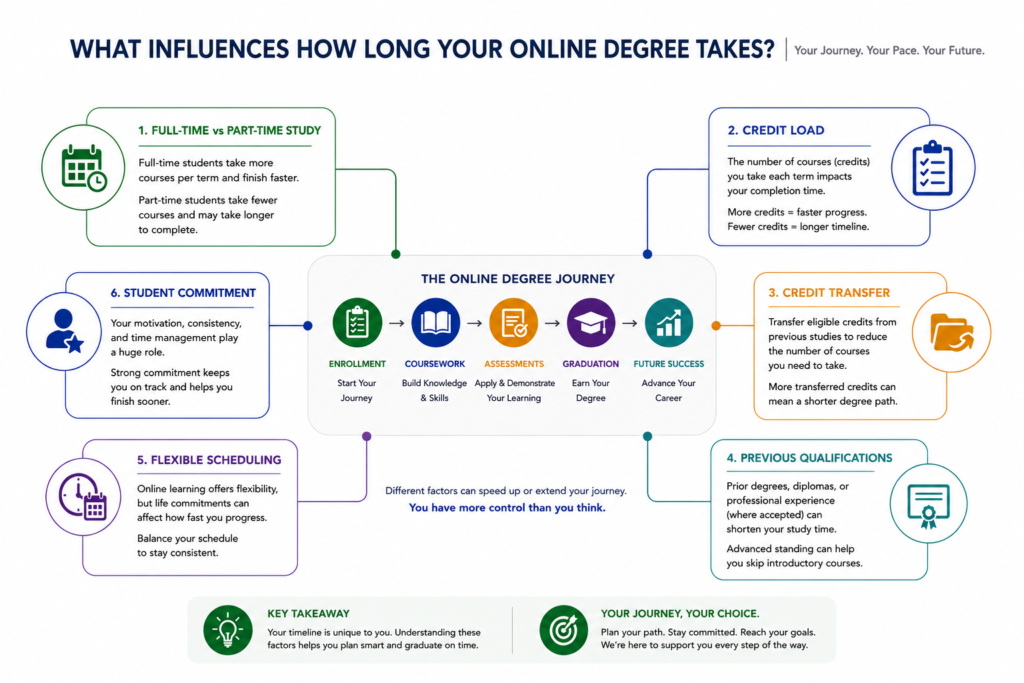
Once you understand typical ranges, the next step is recognising what actually pushes your personal timeline up or down.
- Full-time versus part-time study. Full-time students generally take three to four courses per term and finish sooner, while part-time online degree learners spread the same workload across more years to accommodate work or family commitments.
- Credit load. Programmes with heavier per-semester credit requirements move faster, provided you can sustain that pace without burning out.
- Previous qualifications. Entry with an ND, NCE, or equivalent often qualifies you for direct entry into year two, shortening the overall online degree duration.
- Credit transfer opportunities. Some institutions accept credits from previously completed coursework at accredited universities, reducing the number of courses you need to retake.
- Programme flexibility. Modular, self-paced formats let disciplined students move faster than a fixed semester calendar would otherwise allow.
- Student commitment. Consistent weekly study hours matter more than raw ability; a learner who studies steadily for ten hours a week will usually outpace one who studies erratically for twenty.
Can You Finish an Online Degree Faster?
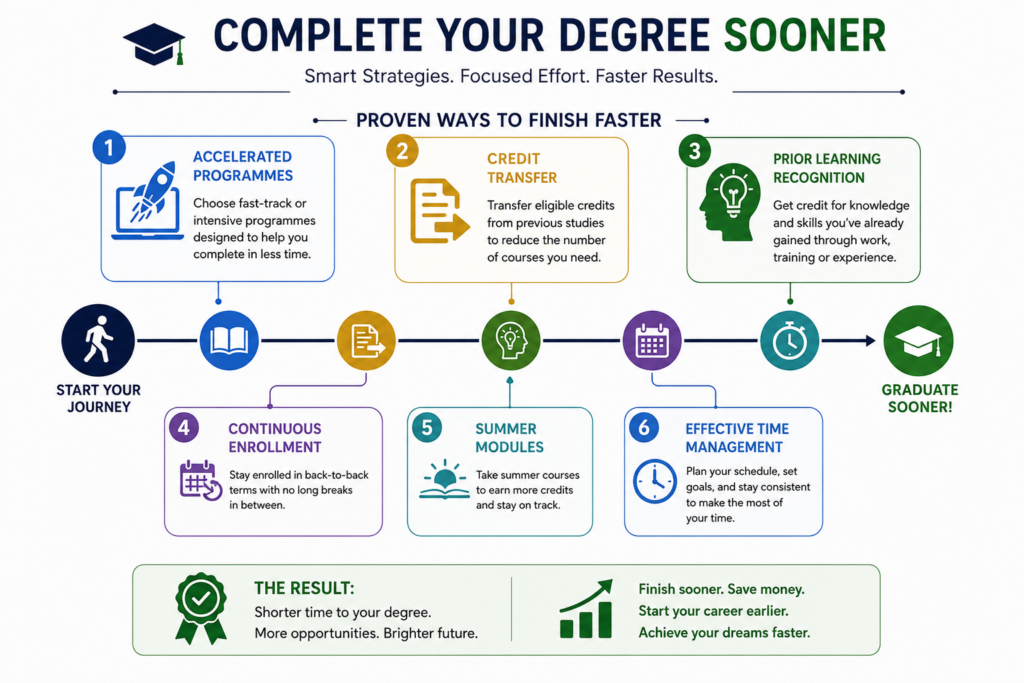
Yes, though how many years an online degree ultimately takes depends on the specific programme’s rules rather than a blanket promise of speed. Several genuine accelerators exist:
- Accelerated programmes compress standard coursework into a shorter timeframe through continuous, year-round enrolment rather than the usual academic breaks.
- Credit transfer from prior university study, where accepted, removes courses you would otherwise need to complete from scratch.
- Prior learning recognition allows some institutions to credit relevant professional experience or certifications towards specific modules.
- Summer or intersession modules let motivated students keep progressing during periods when campus-based peers are on holiday.
- Continuous enrolment avoids the gaps between terms that can otherwise stretch a programme out unnecessarily.
The fastest online degree pathway is rarely a shortcut in the sense of reduced content. It is usually a matter of removing dead time between study periods and making full use of whatever prior learning or transfer credit a programme legitimately allows.
Online Degree vs Traditional Degree Timeline
| Factor | Online Degree | Traditional Degree |
| Duration | Similar core length, but adjustable pace | Fixed by academic calendar |
| Flexibility | High; often modular or self-paced | Low; set semester structure |
| Study pace | Learner-controlled within programme rules | Cohort-paced |
| Schedule | Evenings, weekends, or anytime | Daytime, fixed timetable |
| Work compatibility | Designed for study while working | Often requires reduced work hours |
| Learning format | Digital materials and virtual support | In-person lectures and labs |
The core academic content rarely differs much between formats, since both must meet the same accreditation standards. What changes is how much control you have over the pace at which you move through it, and how much of that control you are prepared to use responsibly rather than letting flexibility turn into procrastination.
How to Choose the Right Online Programme
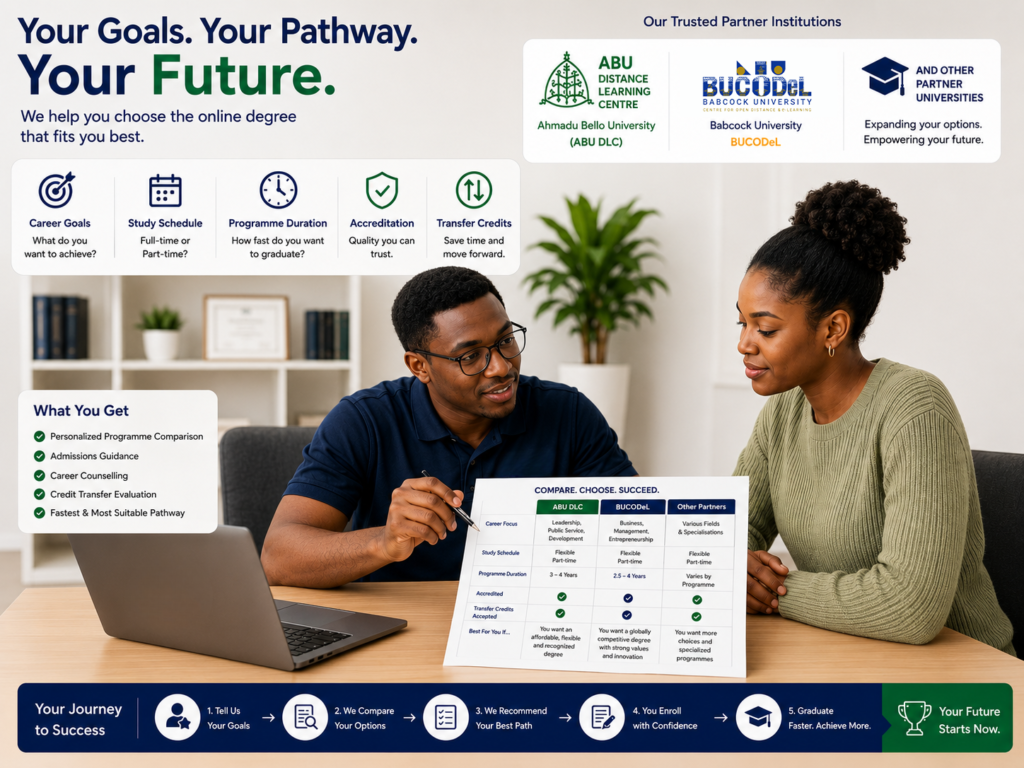
Before enrolling in any online university programme, work through a few practical checks.
- Career goals. Confirm the qualification is actually required or valued in your target field, rather than assuming any credential will do.
- Available study time. Be honest about your realistic weekly hours, since overestimating capacity is the single most common cause of delay.
- Accreditation. Verify the institution’s standing with the National Universities Commission before applying, since unaccredited credentials carry no professional weight regardless of how quickly you earn them.
- University reputation. Resources like QS Top Universities can help you compare institutional standing when weighing international options.
- Support services. Strong learner support, from academic advisors to responsive administrative staff, reduces the friction that often causes delays.
- Programme flexibility. Ask directly how the institution handles part-time pacing, credit transfer, and prior learning recognition before you commit.
Institutions such as the Ahmadu Bello University Distance Learning Centre and Babcock University’s BUCODeL offer accredited, flexible online degree programmes with defined structures rather than open-ended timelines. EduTech Business works with partners like these to help students map out a realistic completion date before enrolment, not after, so nobody is left guessing how long it takes to get a degree online at their chosen institution once they have already paid their first semester’s fees.
Common Mistakes That Delay Graduation
Even well-chosen programmes can run long when a few avoidable habits creep in.
- Taking too few courses per term, often to ease the workload, without accounting for how much this stretches the overall timeline.
- Missing deadlines for assignment submission or exam registration, which can push entire modules into the next term.
- Poor time management, particularly underestimating how much weekly time a course genuinely requires.
- Choosing the wrong programme for your actual schedule, then discovering the pacing does not fit once enrolled.
- Ignoring credit transfer opportunities that could have shortened the path, simply because nobody asked the admissions office directly.
Most of these are avoidable with a short conversation before enrolment rather than a costly correction halfway through. A five-minute call with an admissions advisor about pacing, transfer credit, and term structure can save months, sometimes years, of unplanned delay.
Planning Your Timeline
So, how long does it take to get a degree online? For a bachelor’s, expect three to four years depending on entry qualifications; for a master’s or MBA, expect one to two years full-time or considerably longer part-time. The exact number depends less on the word “online” and more on your chosen programme’s structure, your study pace, and how well you plan around genuine accelerators like credit transfer and continuous enrolment.
Ready to earn your degree on a schedule that works for you? Talk to an EduTech Business advisor to compare accredited online degree programmes, understand expected completion timelines, and choose the fastest pathway that matches your academic background and career ambitions. Get in touch or browse our partner institutions.
Read More: How Employers View Online Degrees in 2026
Frequently Asked Questions
How long does an online bachelor’s degree take? Typically three to four years, depending on whether you enter at year one or qualify for direct entry with prior credentials.
Can I study while working? Yes. Most online degree programmes are specifically structured around part-time and flexible pacing to accommodate working students.
Can transferred credits reduce study time? Often, yes, where an institution’s transfer policy accepts prior coursework from an accredited university. Always confirm this directly with admissions before enrolling.
Are accelerated online degrees recognised? Yes, provided the awarding institution and programme are properly accredited. Speed of completion does not affect a degree’s recognition; accreditation does.
Is an online degree faster than a traditional degree? Not automatically. Core academic requirements are usually similar in length, but online formats often give you more control over pace, which can shorten or lengthen your personal timeline depending on how you use that flexibility.