
More Degrees. More Certificates. Same Salary.
You did everything people told you to do. You studied hard, earned the degree, completed the certifications, attended the workshops, and perhaps even went back for a postgraduate qualification when the first one did not produce the results you expected. Yet somehow, years later, your career feels exactly where it was. The salary has barely moved. The job title still reads the same. And every time you apply for a role that should, by all reasonable measures, belong to someone with your credentials, you are either told you are overqualified or quietly passed over for a candidate with fewer letters after their name but a more compelling portfolio. If this sounds familiar, you are living the overqualified but underpaid career paradox, and it is more common than most professionals are willing to admit.
Here is what makes this situation particularly frustrating: the advice that put you here felt completely rational. More qualifications should mean more opportunities. More learning should translate into more earning. That has been the foundational promise of formal education for generations. But something has shifted in how employers evaluate talent, how careers actually progress, and what “being qualified” genuinely means in the modern labour market. The question worth asking now is not how to earn another certificate. It is why so many deeply educated professionals remain stuck, and what it actually takes to move forward.
Read More: Why Your Degree Doesn’t Matter as Much as Your Skills (And How to Get Both)
The Qualification Trap Nobody Talks About

The traditional belief is straightforward: the more you learn, the more you earn. And to a point, it is true. A degree still opens doors that remain firmly shut without one. But somewhere between acquiring useful knowledge and compulsively collecting credentials, many professionals cross an invisible line. They enter what might be called the qualification trap, a cycle where studying becomes a substitute for acting, and learning becomes a way of postponing the discomfort of visibility, rejection, or risk.
It is worth being honest about why this happens. Enrolling in another course feels productive. It generates momentum without generating exposure. There is no risk of failure in a classroom the same way there is in pitching to a client, launching a project, or applying for a stretch role. So professionals keep studying, keep accumulating, and keep waiting until they feel “ready enough.” The problem is that readiness built entirely on credentials is a feeling, not a fact.
This is not an argument against education. It is an argument against learning without a strategy. The overqualified but underpaid career trap is rarely caused by too much knowledge. It is caused by knowledge that was never connected to a specific goal, never applied in a measurable context, and never converted into visible, demonstrable output. Learning without application is like building a library in a house nobody visits.
Why Employers Rarely Pay for Qualifications Alone
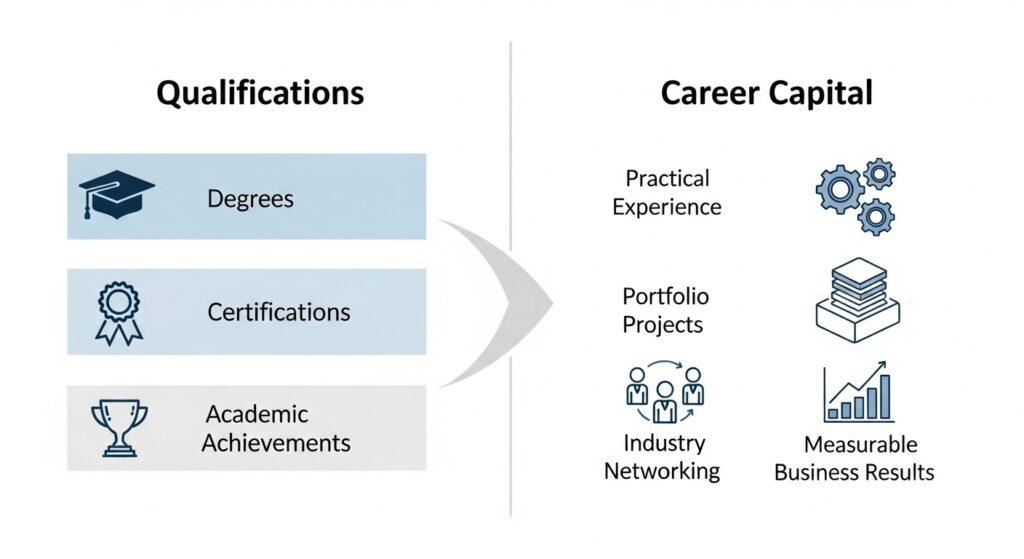
To understand the paradox at the centre of the overqualified but underpaid career experience, it helps to understand how employers actually make compensation decisions. Salaries are not paid for what you know in the abstract. They are paid for what you can deliver in a specific context. That distinction matters enormously.
According to a 2025 OECD report on skills-first hiring, employers across OECD countries are increasingly shifting their hiring criteria away from formal qualifications toward demonstrated skills and practical competence. Meanwhile, the World Economic Forum’s Future of Jobs Report 2025 found that 63% of employers globally now identify skills gaps, rather than a lack of formal qualifications, as the primary barrier to business transformation. Employers are not looking for the most credentialed candidate. They are looking for the candidate who can solve the most pressing problem.
The five qualities employers consistently value above raw credentials are:
- Problem-solving ability: Can you identify what is broken and fix it?
- Relevant experience: Can you apply what you know to real situations?
- Communication skills: Can you work across teams, manage up, and influence decisions?
- Adaptability: Can you learn quickly when circumstances change?
- Business impact: Can you contribute to growth, efficiency, or revenue?
A marketing professional who can show a 40% increase in lead generation from a campaign they ran will consistently outperform one with two marketing diplomas and no portfolio. A data analyst with a dashboard that their employer actually uses day-to-day will move faster than one who has completed three analytics certifications but has no live project to reference. Qualifications are proof of learning. Results are proof of capability. Employers buy the latter.
The Difference Between Learning and Career Capital
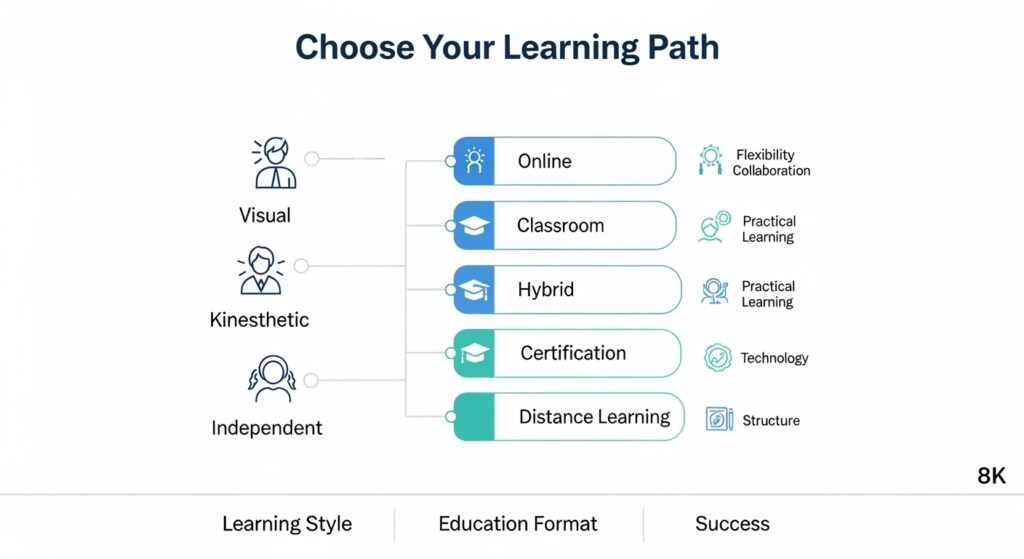
There is a useful distinction that most CVs never capture: the difference between a qualification and career capital. A qualification tells an employer what you studied. Career capital tells them what you can do, what you have done, and how reliably you deliver outcomes.
Career capital is built from five components:
- Skills: Specific, applicable abilities that solve real problems.
- Experience: A track record of using those skills in genuine contexts.
- Network: Relationships with people who can vouch for your work and open doors.
- Reputation: The professional perception others carry of your reliability and output.
- Portfolio evidence: Tangible proof of results, visible and verifiable.
The uncomfortable truth is that many professionals in an overqualified but underpaid career situation have accumulated considerable qualifications but built very little career capital. Their knowledge is real, but it is private. It has never been translated into something an employer can point to and say: “This person delivered that.” Closing that gap is where career progress actually lives.
The 4 Types of Overqualified Professionals
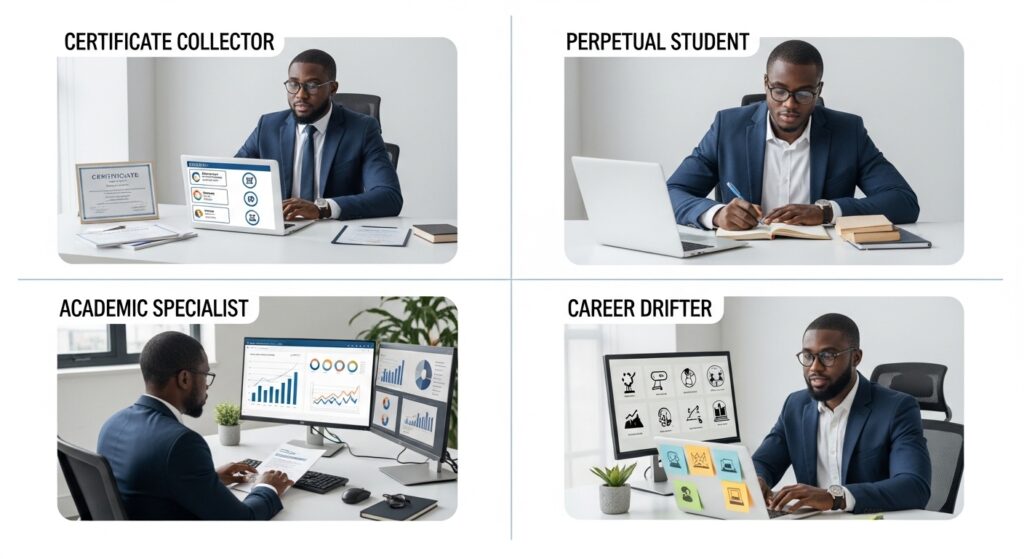
Understanding which type of overqualified professional you resemble is a useful first step toward changing course. Four patterns come up repeatedly.
The Certificate Collector is always enrolled in something. The LinkedIn profile is full of completion badges. The CV runs to three pages. But when asked about a recent project or demonstrable outcome, the answer is thin. The accumulation feels like progress, but it is circular.
The Perpetual Student is permanently preparing. There is always one more course to finish before launching the business, applying for the promotion, or pursuing the client. Preparation has become its own destination rather than a runway to somewhere specific.
The Academic Specialist has deep, genuine expertise in a narrow area, but that expertise exists largely within academic or theoretical contexts. The knowledge is real and impressive. The commercial visibility is close to zero. Employers who would genuinely benefit from this person’s skills simply cannot see them.
The Career Drifter has collected qualifications across multiple unrelated fields without a clear direction, threading them together. A business degree here, a digital marketing certificate there, a project management qualification somewhere else. None of it is wasted, but none of it tells a coherent professional story.
Which one sounds most like you? The honest answer shapes the strategy that follows.
What Actually Moves Careers Forward in 2026
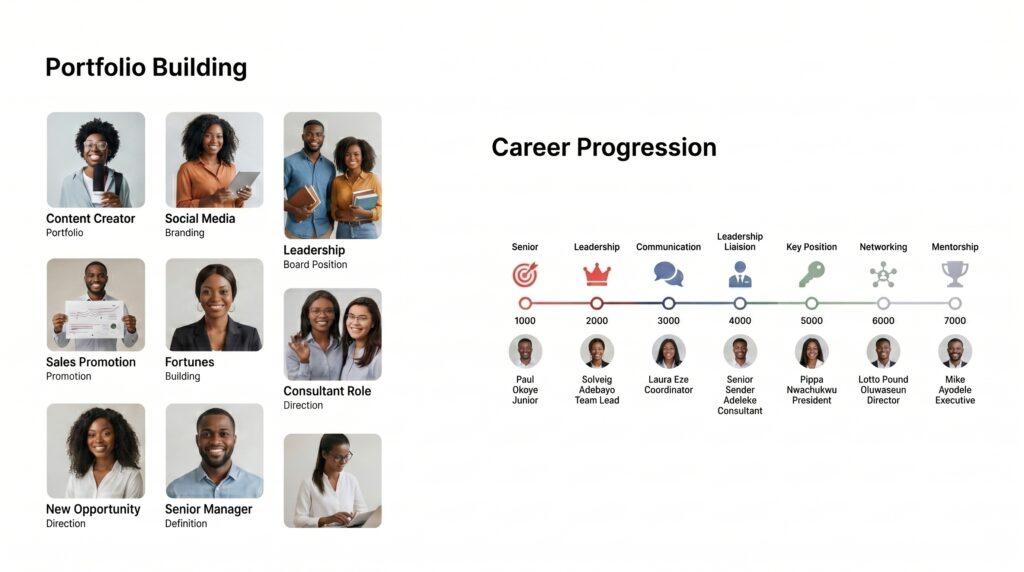
According to the WEF Future of Jobs Report 2025, approximately 39% of workers’ core skill sets will be transformed or become obsolete by 2030. That is a significant shift over a short period. The professionals who will navigate it most successfully are not those with the most certificates. They are those who combine a strong educational foundation with the right skills, practical application, and deliberate professional visibility.
The combination that consistently drives career progression looks like this:
- A relevant degree: Provides conceptual depth, analytical grounding, and institutional credibility.
- A marketable skill: Areas like data analytics, digital marketing, artificial intelligence, cybersecurity, and project management are in high and sustained demand.
- Practical experience: Projects, internships, freelance work, or any context where skills have been applied to real problems for real stakeholders.
- Professional visibility: A considered LinkedIn presence, a portfolio, published work, or active participation in industry communities.
It is the combination that creates traction. Each element on its own is incomplete. Together, they produce the kind of career capital that employers recognise, remember, and reward.
The New Qualification Strategy: Learn With a Purpose
The antidote to the overqualified but underpaid career cycle is not fewer qualifications. It is more intentional ones. Every programme, course, or certification you pursue should be solving a specific, identifiable career problem. Here is a practical five-step framework:
Step 1: Identify your target role. Be specific. Not “a management position” but “Head of Digital Marketing at a mid-sized financial services company.” Clarity at this stage makes every subsequent decision sharper.
Step 2: Find the skill gap. Research the role. Look at ten job descriptions. What shows up repeatedly that your current CV cannot yet demonstrate? That is the gap.
Step 3: Choose an education that closes it. Not the most prestigious programme available, and not the cheapest. The one most directly aligned to that specific gap.
Step 4: Apply the skill immediately. Do not wait to finish the course. Use what you are learning on a live project, a volunteer brief, a freelance piece of work, or a well-documented personal initiative.
Step 5: Build proof of competence. Document the outcome. Write about it. Add it to your portfolio. Make it visible.
Every qualification should have a clear answer to the question: what career outcome does this create? If the answer is vague, that is a signal to reconsider before enrolling.
Real Examples of Strategic Learning Paths
The right combination will always outperform the largest collection of credentials. Here are four pairings that consistently open doors in competitive job markets:
- Business Administration degree + Digital Marketing certification: Ideal for marketing leadership roles that require both strategic thinking and channel-level execution.
- MBA + Data Analytics: Highly effective for management roles where business intelligence and data-driven decision-making are now baseline expectations.
- Computer Science degree + Cybersecurity certification: One of the highest-demand combinations in the technology sector, with a significant shortage of qualified candidates globally.
- Education degree + Learning Technology certification: Opens substantial opportunities in digital education design, EdTech platforms, and institutional learning and development.
In each case, the degree provides the foundation, and the certification sharpens a commercially visible edge. The result is a profile that is both credible and immediately useful to an employer.
How EduTech Business Helps Professionals Break the Cycle
The overqualified but underpaid career experience is not a permanent condition. But escaping it requires a different kind of thinking about education: less accumulation, more strategy. EduTech Business works with professionals to do exactly that, helping individuals identify which qualifications will genuinely advance their career trajectory and which ones are likely to extend the cycle.
Through partnerships with institutions including ABU Distance Learning Centre, Babcock University’s postgraduate pathways, Ingryd Academy, and I-Con Business School, EduTech Business connects professionals with programmes that are flexible, accredited, and designed around real career outcomes rather than academic completeness alone.
The advisory process goes beyond admissions. It starts with a conversation about where you are, where you want to be, and what is genuinely standing between the two. From there, it maps specific educational pathways that close the gap without adding unnecessary weight to an already strong CV.
Stop collecting qualifications that do not move your career forward. Speak with an EduTech Business advisor and discover strategic degree and certification pathways designed to create real career growth, genuine employability, and the income opportunities your effort has always deserved.
Frequently Asked Questions
Can you be overqualified for a job? Yes. Employers sometimes hesitate to hire candidates with qualifications significantly beyond the role’s requirements, fearing they will leave quickly or expect compensation the role cannot offer. However, the more common problem is not being rejected for over-qualification but being stuck because qualifications have not been converted into visible, demonstrable career capital.
Why am I underpaid despite having multiple qualifications? Employers pay for outcomes and demonstrated capability, not credentials alone. If your qualifications have not been applied in ways that produced measurable results, they may not translate into higher compensation. The OECD’s 2025 skills-first hiring research confirms that employers are increasingly focused on what candidates can do rather than what they have studied.
Do employers care more about skills or degrees? Both matter, but context determines which matters more. Research from Workable shows that in 2024, 45% of companies were eliminating degree requirements for some roles, prioritising practical skills instead. A degree provides credibility and foundational knowledge; demonstrable skills provide the proof of application that closes the hire.
How do I know which qualification will help my career? Work backwards from the role you want. Study ten job descriptions for that role, identify the recurring skill requirements you cannot yet evidence, and choose a programme that closes that specific gap. Every qualification should have a clear career outcome attached to it before you enrol.
What is the difference between qualifications and experience? A qualification is evidence that you studied and completed a programme. Experience is evidence that you applied knowledge in a real context and produced results. Career advancement requires both, but experience is frequently the harder evidence for employers to substitute.
How can professionals avoid career stagnation? By combining targeted education with immediate application, building a visible portfolio of outcomes, and developing professional visibility through networks, platforms, and industry participation. The World Economic Forum consistently identifies continuous, strategically directed learning as the primary differentiator between professionals who advance and those who plateau.



One Response
This is very enlightening.