“How do I get the qualification I need without losing the ground I’ve already built?” This is a question many Nigerian professionals ask as they think about postgraduate education. The MBA, once reserved for those willing to pause careers, relocate to a university city, and commit to two years of full-time study, no longer works that way for most people.
MBA programs in Nigeria, online, part-time, and executive formats have each matured significantly over the past five years. Post-COVID learning behaviour shifted permanently: Nigeria’s Federal Ministry of Education reported a 200% increase in digital learning platform usage between 2020 and 2023, and professionals who were forced online discovered they could balance study and work far more effectively than they assumed. And employer attitudes have followed suit. Accreditation and practical capability now matter more than delivery method. The question is no longer whether to pursue an MBA. It’s which structure actually fits your life, your career stage, and what you want on the other side of it.
Read More: Is an Online MBA Worth It in Nigeria?
The 3 MBA Routes Available in Nigeria: What They Actually Mean
Before comparing, it’s worth being precise about what each format involves.
- Online MBA Programs
A fully remote MBA, like the BUCODEL programme offered by Babcock University, allows you to complete your degree entirely via a Learning Management System (LMS), with live sessions typically scheduled at weekends or evenings. There are no campus relocations, no daily commuting, and significantly lower indirect costs. For professionals spread across Nigeria’s states, this removes a barrier that previously made the MBA inaccessible outside Lagos and Abuja.
What it demands in return is self-discipline. Without a physical classroom creating structure, the pace of your progress depends largely on your own consistency. Assignment submissions, peer discussions, and live virtual sessions require active engagement. Accreditation is also non-negotiable: the National Universities Commission (NUC) is the statutory body that accredits Nigerian universities and their programmes. Any online MBA you consider should be NUC-recognised.
- Part-Time MBA
Part-time formats retain physical classes, typically scheduled for evenings during the week or full weekend blocks. This appeals to professionals who want structured classroom interaction, direct access to lecturers, and the informal networking that happens in corridors and break rooms. It sits between full-time and fully remote: you remain employed, but you show up in person.
The trade-off is real. Commuting time in cities like Lagos is a serious consideration, and the longer timeline (often 24 to 30 months) means sustained energy over a longer stretch. For professionals who thrive in in-person environments and can manage the logistics, the part-time MBA offers a strong balance between networking depth and employment continuity.
- Executive MBA (EMBA) Nigeria
The Executive MBA is structurally distinct from the other two. It’s designed specifically for senior professionals, typically those with eight or more years of experience, who are looking to deepen their strategic and leadership capabilities rather than build foundational business knowledge. Programmes are cohort-based, meaning you move through the curriculum with a fixed group of peers who are at similar career stages.
This peer dynamic is deliberate. The learning happens not only in classrooms but in discussions among managers, directors, and business owners who are actively navigating real organisational decisions. Metropolitan School of Business and Management (MSBM) offers an EMBA pathway designed with this profile in mind, with a curriculum centred on practical leadership application, strategic management, and executive mentorship. The EMBA is as much about who you study alongside as what you study.
MBA Comparison at a Glance
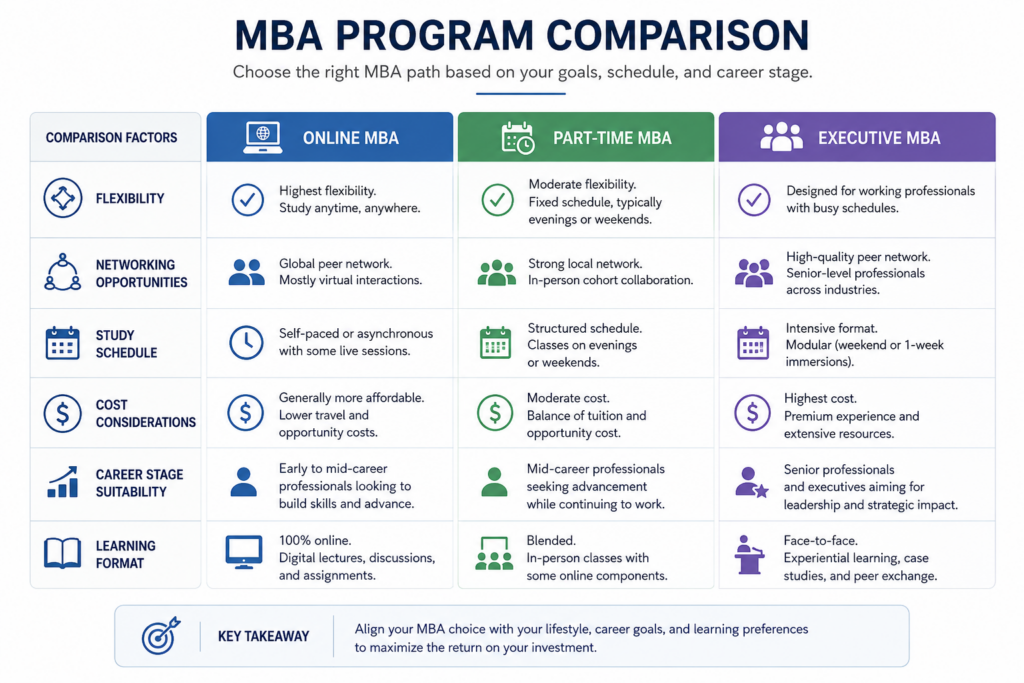
| Online MBA | Part-time MBA | Executive MBA | |
| Typical Duration | 18-24 months | 24-30 months | 12-24 months |
| Learning Format | Fully remote, LMS-based | Physical, evenings/weekends | Cohort-based, modular residencies |
| Flexibility Level | High | Moderate | Moderate (structured cohorts) |
| Cost range | Lower | Moderate | Higher |
| Networking Opportunity | Digital peer networks | Local cohort, classroom | Senior-level peer cohort |
| Ideal Candidate | Early to mid-career professional | Mid-career, prefers in-person | Senior manager, founder, executive |
| NUC Accreditation | Available (e.g., Babcock BUCODEL) | Available (various institutions) | Available (check per institution) |
There is no universally superior format. The right MBA is the one that fits your current career stage, your schedule, and the specific problem you are trying to solve.
MBA Programs Nigeria Online: The Case for Babcock BUCODEL

Babcock University’s Centre for Distance and e-Learning (BUCODEL) offers one of the most established online MBA pathways in Nigeria. It is NUC-accredited, fully remote, and designed with the working professional in mind. The programme uses a structured LMS for coursework, live virtual sessions, and assignment submission, with student support systems built to keep remote learners on track.
For professionals who need career advancement but cannot pause work, whether due to financial realities, family commitments, or career momentum they don’t want to interrupt, this format removes the traditional obstacle. A manager in Enugu, a supply chain professional in Kano, or a finance officer in Lagos can complete the same accredited MBA without relocating or rearranging their working week around daily lectures.
The career outcomes it supports are broad: management progression within existing organisations, transition into business leadership roles, entrepreneurship, or lateral moves into new industries. It is particularly well-suited to early and mid-career professionals building foundational and strategic business knowledge.
Executive MBA: Metropolitan School of Business and Management

Metropolitan School of Business and Management (MSBM) operates with a clear focus on business leaders: managers, founders, directors, and senior executives who want a postgraduate experience that meets their level of experience rather than treating them as beginners. The curriculum is built around strategic decision-making, leadership development, and practical business applications, drawing on case studies and discussions that reflect the complexity of real executive environments.
The cohort model at MSBM is a significant differentiator. When your classmates are other senior professionals, the learning dynamic changes entirely. Discussions become richer, more textured, and grounded in real organisational experience. The networking value is correspondingly higher: you are building relationships with people who are already operating at senior levels across industries, which matters considerably for business development, career transitions, and strategic partnerships.
For executives and business owners who want more than a credential, but a genuine leadership development experience with high-level peers, the MSBM pathway is worth serious consideration.
Read More: Can You Work and Study Online at the Same Time?
How to Choose Based on Where You Are in Your Career
The most useful framing is not “which MBA is best” but “what problem am I trying to solve?”
Early-career professionals (0–5 years of experience) Best fit: Online MBA or part-time MBA. The priority here is building foundational business knowledge affordably and flexibly, without sacrificing early-career momentum. MBA programs in Nigeria online are particularly practical at this stage.
Mid-level managers (5–10 years of experience) Best fit: Part-time MBA or executive-track online programmes. The focus shifts to promotion readiness, managing upward, and building managerial confidence. An accredited programme with strong peer cohorts — whether online or in-person — will serve this stage well.
Senior executives and business owners (10+ years of experience) Best fit: Executive MBA. At this level, the return on investment comes primarily from strategic leadership development and high-calibre peer networking, not from foundational coursework.
A practical decision filter:
- Salary growth or promotion? Online or part-time MBA with strong accreditation.
- Leadership transition or C-suite readiness? Executive MBA.
- Career Switch or industry pivot? Online MBA with flexible elective structure.
- Business expansion or entrepreneurship? Executive MBA with practical business application focus.
What Employers in Nigeria Actually Think About MBA Format

The old concern that online degrees carried less weight has largely faded, particularly among employers in tech, consulting, finance, and business operations. Programme quality, accreditation, and outcomes matter far more than delivery mode.
Flexibility is a growing priority globally, with major business schools launching hybrid and online EMBA formats. This mirrors what is happening locally: Nigerian employers in growth-oriented industries increasingly evaluate what a candidate can apply, not simply where they studied.
Accreditation, however, remains the baseline. A degree that is not NUC-recognised carries real risks for its holder. Before enrolling in any programme, verify its status directly with the NUC. This is especially important for MBA programs Nigeria online, where the market has seen growth in both legitimate and non-accredited options.
The World Economic Forum’s Future of Jobs Report 2025 projects strong demand for business leaders and data-literate managers across African economies. Professionals who combine practical experience with credible postgraduate qualifications will be better positioned for the roles being created.
How EduTech Business Can Help You Decide
Choosing the right MBA is a significant decision, and navigating the options alone, with accreditation requirements, institutional reputations, and programme structures all in play, takes time most professionals do not have. EduTech Business exists to close that gap.
As a trusted postgraduate advisory partner for working professionals in Nigeria, EduTech Business helps you compare MBA formats, understand admission requirements, evaluate career alignment, and access programmes through partner institutions, including Babcock University and MSBM.
Frequently Asked Questions
Can I study MBA online in Nigeria?
Yes. NUC-accredited online MBA programmes are available in Nigeria. Babcock University’s BUCODEL programme is among the most established. Always confirm accreditation status before enrolling.
Is an online MBA recognised by employers?
Increasingly, yes. Accreditation and programme quality matter more than delivery format. Employers in tech, consulting, finance, and business operations are particularly receptive.
What is the difference between an Executive MBA and a part-time MBA?
A part-time MBA is designed for working professionals of any experience level and follows a traditional academic structure. An Executive MBA is specifically designed for senior professionals, with a leadership-focused curriculum, cohort-based learning, and a stronger emphasis on peer networking.
Which MBA is best for working professionals in Nigeria?
It depends on your career stage. Online and part-time MBAs suit early to mid-career professionals. The Executive MBA suits senior managers, founders, and executives.
How long does an MBA take in Nigeria?
Typically 18 to 30 months, depending on the format. Some executive programmes run on accelerated 12 to 18-month timelines.
Can I do an MBA without a business degree?
Yes. Most MBA programmes accept applicants from any undergraduate discipline, particularly candidates with relevant professional experience.
Explore MBA programs built for modern professionals with EduTech Business. Compare Babcock University and MSBM MBA pathways and book a free MBA advisory session today.