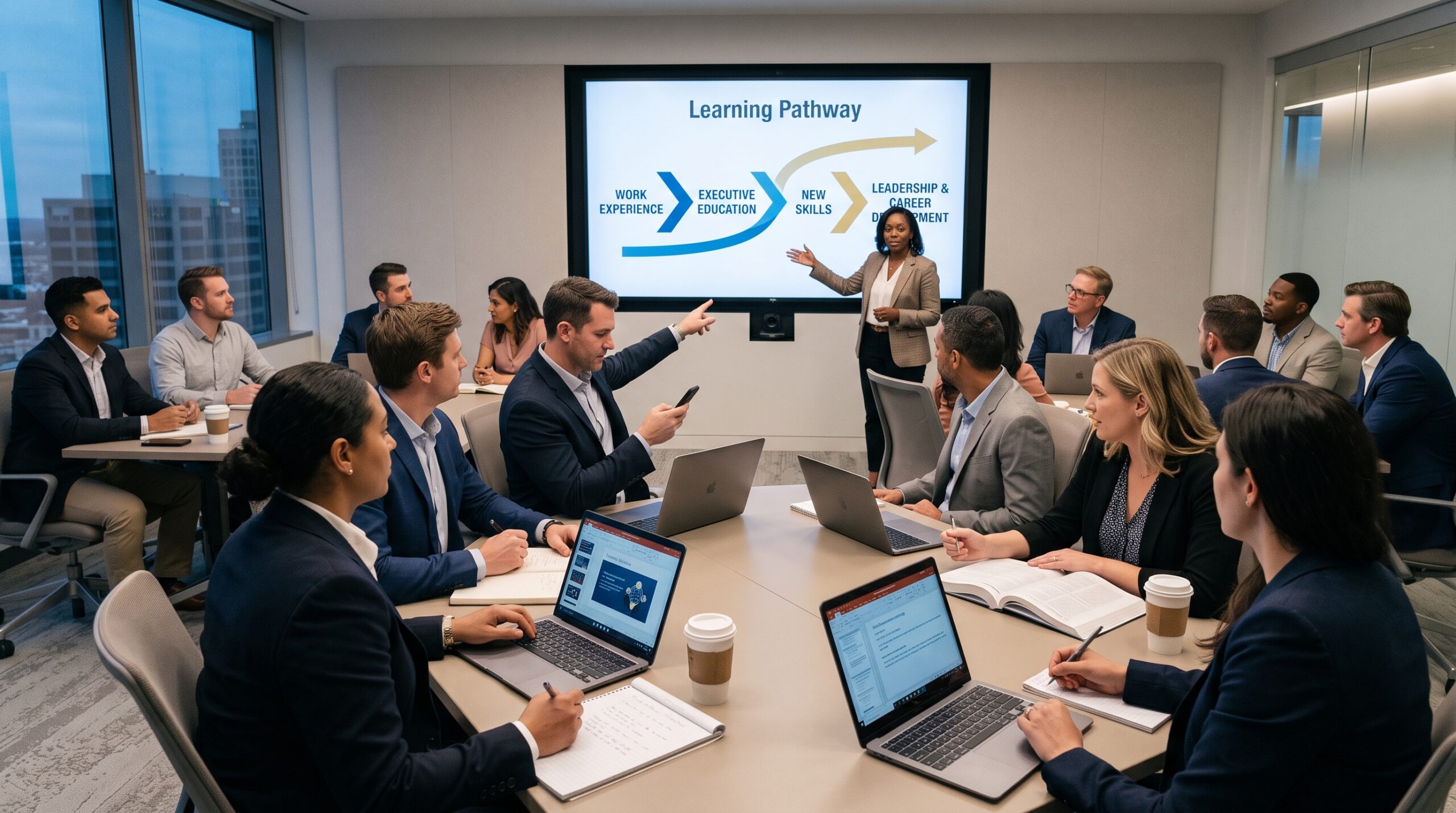
Your brain is either growing or shrinking. There is no neutral state.
That is not a motivational slogan. It is neuroscience. Every day, based on what you expose your mind to and what you withhold from it, your brain is either forging new connections or allowing old ones to weaken. The benefits of continuous learning for the brain are not abstract or theoretical; they are biological, documented, and measurable. When did you last learn something genuinely new? Not scroll past an interesting headline, but actively engage with something that stretched you? If you are struggling to recall the moment, this article is for you.
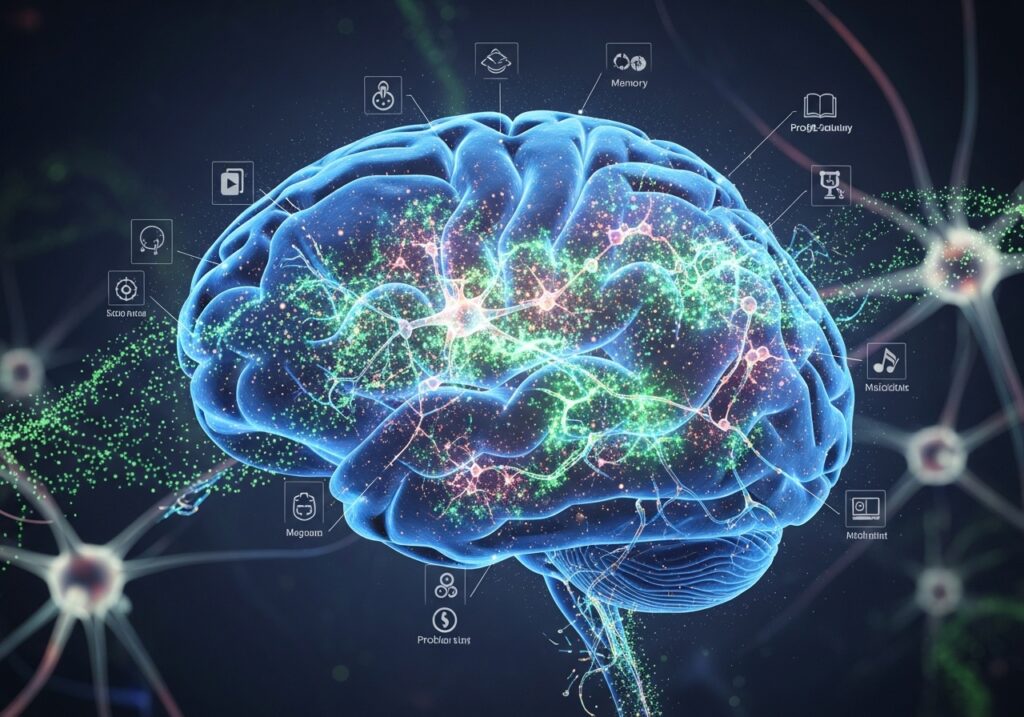
The human brain contains roughly 86 billion neurons, and every skill, concept, or piece of knowledge you acquire prompts those neurons to build new pathways. This capacity, known as neuroplasticity, is what makes the brain fundamentally different from every other organ. A liver does not reorganise itself in response to what you expose it to. A brain does. Critically, research confirms this plasticity persists across the entire lifespan. The question is simply whether you are using it.
What Neuroscience Actually Says About the Benefits of Continuous Learning for the Brain
For most of the 20th century, scientists believed the adult brain was essentially fixed. Decades of research have since dismantled that view entirely.
Harvard Health describes it plainly: just as physical exercise strengthens muscles, mental challenges keep the brain sharp by promoting neuroplasticity and building cognitive reserve, the brain’s capacity to maintain function despite ageing or disease. That reserve builds over time through education, demanding work, and sustained intellectual engagement.
The analogy to physical fitness is not just accessible; it is structurally accurate. When you learn something genuinely new, your brain strengthens synaptic connections, increases neural efficiency, and in some cases generates new neurons in regions critical to memory. UCL research on motor learning and neuroplasticity confirms that experience, through learning and memory, remains the primary driver of structural change in the adult brain throughout life. Every time you learn, you are laying fresh cable in an ageing building. The infrastructure becomes stronger and better able to handle increased load.
What Happens When Learning Stops
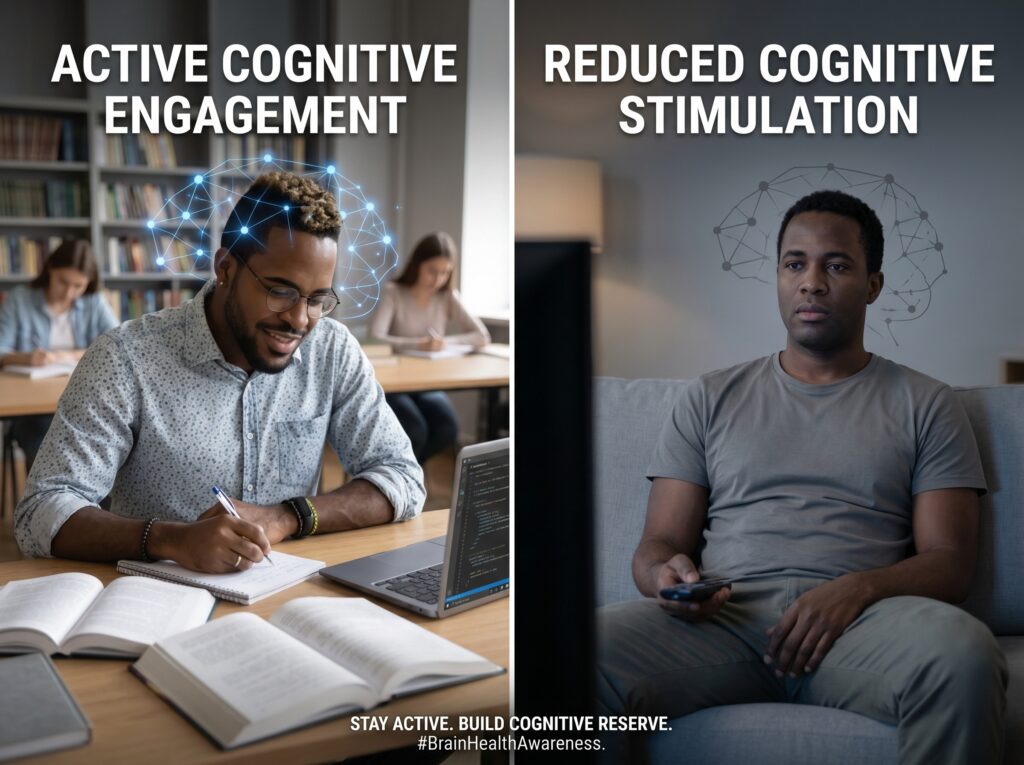
The science here is sobering. When cognitive engagement falls away, the brain does not pause; it begins to atrophy. Unused pathways weaken, processing slows, and the capacity to form and retrieve memories diminishes. The 2020 Lancet Commission on Dementia Prevention, one of the most comprehensive research reviews of its kind, identified low educational engagement as a primary modifiable risk factor for dementia, with the 2024 update strengthening that conclusion further. Less education directly reduces cognitive reserve, the brain’s critical buffer.
The documented consequences of cognitive stagnation include:
- Slower information processing
- Weakened working memory and recall
- Reduced problem-solving capacity
- Lower mental resilience under pressure
- Heightened vulnerability to age-related decline
This is not an argument about intelligence. It is an argument about use. An unused muscle does not stay the same. It weakens. The brain operates by the same principle.
The Emotional Cost Nobody Talks About
Beyond neuroscience, there is a quieter cost to stopping learning, one that surfaces in daily life rather than in brain scans.
Sustained disengagement from intellectual challenge tends to produce a gradual dulling of curiosity, a narrowing of confidence, and a growing sense of irrelevance in environments that are changing faster than ever. The World Economic Forum has consistently highlighted that the half-life of professional skills is shortening rapidly. Workers who are not actively learning are, by default, falling behind.
Research on learning and self-efficacy shows that active learners consistently demonstrate higher psychological resilience. When you engage with new knowledge, you are not just building brain tissue; you are affirming your own agency. The inverse is equally true: sustained disengagement tends to erode self-confidence and narrow a person’s sense of what is possible. When did you last feel genuinely stimulated by something you were learning? If that feeling is distant, the cost of reclaiming it is almost certainly lower than the cost of losing it.
The Specific Benefits of Continuous Learning for the Brain

The benefits of continuous learning for the brain span cognitive, emotional, and professional dimensions. Here is what the evidence shows:
Cognitive Protection. Learning builds and sustains cognitive reserve, the brain’s primary defence against age-related decline. The Lancet Commission is unambiguous: sustained education throughout life reduces dementia risk.
Memory Strengthening. Actively engaging with new information challenges the brain’s encoding and retrieval systems. Passive consumption, scrolling, and skimming do not produce the same effect.
Problem-Solving Enhancement. Exposure to new domains improves lateral thinking. People who learn across disciplines develop stronger capacities to connect disparate ideas and generate creative solutions.
Emotional Regulation. Engaged learners show greater psychological resilience under stress. Mastering something new has a measurable positive effect on mood and mental stability.
Professional Longevity. Continuous learners remain relevant and adaptable longer. In today’s rapidly evolving markets, this is not a soft benefit. It is a career imperative.
It Is Not About Going Back to School. It Is About Staying Engaged.
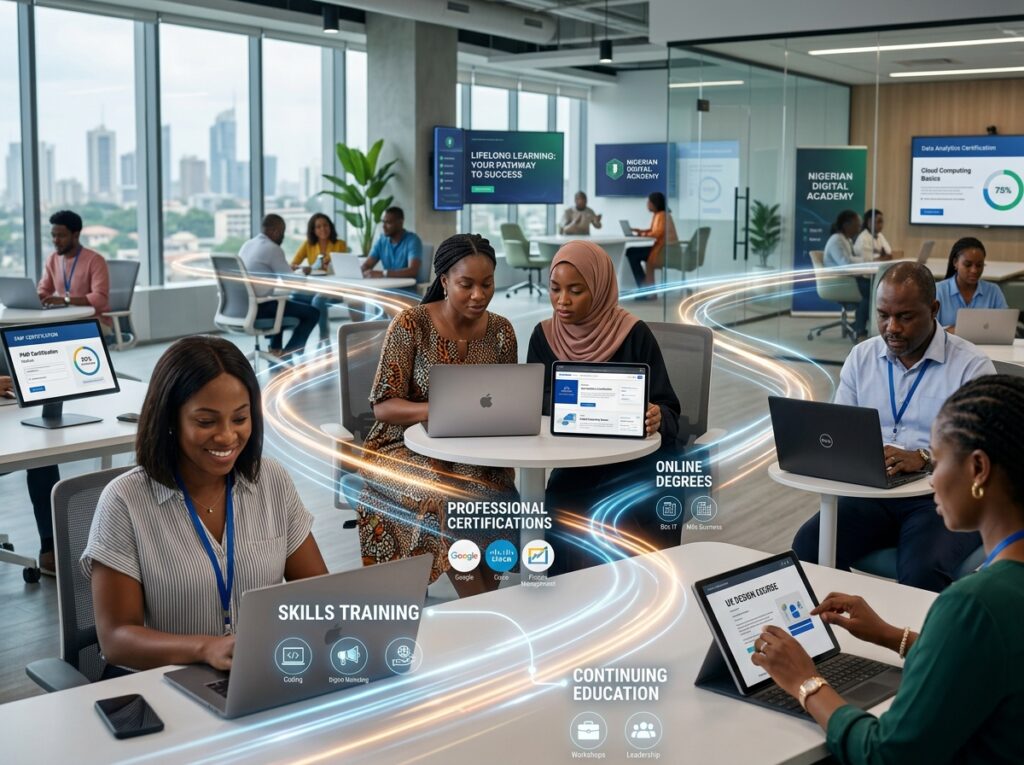
One of the most persistent misconceptions about continuous learning is that it requires a classroom. It does not. What the research demonstrates is that neurological benefit comes from sustained cognitive engagement, from regularly exposing your brain to material that requires genuine effort to process. The format is secondary.
What qualifies as meaningful learning:
- Online short courses and professional certifications
- Skill-based programmes in your field or adjacent ones
- Flexible degree programmes studied at your own pace
- Structured reading around a challenging subject
- Mentored learning within a professional context
The benefits of continuous learning for the brain accumulate through small, consistent intellectual challenges over time. Neuroplasticity responds to regularity as much as intensity. You do not need to transform your schedule overnight. You need to begin, and then continue.
Read More: Why Your Degree Doesn’t Matter as Much as Your Skills (And How to Get Both)
At What Age Does Continuous Learning Still Make a Difference?
Every age. Research into adult neuroplasticity confirms the brain retains structural adaptability throughout the entire lifespan:
In your 20s and 30s, you are at peak neurological capacity. Learning now builds the reserve you will draw on for decades. Every qualification and skill compounds.
In your 40s and 50s, learning maintains the sharpness and professional adaptability that keep you competitive. Slowing during this stage is not inevitable; it is accelerated by disengagement.
At 60 and beyond, the WHO projects the global population aged 60 and over will reach 2.1 billion by 2050. Evidence is consistent: cognitive engagement at this stage meaningfully delays decline and improves quality of life.
There is no age at which the brain stops responding positively to learning. That is not optimism. It is neuroscience.
How EduTech Business Helps You Stay in Learning Mode
Understanding the science matters. Acting on it requires access, and access requires removing real barriers: time, cost, unclear pathways, and uncertainty about where to begin. EduTech Business is built to remove those barriers, connecting learners at every stage of life to flexible, accredited education that fits around existing commitments.
Available pathways include:
- ABU Distance Learning Centre: Flexible online degrees without sacrificing professional or family commitments
- Babcock University Distance Learning: Accredited programmes accessible fully remotely
- Ingryd Academy: Skills-focused certifications in high-demand technical areas for career transitions
- I-Con Universal Polytechnic: Professional and vocational programmes that meet learners where they are
The question is not whether you can afford to learn. Given what is at stake neurologically, professionally, and personally, the more honest question is whether you can afford not to. Speak to an advisor at EduTech Business and find the format that fits your life.
Frequently Asked Questions
What are the benefits of continuous learning for the brain? Continuous learning builds cognitive reserve, strengthens memory, improves problem-solving, supports emotional regulation, and reduces the risk of age-related cognitive decline and dementia. The effects are cumulative.
Does stopping learning cause cognitive decline? Sustained cognitive disengagement accelerates decline over time. Unused neural pathways weaken, processing slows, and the brain’s reserve buffer diminishes. It is a gradual process, which makes it easy to overlook until it is already well under way.
Can learning new things prevent dementia? Research from the Lancet Commission positions sustained cognitive engagement as one of the most significant modifiable factors in reducing dementia risk. No single activity offers a guarantee, but the evidence for learning as a protective factor is robust.
Is it too late to start learning again as an adult? No. Neuroplasticity persists throughout adulthood. Starting later is always better than not starting at all.
What counts as continuous learning for brain health? Any mentally demanding activity that requires active engagement: formal courses, certifications, structured reading, new skill practice, mentored learning, or flexible degree programmes. Genuine cognitive effort is the key variable, not format.
How much learning is needed to see cognitive benefits? Consistency matters more than volume. Regular, moderate intellectual engagement over time produces compounding neurological benefits. Small and sustained outperforms intense but intermittent.
Keep Giving Your Brain Challenges
Your brain responds to every learning challenge you give it. The science is unambiguous.
Explore flexible degree programmes, professional certifications, and online learning pathways with EduTech Business. Speak to an advisor and discover the education format that fits your life, your goals, and your schedule. The right time to start was years ago. The next best time is now.