There was a time when advancing into management meant one of two things: resigning to study full time, or putting your ambitions on hold for years while waiting for the right opportunity. That trade-off no longer holds. A growing number of Nigerian professionals are enrolling in an online MBA in Nigeria precisely because it removes the choice between career and classroom altogether, letting them build the credential employers look for while still showing up to work every Monday morning. It’s this shift that has made an MBA for working professionals a genuinely practical option rather than a distant ambition.
Is it actually worth it, though? For most working professionals, yes, provided the programme is properly accredited and matched to their goals. An online MBA in Nigeria can open the door to promotions, better-paying roles, and entrepreneurial credibility, but only when it comes from an institution recognised by the right regulatory bodies. This guide walks through what an online MBA involves, how it compares with part-time and executive formats, which accredited providers are worth considering, and how to choose the pathway that fits your specific career stage.
Read More: Career Options After an Online MBA in Nigeria
What Is an Online MBA?
An online MBA is a Master of Business Administration delivered primarily or entirely through digital learning platforms rather than physical lecture halls. Course materials, assignments, and often examinations are hosted online, while the underlying curriculum, covering strategy, finance, marketing, operations, and leadership, mirrors what’s taught on campus. The format exists to remove geography and rigid scheduling as barriers, not to water down the qualification itself.
A common misconception is that an online MBA is somehow a lesser degree than a full-time one. In practice, when the awarding institution is properly accredited, graduates receive the exact same certificate as their campus-based counterparts, sit comparable assessments, and are taught by the same faculty. What differs is delivery, not standard. The confusion usually comes from unaccredited providers who use “online MBA” as a marketing label without any recognised university standing behind it, which is precisely why verifying accreditation matters more than comparing course brochures.
The MBA Landscape in Nigeria Has Changed
Nigeria’s postgraduate business education scene looks different today than it did a decade ago. Distance and online delivery, once viewed with scepticism, gained mainstream acceptance after the shift toward remote work and digital learning that followed the pandemic years. Employers who once assumed online meant inferior now routinely hire, and promote, graduates of NUC-approved distance learning centres, largely because verifying these credentials has become far more straightforward.
The National Universities Commission (NUC) is the regulatory body that determines which Nigerian universities may legally award degrees, including postgraduate business qualifications delivered through distance or e-learning. A distance learning MBA Nigeria applicants choose should always be checked against the NUC’s current list of accredited institutions before enrolment, since accreditation status is the single most reliable indicator of whether an online postgraduate degree will be recognised for employment or further study. This matters strategically: an accredited MBA in Nigeria, whether delivered online, part time, or through an executive format, now carries genuine standing in the job market, provided the awarding institution has actual NUC approval.
The Three MBA Routes Explained
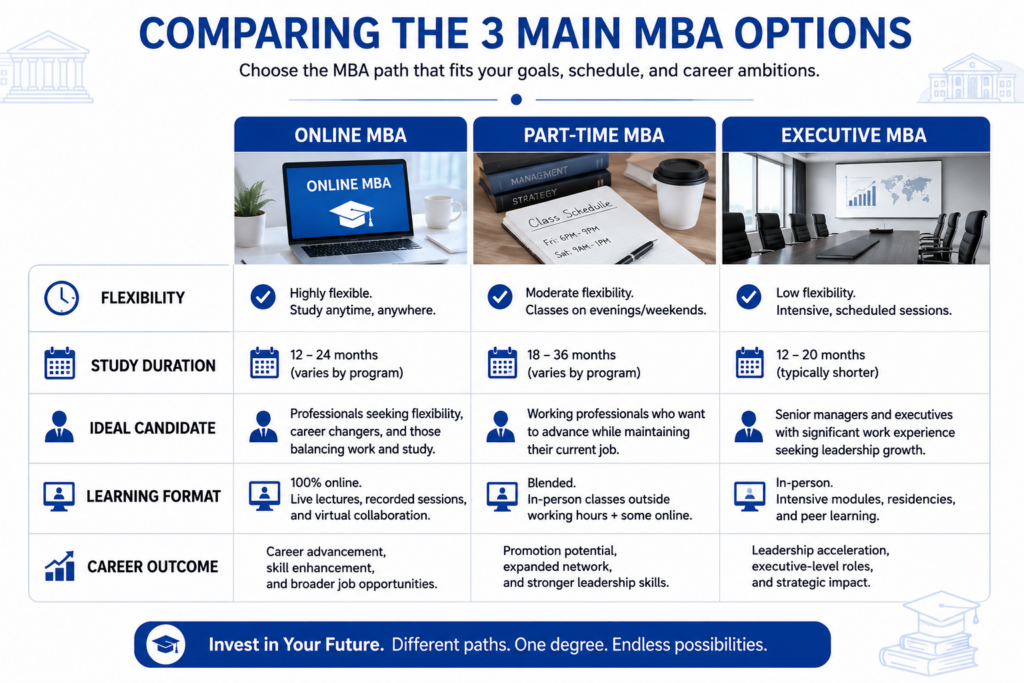
Not every MBA is structured the same way, and the right format depends heavily on your current job, income needs, and how quickly you want to finish. Understanding the differences between an online MBA, a part-time MBA Nigeria route, and an executive MBA Nigeria track before you apply saves considerable time later.
Online MBA: Delivered almost entirely through a digital learning platform, this format suits professionals who need maximum flexibility around unpredictable work schedules or who live far from a physical campus. The main benefit is convenience: you study when your calendar allows, often one course at a time. The trade-off is that it demands strong self-discipline, since there’s no fixed classroom rhythm to keep you on track. It’s best suited to self-motivated professionals who already have a clear reason for pursuing the degree.
Part-Time MBA: A part-time MBA Nigeria programme typically blends occasional in-person sessions, often on weekends, with independent study during the week. This suits professionals who want more structure and peer interaction than a fully online format offers, but who still can’t commit to full-time residential study. It tends to take slightly longer than an accelerated online track, but many candidates value the face-to-face networking it preserves.
Executive MBA: An executive MBA Nigeria programme is aimed squarely at senior managers, directors, and established business owners rather than early-career professionals. The curriculum leans heavily on leadership, negotiation, and strategic decision-making, and cohorts are usually made up of peers at a similar seniority level, which changes the quality of classroom discussion considerably. It’s the right choice for someone who already has years of management experience and wants to sharpen strategic capability rather than learn foundational business concepts from scratch.
Comparing the Three Formats
| Format | Typical Duration | Cost Range | Flexibility | Ideal Candidate | Career Outcome |
| Online MBA | 18-24 months | Lower, often paid per course | Highest | Working professionals needing full flexibility | Mid-level management, specialist roles |
| Part-Time MBA | 20-30 months | Moderate | Moderate, some fixed sessions | Professionals wanting structure and networking | Management progression, sector switching |
| Executive MBA | 12-18 months | Higher, reflects seniority focus | Lower, cohort-based scheduling | Senior managers and business owners | Director-level and leadership roles |
Costs and durations vary by institution and specialisation, so treat this as a general guide rather than a fixed quote; always confirm current fees directly with the university before applying.
Read More: Professional Certifications That Actually Pay Off: A 2026 Career Guide
Universities Worth Considering
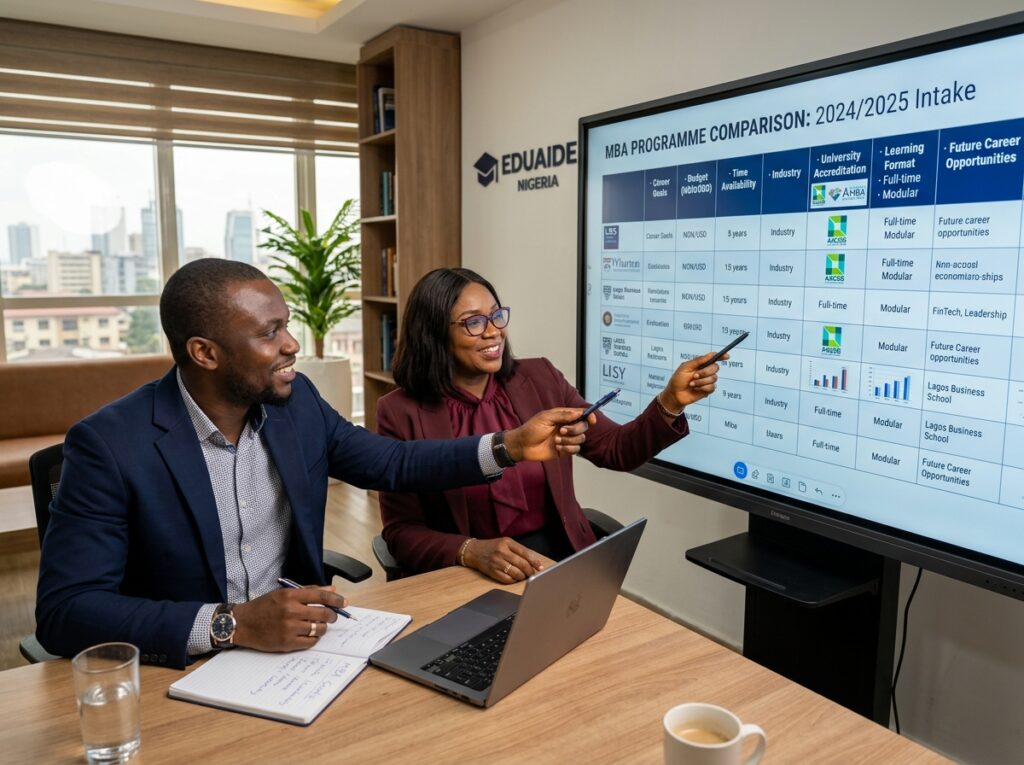
Two NUC-accredited institutions stand out for Nigerian professionals researching an online business degree Nigeria employers will recognise.
Babcock University (BUCODeL)
Delivered through the Babcock University Centre for Open Distance and e-Learning, the Babcock MBA is recognised by the NUC and additionally accredited by the Accrediting Association of Seventh-day Adventist Schools, Colleges, and Universities. Admission requires a bachelor’s degree with at least second class lower division, alongside five O’Level credits including English and Mathematics; HND holders with a lower credit and a postgraduate diploma in management may also qualify. The Babcock MBA combines faith-based values with structured online facilitation, and it’s well suited to professionals who want strong learner support alongside their qualification.
ABU Distance Learning Centre
Ahmadu Bello University’s DLC MBA is delivered entirely online and taught by the same faculty who teach the full-time and part-time equivalents, with specialisations in finance and investment, human resources, and marketing. It runs on a trimester system with a minimum of four courses per semester, letting motivated students fast-track to as little as 18 months with a business administration background, or 24 months without one. Admission requires a bachelor’s degree with at least second class lower or a 2.40 CGPA, or an HND with lower credit plus a postgraduate diploma in management, along with the standard five O’Level credits.
Both institutions illustrate what a properly accredited MBA Nigeria professionals can trust looks like in practice: recognised faculty, transparent admission requirements, and a curriculum that matches what’s taught on campus.
How to Choose the Right MBA

Rather than starting with a list of universities, it helps to start with yourself. Ask honestly:
- What career stage am I at? Early-career professionals usually benefit more from an online or part-time MBA, while established managers get more value from an executive format built around peer-level discussion.
- Which industry am I in, or moving into? Some specialisations, such as finance or marketing, align more closely with certain institutions’ strengths than others.
- What’s my realistic budget? Per-course fee structures, like ABU DLC’s, can make costs easier to spread than a single upfront tuition figure.
- How much time can I genuinely commit each week? Be honest here; overestimating available study time is one of the most common reasons candidates fall behind.
- What outcome am I actually working toward? A promotion within your current employer requires a different emphasis than a pivot into consulting or starting your own business.
Answering these questions first narrows the field considerably, and makes comparing specific programmes far less overwhelming.
Is an Online MBA Worth It?
For most working professionals, the return goes beyond a single salary figure. Global employer sentiment gives a useful signal: according to the Graduate Management Admission Council’s 2025 Corporate Recruiters Survey, roughly three in four employers worldwide planned to hire the same number or more MBA graduates in 2025 compared with the previous year, with nine in ten reporting plans to hire MBA-qualified candidates specifically. That sustained employer confidence, tracked by GMAC, reflects genuine demand for the skills an MBA builds, not just the credential.
Beyond salary and hiring trends, the value of an accredited MBA in Nigeria tends to show up in three practical ways: stronger case for promotion into management roles, credibility when raising capital or negotiating partnerships as an entrepreneur, and a peer network built during the programme that often outlasts the coursework itself. None of that materialises automatically, though; it depends on choosing an accredited institution and engaging seriously with the coursework, rather than treating the certificate as the entire point.
How EduTech Business Helps MBA Applicants
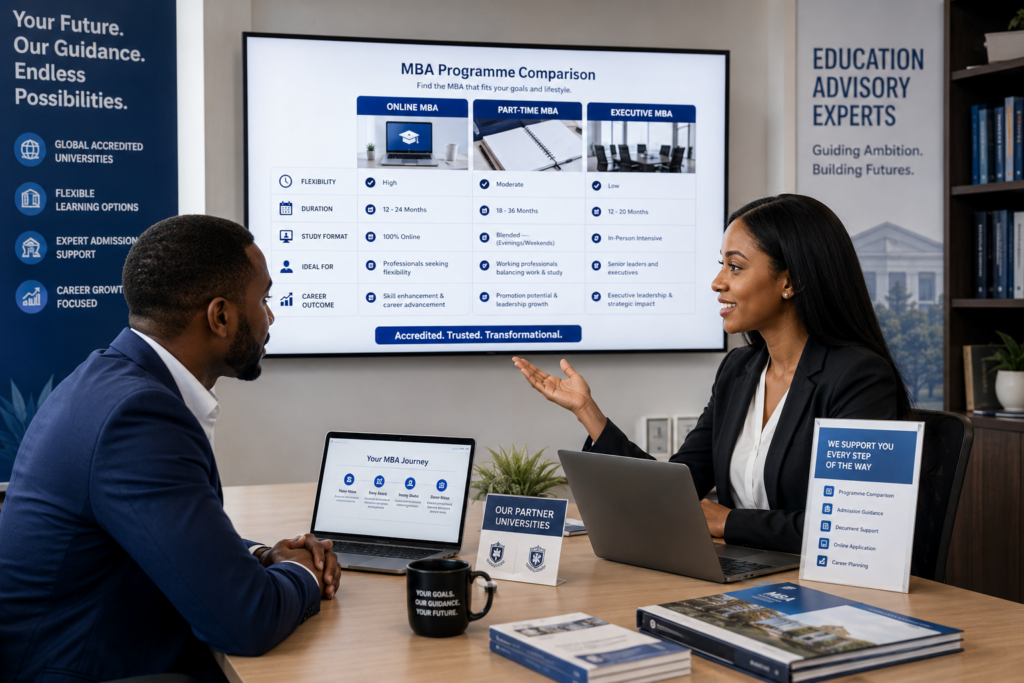
Choosing between an online MBA in Nigeria, a part-time programme, and an executive track is rarely straightforward, particularly when applicants are also trying to verify accreditation and compare admission requirements across institutions. EduTech Business works with applicants to compare programmes side by side, offer career guidance based on individual goals, and support the practical side of admission, including documentation and application tracking, with partner institutions such as Babcock University’s BUCODeL and the ABU Distance Learning Centre.
The goal isn’t to steer every applicant toward the same programme; it’s to help each professional match their career stage, budget, and time availability to the MBA format that actually fits, using accredited partners rather than unverified agents. For further reading on flexible postgraduate study options, our blog covers related pathways in more depth.
Take the next step in your career with an accredited MBA that fits your schedule. Speak with an EduTech Business advisor to compare programmes from trusted partner institutions and choose the MBA that matches your career goals.
Frequently Asked Questions
Is an online MBA recognised in Nigeria? Yes, provided the awarding university and programme are accredited by the NUC. Graduates of accredited providers such as Babcock’s BUCODeL or ABU’s Distance Learning Centre receive the same certificate as full-time students and are recognised by employers and postgraduate institutions alike.
Can I study an MBA while working? Yes. Online and part-time MBA formats are specifically designed around working schedules, with course materials, lectures, and assessments delivered flexibly so professionals can study without resigning from their jobs.
Which university offers the best online MBA? There isn’t a single “best” answer; it depends on your goals. Babcock University’s BUCODeL and ABU’s Distance Learning Centre are both NUC-accredited and well suited to working professionals, but their specialisations, fee structures, and delivery styles differ.
How long does an online MBA take? Most accredited online MBA programmes in Nigeria run between 18 and 24 months, depending on your prior academic background and how many courses you take per semester.
Is an MBA worth it in Nigeria? For most working professionals, yes, particularly when the programme is accredited and aligned with a clear career goal. Value typically shows up through promotion readiness, stronger professional networks, and improved credibility for entrepreneurship, rather than a single guaranteed salary jump.
What’s the difference between an Executive MBA and an Online MBA? An Executive MBA is built for senior managers and business owners, with a curriculum weighted toward leadership and strategy and cohorts of similarly experienced peers. An online MBA is open to a broader range of career stages and prioritises flexible, self-paced delivery over cohort seniority.