Is AI replacing jobs, or simply changing what your job looks like day to day? It is a fair question, and one that deserves a more careful answer than the headlines usually give it. The anxiety behind it is real: nobody wants to spend years building a career only to watch it become irrelevant overnight.
Here is the more grounded picture. AI is automating specific tasks within roles far more often than it is eliminating entire occupations outright, and the pace of that change varies enormously by industry, task type and how a given employer chooses to deploy the technology. Discussions of AI and employment often collapse this nuance into a single, alarming headline, when the reality is far more uneven and far more workable. This article is a practical guide for Nigerian professionals, graduates and students who want a clear-eyed view of what is actually shifting, and what to do about it, without the fear-based framing that so much AI commentary leans on.
Read More: Highest Paying Jobs in Nigeria: Top Careers and the Degrees That Can Get You There
Is AI Replacing Jobs or Changing Them?
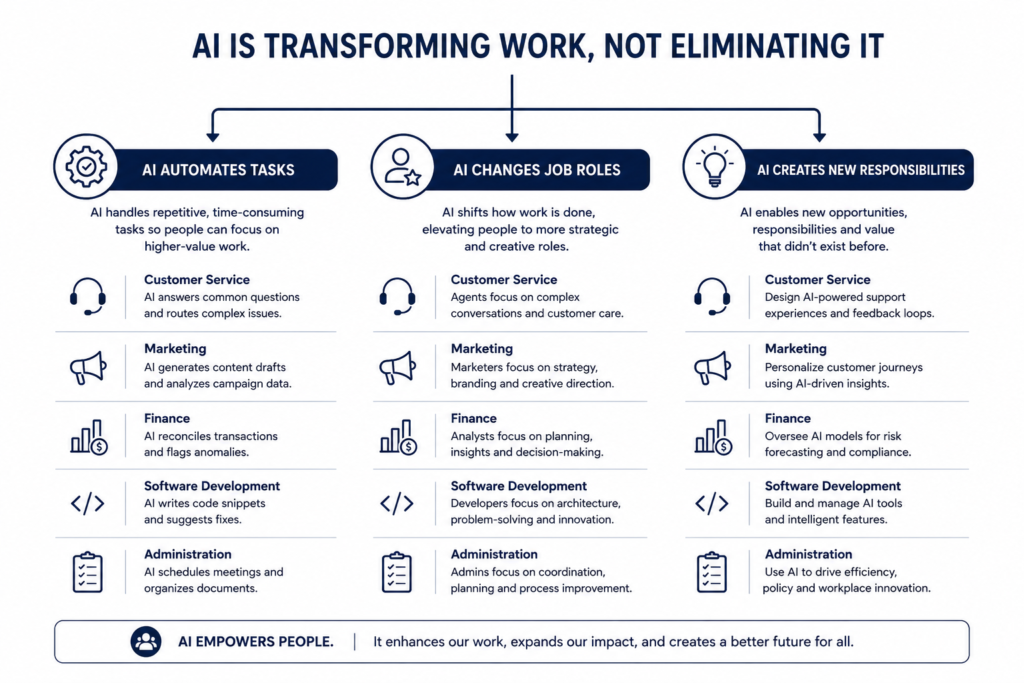
The honest answer is: both, depending on the task. It helps to separate four distinct things that often get lumped together.
- AI replacing a task: A single, well-defined activity, like transcribing a call or drafting a first version of a report, gets automated, while the surrounding role stays intact.
- AI changing a role: The job title and core responsibility remain, but daily work shifts. A marketing executive who once spent hours on manual reporting now spends more time interpreting AI-generated insights and deciding what to do with them.
- AI creating new responsibilities: Entirely new tasks appear, such as reviewing AI outputs for accuracy or managing prompts and workflows, that did not exist in the role five years ago.
- AI eliminating certain roles: In a smaller number of cases, particularly narrow, highly repetitive roles, the function itself becomes largely unnecessary.
Consider a few real examples. In customer service, AI increasingly handles routine queries, but complex complaints and relationship management still need a human. In finance, AI can reconcile transactions and flag anomalies, while judgement calls on risk and client strategy remain firmly human territory. In software development, AI writes and reviews code faster, but architectural decisions and understanding what a client actually needs still depend on experienced engineers. Research on how people actually use AI tools day to day, from Anthropic’s Economic Index, found that just over half of AI-assisted work leaned towards augmentation, where the tool collaborates with a person, rather than full automation. That is a meaningfully different picture from AI simply taking over.
Which Types of Work Are Most Exposed to AI?
Rather than asking which professions will vanish, a more useful question is which types of work sit closest to AI’s current strengths. Jobs affected by AI most directly tend to involve:
- Repetitive, high-volume tasks with predictable inputs and outputs
- Standardised processes that follow clear rules
- Routine data entry and processing
- Basic content generation, such as first drafts or simple summaries
- Simple administrative workflows like scheduling or basic correspondence
- Standardised analysis that does not require deep contextual judgement
The ILO’s 2025 update on generative AI and jobs found that roughly one in four workers globally are in occupations with some degree of GenAI exposure, but only around 3.3 per cent fall into the highest-risk category where automation potential is both high and consistent across most tasks in the role. Clerical and administrative roles show the greatest exposure. Crucially, exposure is not the same as displacement: most jobs combine exposed and unexposed tasks, which is exactly why full occupations rarely disappear even when individual tasks within them do.
Forecasts, employer surveys and observed labour-market data are three different things. A forecast projects years ahead. An employer survey, like the WEF’s, captures current intentions, which do not always match outcomes. Observed data, the kind national statistics offices collect, shows what has actually happened. Treating all three as equally certain is where AI anxiety gets overstated.
Which Skills Are Becoming More Valuable?
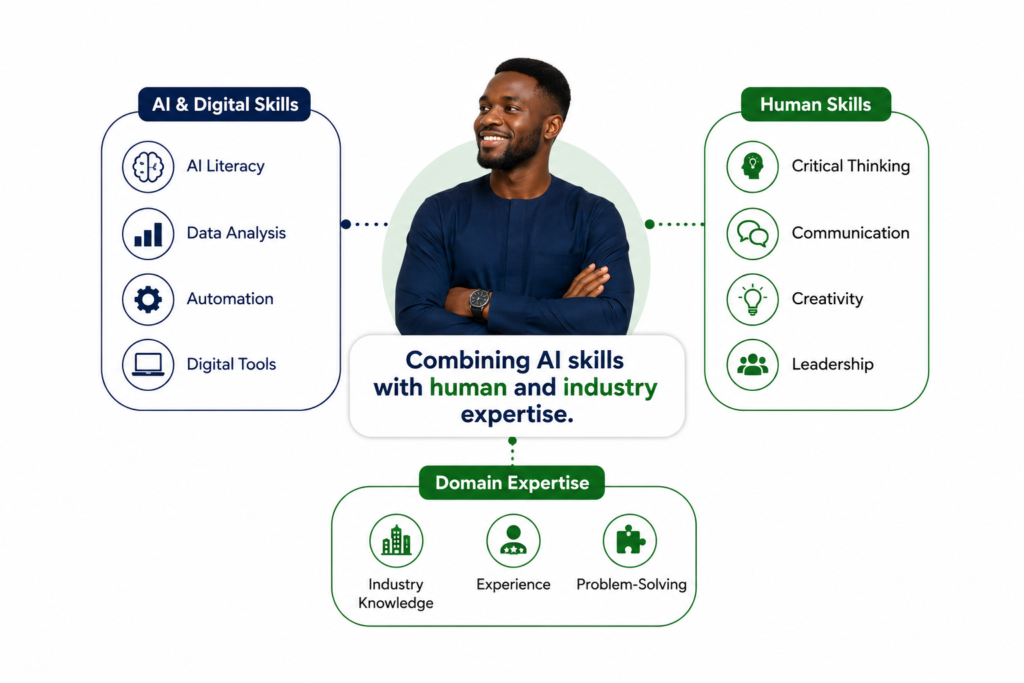
If AI is absorbing routine tasks, the skills that remain distinctly valuable cluster into three groups.
AI and digital skills include basic AI literacy, the ability to prompt and direct AI tools effectively, data analysis, familiarity with automation tools, and comfort navigating new digital platforms as they emerge.
Human skills include critical thinking, clear communication, leadership, creativity, negotiation and structured problem-solving, all of which remain difficult for AI to replicate convincingly in ambiguous, high-stakes situations.
Domain expertise ties both together. A person who understands the specific logic of Nigerian banking regulation, or the practical realities of construction project delivery, brings judgement that generic technical training cannot substitute for on their own. The World Economic Forum’s Future of Jobs Report 2025 projects that AI and information processing technologies will displace 92 million roles globally by 2030 while creating 170 million new ones, a net gain, but one that depends heavily on workers actually developing the skills the new roles require. Someone who combines technical AI fluency with real domain knowledge is generally better positioned than someone with either alone, and this combination is increasingly what employers mean when they talk about AI skills for job security. PwC’s 2025 Global AI Jobs Barometer found that workers with recognised AI skills commanded a wage premium of 56 per cent over similar roles without them, based on an analysis of close to a billion job advertisements, which suggests employers are already paying a real premium for exactly this combination.
Read More: Professional Certification vs Degree: Which One Actually Advances Your Career?
AI Skills Nigerian Professionals Can Learn
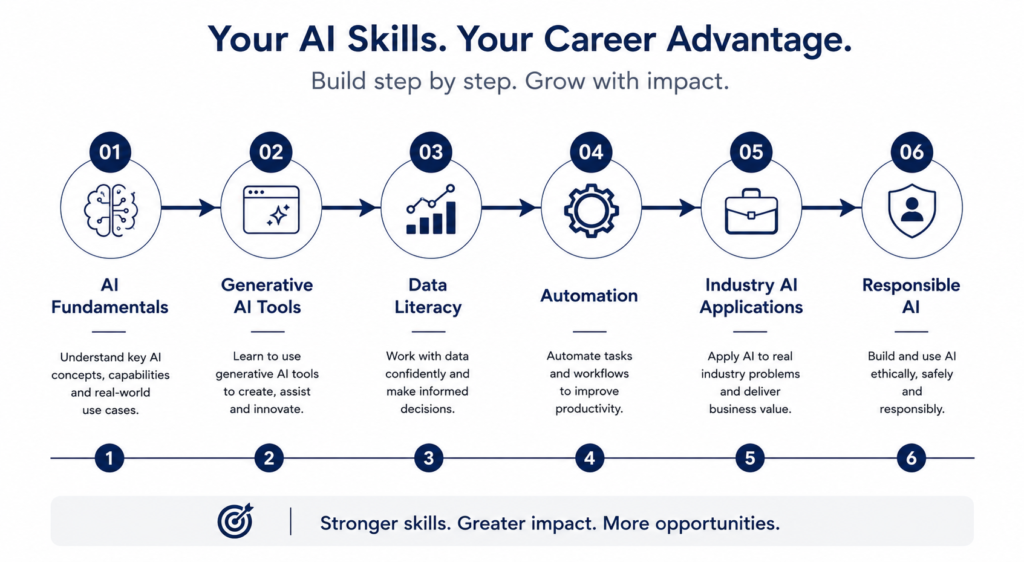
Building AI skills in Nigeria does not require starting with a machine learning degree. A more realistic roadmap moves through stages.
- AI fundamentals: Understanding what generative AI can and cannot reliably do.
- Generative AI tools: Practical, hands-on use of tools relevant to your field.
- Data literacy: Reading, interpreting and questioning data rather than just producing it.
- Automation: Using no-code or low-code tools to streamline repetitive parts of your own work.
- Industry-specific AI applications: Learning how AI is actually being used within your particular sector.
- AI governance and responsible use: Understanding data privacy, bias and the ethical boundaries of deploying these tools at work.
The right starting point depends entirely on your current career. A marketer benefits more from generative AI tools and campaign automation, while an accountant gains more from data literacy and automated reconciliation tools.
Careers That May Be More Resilient to AI
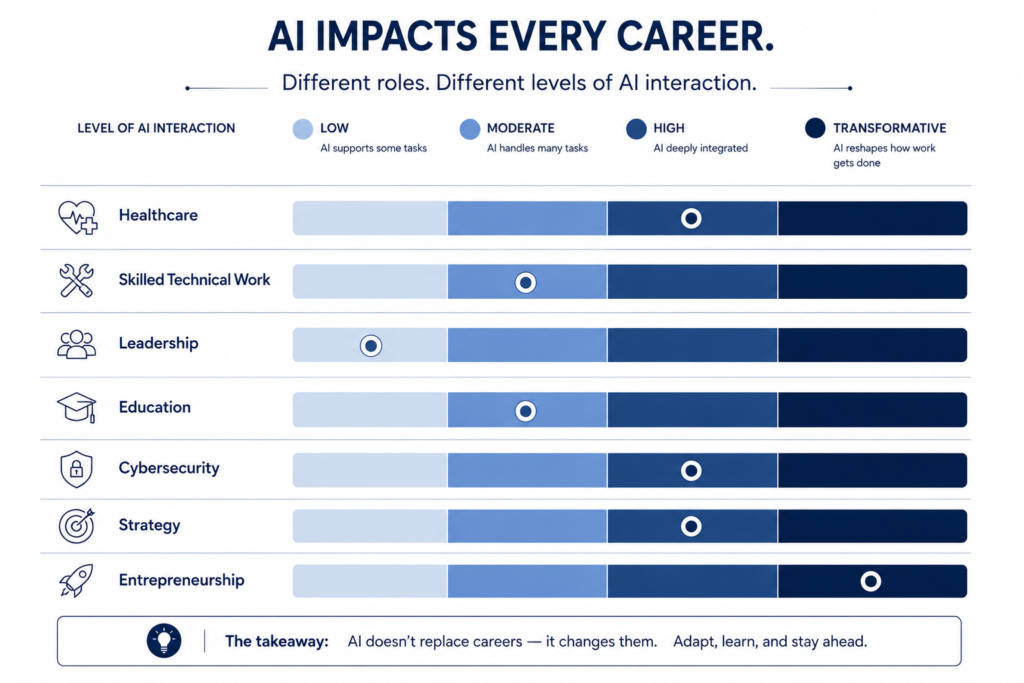
There is no such thing as fully AI-resistant jobs, and it is worth being upfront about that rather than offering false comfort. What genuinely varies is degree of exposure, not immunity. Certain characteristics tend to make roles more resilient: heavy reliance on physical presence, complex human relationships, high-stakes judgement, or leadership under uncertainty. Fields that often show these traits, and that come closest to what people mean by AI-resistant jobs, include healthcare, skilled technical trades, leadership and management, education, complex project management, cybersecurity, strategic consulting and entrepreneurship. Even within these fields, specific tasks are already being reshaped by AI tools, so treat this as a spectrum of relative resilience rather than a guaranteed shield.
Why Nigerian Professionals Should Focus on Upskilling for the AI Economy
Upskilling for the AI economy is not optional background noise for Nigerian professionals; it responds to a few converging pressures. Global competition for skilled talent is intensifying, remote work increasingly lets employers hire across borders, employer expectations around AI fluency are rising fast, and parts of the local labour market still show a persistent digital skills gap. Nigeria’s own labour force data illustrates the stakes: the National Bureau of Statistics has reported a youth NEET rate (young people not in employment, education or training) of around 15.6 per cent nationally, a reminder that the gap between available talent and market-ready skills is already a pressing issue independent of AI.
The upside is real too. Nigerian professionals who build strong AI and domain skills are increasingly competitive for the kind of international, future-proof career opportunities that simply did not exist a decade ago, provided they invest in continuous learning rather than treating a single course as a finish line. A future-proof career, in this context, does not mean a role immune to change; it means a skill set flexible enough to keep adapting as the tools do.
Degree vs Certification vs Short Course: What Should You Learn?
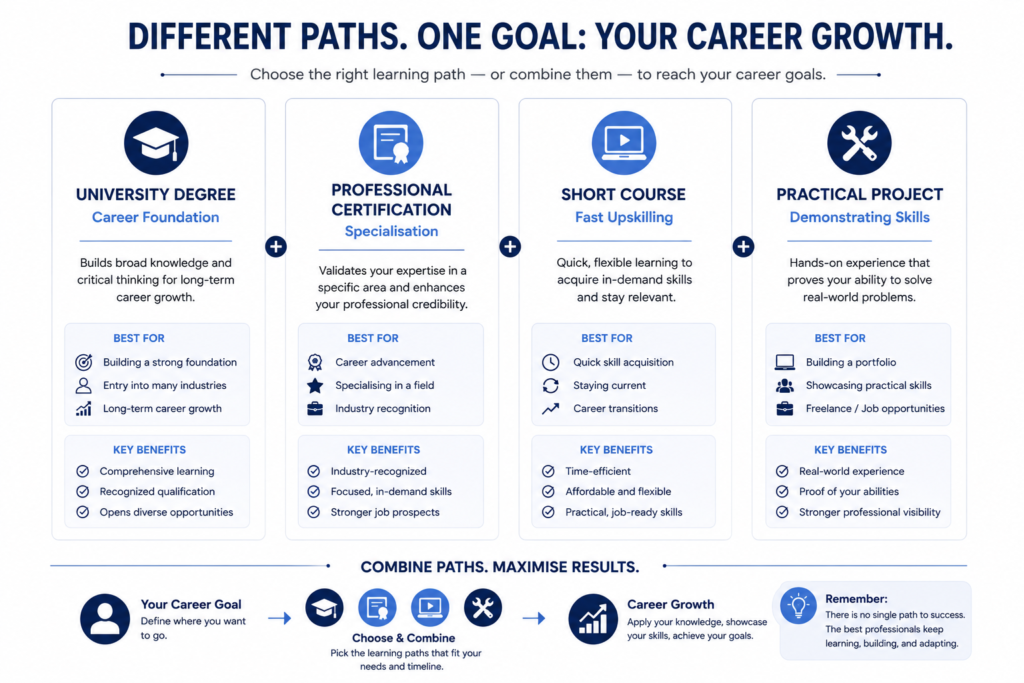
These learning paths are not competitors; they serve different purposes and often work best combined.
| Learning Path | Best For | Typical Goal |
| University Degree | Career foundation | Broad, structured qualification |
| Professional Certification | Specialisation | Recognised industry skill |
| Short Course | A specific, targeted skill | Fast, practical upskilling |
| Practical Project | Demonstrating ability | Portfolio evidence |
A degree builds the structured foundation. A certification proves specific, current competence. A short course closes an immediate gap quickly. A practical project shows employers you can actually do the work. For a deeper comparison of when each makes sense, see our earlier piece on professional certification versus university degree.
How to Build a Career Development Plan for the AI Economy
A practical plan for navigating a future of work that Nigeria’s professionals can trust does not need to be complicated.
- Identify how AI is already affecting tasks in your current role.
- List which specific tasks are likely to change over the next two to three years.
- Identify the skills your industry will need as those tasks shift.
- Choose one technical or AI-related skill to develop first.
- Develop one human skill alongside it, deliberately, not as an afterthought.
- Take relevant, focused training rather than trying to learn everything at once.
- Apply what you learn to a real project, even a small one.
- Update your CV and portfolio to reflect the new evidence of capability.
- Reassess your skills every six to twelve months, since the pace of change here is genuinely fast.
Read More: How AI in Education Is Transforming Global Student Outcomes
How EduTech Business Can Help You Prepare
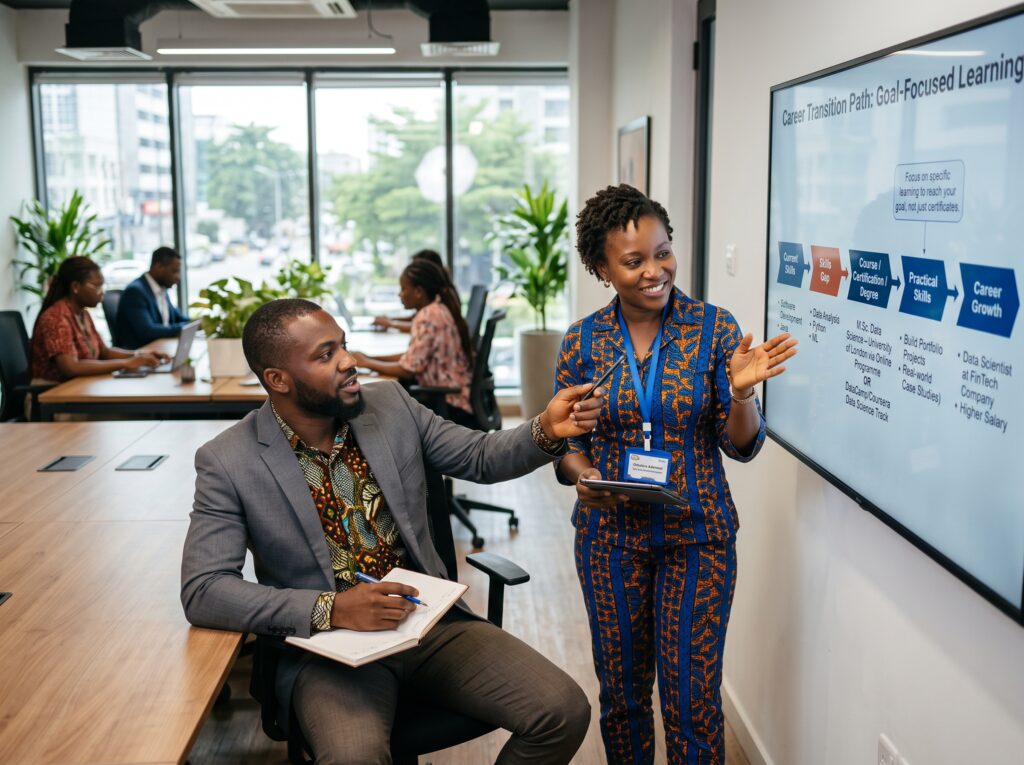
Wherever you are on this path, closing a specific skills gap is usually more useful than chasing every AI trend at once. EduTech Business connects learners to professional certifications and short courses, technology and business programmes, and flexible bachelor’s and postgraduate degrees through partners including MSBM, Ingryd, ABU DLC and Babcock BUCODeL. The right programme follows your specific career pathway rather than being a generic recommendation, whether that means a data analytics certification for a finance professional or a project management qualification for someone moving into a leadership track.
The question is not only whether AI is replacing jobs in some abstract, industry-wide sense. The more useful question is whether your own skills are keeping pace with how AI is changing the specific tasks in front of you. Speak with our student advisory team to explore flexible courses, certifications and degree programmes that build the skills your next career move actually requires.
Frequently Asked Questions
Is AI replacing jobs? AI is automating specific tasks within many jobs more often than eliminating entire occupations. Full displacement varies significantly by role and industry, and forecasts like the WEF’s projection of a net job gain by 2030 differ from observed, present-day labour market data on AI and employment.
Which jobs are most affected by AI? Jobs affected by AI most directly are roles built around repetitive, predictable and standardised tasks, such as basic data entry, routine content drafting and simple administrative work.
Will AI replace entry-level jobs? Some entry-level tasks are being automated, and several employer surveys report intentions to hire fewer entry-level staff for automatable work. This is a documented employer expectation rather than a certainty, and it makes demonstrable skills and portfolio evidence more important for new graduates.
What skills should I learn to stay employable? A combination of practical AI literacy, data skills, and durable human skills like critical thinking, communication and leadership, applied within your specific domain; together, these form the core of AI skills for job security.
What are the best AI skills for Nigerian professionals? Prompting and generative AI tool use, basic data literacy, and automation skills relevant to your field tend to offer the most immediate, practical value. Building AI skills in Nigeria works best when paired with the future of work Nigeria’s own industries are heading towards, rather than generic global trends alone.
Which careers are less exposed to AI? Careers built on physical presence, complex relationships, high-stakes judgement or leadership, such as healthcare, skilled trades and strategic roles, tend to be more resilient, though no field is entirely unaffected.
Should I get an AI certification? It can help as part of a broader plan for upskilling for AI economy demands, particularly when paired with a portfolio of real project work, but the certification’s value depends on how relevant and recognised it is within your specific industry.
Is a degree still valuable in the AI economy? Yes, particularly for roles requiring depth and structured foundational knowledge. A degree and an AI-related certification or short course often complement each other rather than competing.