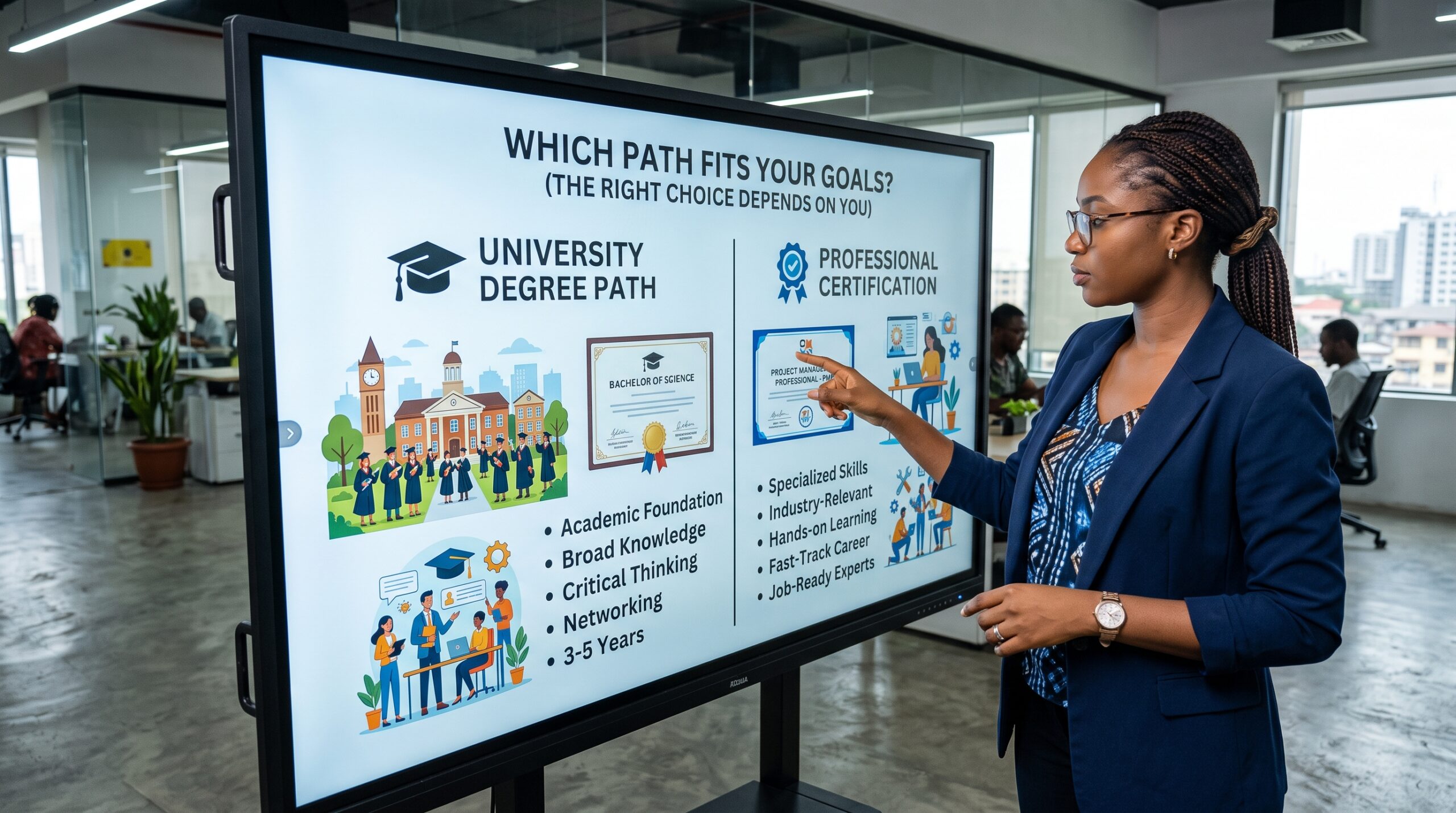
A single missing document can quietly stall a university application for weeks, sometimes long enough to miss an intake entirely. That is why a proper university admission requirements checklist matters more than most applicants realise until it is too late: it turns a stressful scramble into a manageable, sequenced task.
Requirements are not identical across institutions, and they rarely stay static from one intake to the next. A programme in engineering may ask for subjects and grades that a business programme never mentions, and an online university may request a different mix of documents than a traditional campus does. What follows is a practical university admission requirements checklist built to work across most Nigerian institutions, alongside clear notes on where requirements typically vary, so you can prepare with confidence rather than guesswork.
Read More: Online Bachelor’s Degree: A Complete Guide for Working Adults
University Admission Requirements Checklist
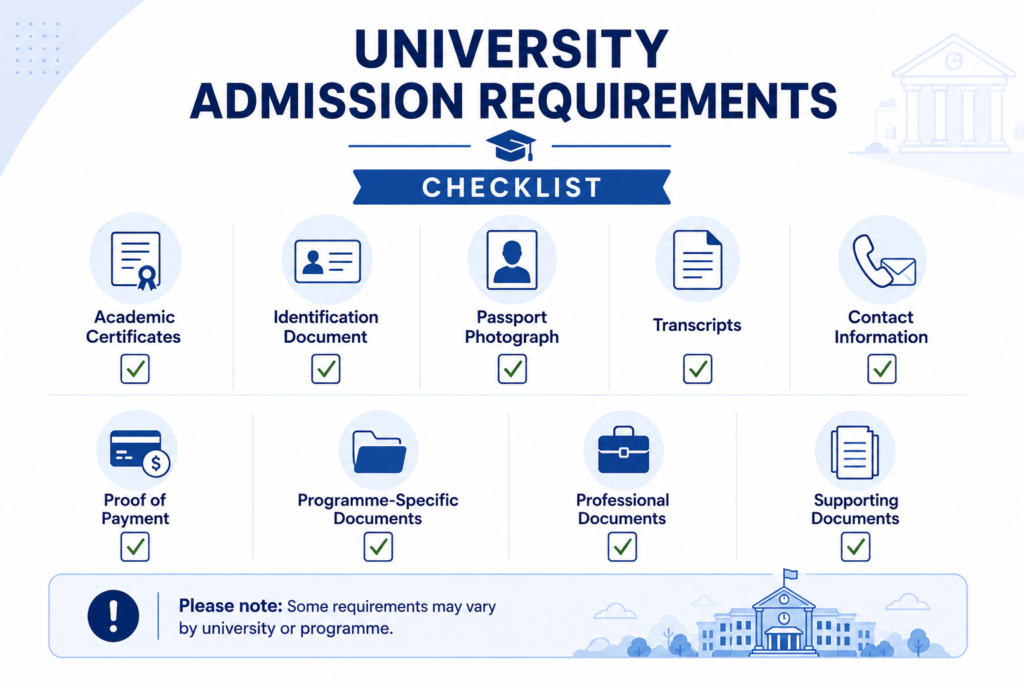
Before diving into the details, use this as your working university admission requirements checklist. Tick off each item as you gather it, and pay close attention to the ones flagged as variable, since these are the most common source of last-minute delays.
- Academic certificates or results (WAEC, NECO, or equivalent) — required by nearly every institution
- Valid identification document (national ID, international passport, or driver’s licence)
- Recent passport photograph, usually in a specific size and background colour
- Academic transcripts, where the programme or institution requires them
- Application information, including your bio-data, chosen programme, and intake preference
- Contact details, such as a functioning email address and phone number
- Proof of payment, where an application fee applies
- Programme-specific documents (varies by course; see below)
- Professional documents, where applicable (licences, work references, portfolios)
- Additional supporting documents, as individually requested by the institution
Treat this as your baseline. Some universities will ask for less; others, particularly for professional or postgraduate programmes, will ask for considerably more.
Academic Requirements
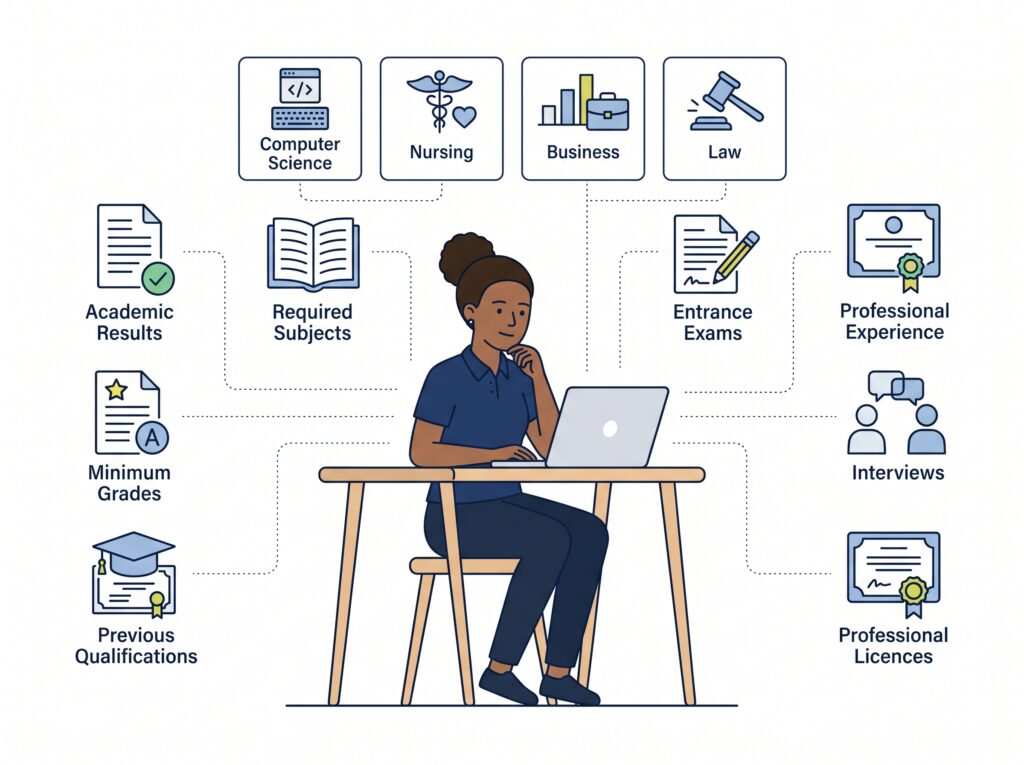
Academic documents form the backbone of any university admission requirements checklist, and they are rarely negotiable. At minimum, most Nigerian universities expect a secondary school qualification, typically WAEC or NECO results, showing a minimum number of credit passes that usually includes English Language and Mathematics.
A few details worth checking carefully before you apply:
- Relevant subjects. Some courses require specific subject combinations at credit level, such as Physics and Chemistry for engineering, or Economics for business-related degrees.
- Minimum grades. Competitive programmes often set a grade threshold above the general university requirement, so check the specific programme page rather than assuming the institution’s general minimum applies.
- Previous qualifications. Applicants with a Diploma, HND, or NCE may be eligible for Direct Entry into a later year of study, but this depends on the grade obtained and whether the awarding institution is recognised.
- Transcripts. These are frequently required for Direct Entry, postgraduate, or transfer applicants, and can take several weeks to process, so request them early rather than in the final days before a deadline.
Because programme requirements can differ significantly even within the same faculty, always verify the specific subject and grade requirements on the programme’s own page rather than relying on general assumptions about the university.
Personal and Identification Documents
Beyond academic records, every university admission requirements checklist includes a set of personal and identification documents that confirm exactly who you are. These typically include:
- Valid identification, such as a national ID card or international passport
- A recent passport photograph meeting the institution’s specified format
- Accurate contact information, including a phone number and email you check regularly
- Confirmed date of birth
- Current residential address
- An emergency contact, where the application form requests one
One detail catches out more applicants than almost anything else on this list: inconsistent names across documents. If your WAEC certificate reads “Adaeze O. Chukwu” but your national ID reads “Adaeze Chukwu-Obi,” that discrepancy can trigger delays or additional verification requests. Before you submit anything, check that your name, date of birth, and other core details match exactly across every document you plan to upload.
Read More: Student Grants in Nigeria: How to Find Funding for Your Education
Programme-Specific Requirements
Not every requirement applies universally, and this is where a generic checklist stops being useful without some tailoring. Depending on the programme, you may also need:
- Professional experience, particularly for postgraduate business or management programmes
- A previous degree, required for most master’s-level applications
- A portfolio, common for design, architecture, or media-related courses
- An entrance examination, used by some institutions and faculties in addition to, or instead of, standard academic screening
- An interview, sometimes conducted virtually for distance and online programmes
- A professional licence, relevant to fields such as nursing or accounting where prior certification is expected
- Additional academic documents, such as reference letters or a statement of purpose
Because these requirements genuinely differ by programme and institution, it is worth checking the specific admissions page for your chosen course before assuming a general checklist covers everything you need.
How to Prepare Your Documents Before Applying
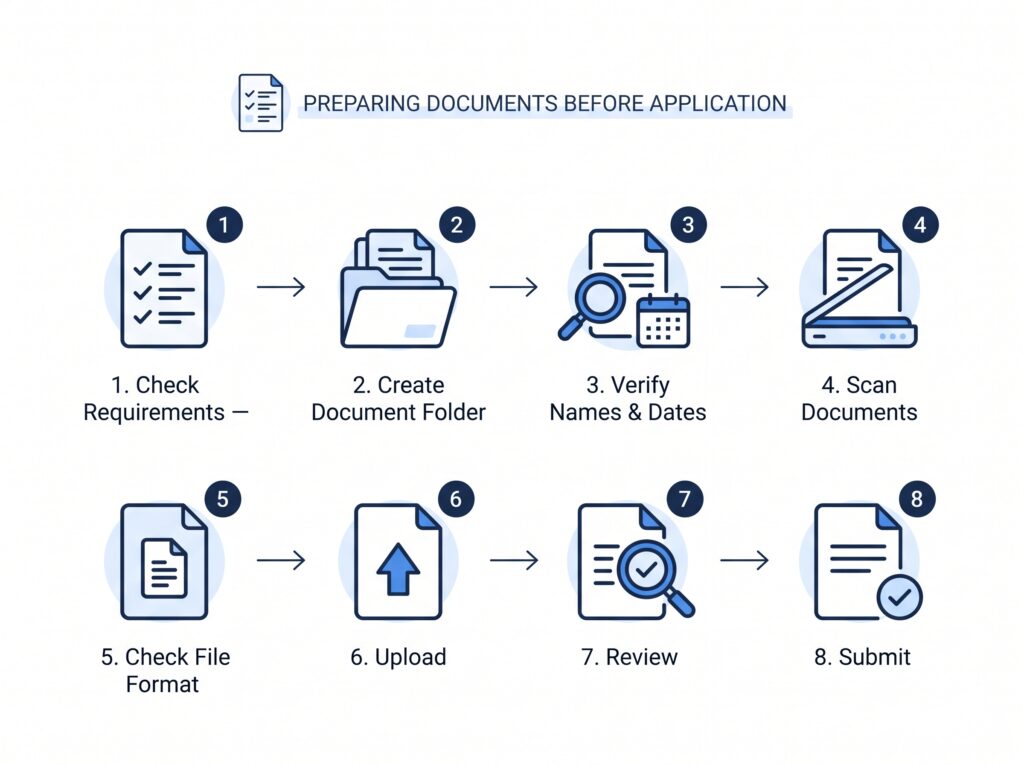
A methodical approach here saves considerable stress later. Work through this sequence:
- Check the exact programme requirements on the university’s official admissions page, not a third-party summary.
- Create a dedicated document folder, physical or digital, so nothing gets misplaced during a busy application period.
- Confirm names and dates match precisely across every document.
- Scan documents clearly, ensuring text is legible, and nothing is cropped or blurred.
- Check file formats and sizes against the portal’s specific upload requirements before you begin.
- Prepare digital copies of everything, even documents you expect to submit physically.
- Keep original documents accessible, since some institutions request physical verification later in the process.
- Review everything before submission, ideally after stepping away and returning with fresh eyes.
This process turns the documents needed for university admission you accumulate over weeks into something organised and submission-ready, rather than a last-minute scramble the night before a deadline.
Common University Application Mistakes to Avoid
Most rejected or delayed applications trace back to avoidable errors rather than genuine ineligibility. Watch for these:
- Incorrect personal information, especially names, dates, or contact details that don’t match your official documents
- Missing documents discovered only after submission
- Poor-quality uploads, such as blurred scans or documents cropped mid-page
- Selecting the wrong programme or campus by mistake
- Applying without checking the specific programme’s requirements first
- Missing published deadlines, particularly for competitive intakes
- Providing incorrect or outdated contact information, which can cause you to miss admission updates entirely
- Submitting an incomplete form and assuming missing sections will be flagged automatically
None of these mistakes reflects a weak application. They reflect rushed preparation, which is precisely what a proper checklist is designed to prevent.
How to Apply to University: Step-by-Step

Understanding how to apply to university broadly follows this sequence, though the exact process varies by institution:
- Programme selection — choose your course and confirm it matches your goals and qualifications
- Eligibility check — compare your qualifications against the programme’s published requirements
- Document preparation — gather everything on your university admission requirements checklist
- Application form — complete the university’s official application accurately
- Document upload — submit clear, correctly formatted files
- Application payment, where applicable
- Submission — confirm you receive an acknowledgement or reference number
- Application review — the institution assesses your eligibility and documents
- Admission decision — you receive an offer, rejection, or a request for further information
Read More: Admission Without JAMB: Legitimate Ways Nigerian Students Can Get Into University
In Nigeria, undergraduate admission requirements for most conventional universities also involve the Joint Admissions and Matriculation Board (JAMB) and its Unified Tertiary Matriculation Examination, which functions alongside, not instead of, an individual university’s own application process. Distance learning and some online programmes follow a different route entirely, so always confirm which university application process applies to your specific programme before you begin.
Checking Requirements for EduTech Business Partner Universities
Because requirements shift by institution and programme, and occasionally by intake, the safest approach is always to verify current admission application checklist details directly against your chosen university before applying. EduTech Business works with a range of accredited partner institutions, including ABU Distance Learning Centre, Babcock University’s BUCODeL, HUST, and MSBM, each with its own specific documentation and eligibility criteria.
Rather than assuming one institution’s requirements apply everywhere, our advisors help you confirm exactly what your chosen programme needs, reducing the risk of delays caused by outdated or incomplete information. If your admission plans don’t involve JAMB at all, our guide to admission without JAMB outlines legitimate alternative routes, while our guide to the online bachelor’s degree covers what distance learning applicants specifically should expect.
A strong application rarely comes down to luck. It comes down to preparation, matching your documents precisely to what a specific programme requires, keeping your personal details consistent, and submitting everything before the deadline rather than in a last-minute rush. This university admission requirements checklist gives you a reliable starting point, but the final word always belongs to your chosen institution’s own current admissions page.
Ready to apply but not sure whether you have everything you need? Speak with an EduTech Business advisor to check your programme options, understand admission requirements and get guidance on the application process.
Frequently Asked Questions
What documents do I need to apply to university? Most applications require academic certificates, a valid identification document, a passport photograph, application information, and contact details, with additional admission documents depending on your chosen programme.
What are the basic university admission requirements? At minimum, expect to provide secondary school qualifications with required credit passes, personal identification, a passport photograph, and completed application information, though university application requirements vary by institution and course.
Do all universities have the same admission requirements? No. While core documents overlap significantly, specific grade thresholds, subject combinations, and additional requirements such as portfolios or interviews differ by institution and programme.
Can I apply without having every document ready? Some institutions allow provisional applications with outstanding results uploaded later, but this varies by university, and missing key documents at the final submission stage typically delays processing.
Do online universities require different documents? Generally, the core academic and identification documents remain the same, though online and distance programmes sometimes request additional verification steps or a virtual interview in place of in-person screening.
What happens if I submit an incomplete application? Incomplete applications are typically paused or rejected until missing information is provided, which can push you into a later intake if deadlines have passed in the meantime.
How can I check if I meet a programme’s requirements? Review the specific programme’s official admissions page, or speak directly with the institution’s admissions office or an education advisor, rather than relying on general assumptions about the university.