If you want to transfer credits to university from a previous programme, the biggest risk is not rejection; it is silence: nobody tells you in advance which credits will actually count, so you find out only after you have already paid fees and enrolled. That uncertainty is why so many capable students delay returning to education altogether.
It does not have to be this way. Universities evaluate transfer credits against fairly consistent criteria once you understand them, and a little preparation before you apply can be the difference between finishing your degree a year early or repeating work you have already done. This guide breaks down how the process works, why credits get rejected, what advanced standing admission really means for diploma and HND holders, and how to protect the time and money you have already invested.
Read More: The Learning Personality Quiz: Which Type of Learner Are You?
What Does It Mean to Transfer University Credits?

To transfer credits to university means asking a new institution to formally recognise coursework you completed elsewhere, so you do not repeat it. The receiving university reviews your transcript and decides how much prior learning counts towards your new degree.
This process sits alongside a related but distinct concept: advanced standing admission, which allows a student to enter a programme at a higher level, often year two, based on qualifications earned before applying. A diploma holder granted advanced standing skips the introductory year entirely, rather than transferring individual course credits one by one.
Both mechanisms rely on recognition of prior learning: the principle that education completed at one accredited institution has genuine value at another, provided the content, depth, and assessment standards are comparable. Put simply, credit transfer moves individual course credits across, while advanced standing moves your entire entry point up a level. Universities differ considerably in how generously they apply either mechanism, which is why comparing institutional policies before you apply matters as much as comparing tuition fees.
Why Students Transfer Credits to University

People rarely transfer credits to university for a single, tidy reason; the motivations usually overlap. A credit transfer university decision is often shaped by more than one of the following at once:
- Changing universities. A programme, city, or institution stops being the right fit.
- Relocating. A new job, marriage, or family responsibility moves a student to a different city or country partway through study.
- Career changes. A student realises a different field suits their goals better and wants credit for general education courses already completed.
- Financial reasons. Starting at a more affordable institution before transferring to a preferred one controls total cost.
- Switching from diploma, HND, or NCE routes. Many Nigerian students build a foundation through polytechnics or colleges of education before pursuing a full bachelor’s degree.
- Returning after a study break. Work, health, or family circumstances interrupt study, and returning students want credit for what they completed before.
Whatever the reason, the underlying fear is usually the same: that years of genuine effort will simply be discarded. It is a reasonable fear. A 2017 U.S. Government Accountability Office review of transfer students found that the average student lost an estimated 43% of previously earned credits when moving between institutions, underlining what is at stake when the process is handled without guidance.
How Universities Evaluate Transfer Credits
University credit evaluation is rarely arbitrary, even when it feels that way. Most institutions follow a broadly similar sequence:

- Confirm accreditation of the sending institution. Every credit transfer university decision starts here: if your previous college was not properly accredited, none of its credits is likely to count, regardless of the grades achieved.
- Compare curriculum content. Admissions officers examine course descriptions, learning outcomes, and contact hours to judge whether a course you completed matches one offered in the new programme.
- Review grades achieved. Most universities set a minimum grade, often the equivalent of a C or above, before a course becomes eligible for transfer.
- Assess credit hours. Credit systems differ between institutions and countries, so evaluators convert your existing credit hours into their own framework.
- Check programme compatibility. A course that transfers easily into one degree, say, general business studies, may not transfer at all into a highly specialised programme such as pharmacy.
- Apply institutional policy limits. Nearly every university caps the proportion of a degree completed through transferred credit, commonly between 25% and 75% of total credits required.
Guidance from the American Association of Collegiate Registrars and Admissions Officers and accreditation oversight from the Council for Higher Education Accreditation have shaped much of this practice internationally, even outside the United States.
Read More: Why Your Degree Doesn’t Matter as Much as Your Skills (And How to Get Both)
Common Reasons Credits Are Rejected
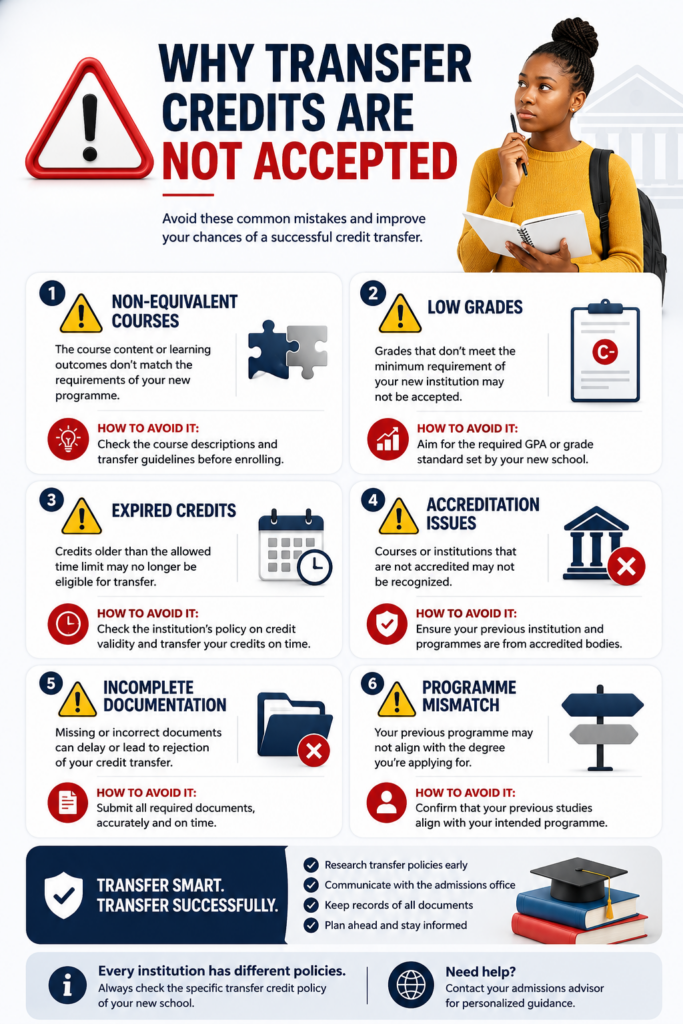
Understanding why credits are rejected is the fastest way to avoid the mistake yourself.
- Non-equivalent courses. A course that sounds similar on paper may cover different content or depth. Solution: request detailed course outlines, not just transcripts, before applying.
- Expired credits. Some institutions refuse credits older than five or ten years, particularly in fast-moving fields such as computing. Solution: apply for transfer soon after completing prior study.
- Low grades. A pass below the receiving university’s minimum threshold will not be accepted, even if the content matches. Solution: check the minimum grade policy first, and consider retaking a borderline course if it genuinely changes your outcome.
- Accreditation issues. Credits from an unaccredited institution are almost never recognised. Solution: verify accreditation status with the National Universities Commission or the equivalent regulator before enrolling anywhere.
- Incomplete documentation. Missing transcripts or unverified certificates stall applications indefinitely. Solution: request official, sealed transcripts well in advance, since processing can itself take weeks.
Advanced Standing Admission Explained
Advanced standing admission allows a student with relevant prior qualifications to enter a degree programme above the standard first-year entry point, often directly into year two. Eligibility depends on both the qualification held and its perceived equivalence to the receiving university’s own first-year content.
Diploma holders, HND graduates, and NCE holders are the most common beneficiaries of this route in Nigeria, since these qualifications typically cover much of first-year content already. This landscape has shifted recently, though: in 2025, the National Universities Commission ordered Nigerian universities to discontinue HND-to-BSc conversion and top-up degree programmes, affecting institutions that previously ran dedicated top-up routes for HND holders. Direct entry into 200 level for qualifying HND, ND, and NCE holders through the standard JAMB Direct Entry channel remains a separate, generally still-available route, but given how quickly Nigerian admissions policy can change, verify current status directly with the NUC or your target institution rather than relying on older programme descriptions.
Where advanced standing is granted, it usually comes with exemptions from specific introductory courses rather than a blanket skip of a year, so students should still demonstrate competence in foundational subjects the university considers essential.
How to Transfer Credits to University Without Losing What You’ve Earned
A few deliberate steps, taken early, dramatically improve how many credits transfer to another university.
- Maintain complete transcripts. Request official transcripts as soon as you finish a programme, not months or years later.
- Gather course outlines and syllabi. These let evaluators compare content directly, rather than guessing from a course title alone.
- Apply early. Credit evaluation can take weeks, and applying close to a deadline leaves no room to appeal a decision or supply missing documents.
- Compare universities before committing. Policies on transfer undergraduate credits vary enormously; a course rejected at one university may be fully accepted at another.
- Consult admissions advisors directly. A short conversation before you apply can reveal flexibility that published policy documents do not mention.
Quick pre-application checklist
- Request official transcripts and course outlines from every institution you have attended.
- Confirm accreditation status of your prior institution through the NUC or relevant regulator.
- Identify two or three target universities and compare their published transfer and advanced standing policies.
- Apply well before the intake deadline, leaving room for follow-up documentation.
- Speak to an admissions advisor before submitting your final application.
How EduTech Business Supports Credit Transfer Applicants
Working out how many credits transfer, and to which institution, is rarely something students should navigate alone, given how much is at stake. EduTech Business supports applicants through every stage of this process, including:
- Eligibility assessment to establish realistically how much of your prior study is likely to count.
- Document review to confirm your transcripts and course outlines meet what receiving institutions require.
- Programme comparison across partner universities’ transfer and advanced standing policies.
- Admissions support throughout the application, including timing and sequencing.
- Partner university guidance, drawing on relationships with accredited institutions that regularly assess applications from diploma, HND, and NCE holders.
Deciding to transfer credits to university should feel like building on what you have already achieved, not gambling it away. The students who protect the most time and money are rarely the ones with the strongest transcripts; they are the ones who prepared documentation early, compared institutional policies honestly, and asked direct questions before committing.
Read More: Student Grants in Nigeria: How to Find Funding for Your Education
Already completed part of your education? Don’t let your previous achievements go to waste. Speak with an EduTech Business advisor to explore transfer opportunities, understand advanced standing options, and find the best pathway to complete your degree faster.
Read more on our blog, review our partner institutions, or explore our guide on online bachelor’s degrees if you are still deciding between transferring and starting fresh.
Frequently Asked Questions
Can I transfer university credits internationally? Yes, in principle, though it depends heavily on whether your prior institution is recognised by bodies comparable to UNESCO or QS Top Universities, and evaluation typically takes longer than domestic transfers.
How many credits can I transfer? This varies by institution, but most cap transferred credit at a defined proportion of the total degree, so ask for this figure before applying.
Will transferring delay graduation? Not necessarily. A well-planned transfer can shorten your remaining study time considerably; poorly planned transfers are what typically cause delays.
What is advanced standing admission? Admission directly into an advanced stage of a degree programme, based on prior qualifications, rather than transferring individual course credits one at a time.
Do all universities accept transfer credits? No. Policies differ significantly, which is why comparing institutions before applying matters as much as comparing their tuition fees.
Can diploma or HND holders transfer credits? Often, yes, through direct entry or advanced standing routes, though eligibility should be confirmed directly with the NUC or the specific institution given how recently some programme types have changed.