Going back to school does not always mean leaving work, returning to campus every weekday, or committing to another two or three-year degree. For many professionals, learning now has a much more specific purpose: becoming better at the job they already have, preparing for the one they want next, or acquiring knowledge their previous education did not cover.
That is where executive education comes in. It offers working professionals a structured way to develop business, management and leadership capabilities while continuing their careers. As technology, business models and workplace expectations change, the question is increasingly less about whether someone should keep learning and more about what they need to learn, why they need it and which format makes sense.
Read More: Going Back to School as an Adult: A Complete Guide to Returning to Education
What Is Executive Education?
Executive education refers to non-degree professional learning designed primarily for people who already have work experience and want to develop specific skills or knowledge. Programmes may focus on leadership, management, strategy, finance, entrepreneurship, digital transformation, project management or other areas relevant to professional practice.
Unlike a traditional undergraduate or postgraduate degree, an executive programme is usually more targeted. Rather than covering a broad academic discipline over several years, it may concentrate on a particular business challenge or capability over a shorter period.
This makes it particularly relevant to professionals who have identified a skills gap and want a practical way to address it.
The terminology varies between providers. One business school may call its offering an executive certificate, another may describe it as a professional programme, while another may offer a short course for working professionals. The name matters less than what the programme actually teaches, who teaches it, how it is assessed and what credential is awarded.
Why Are Working Professionals Going Back to School?
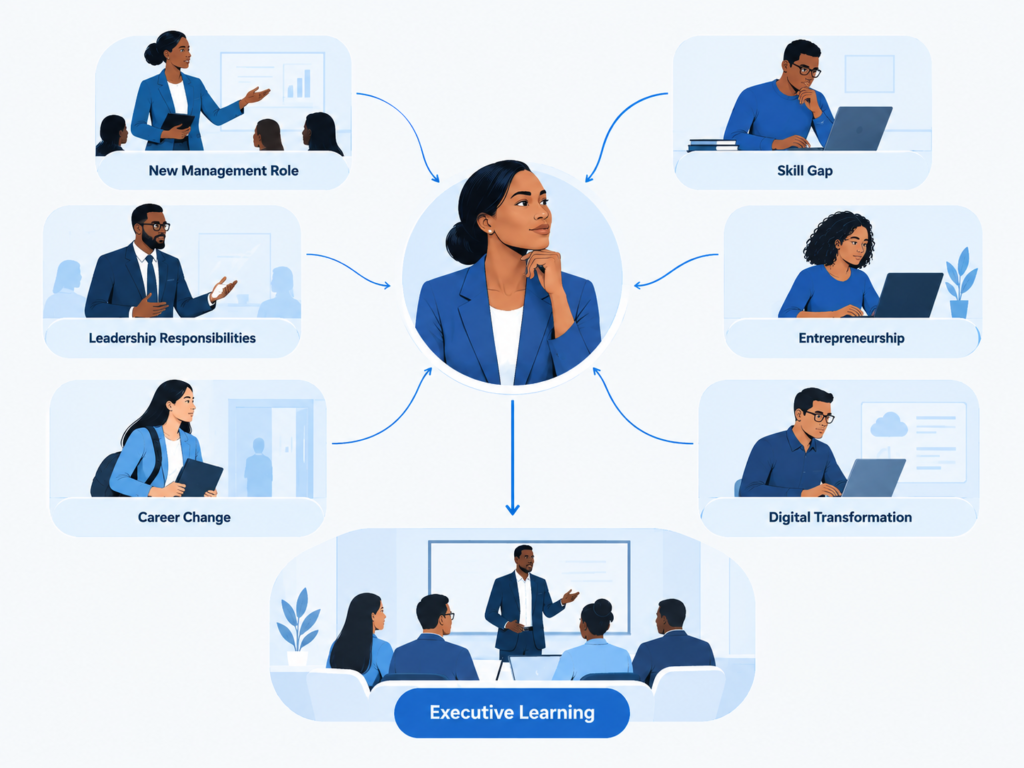
The modern workplace gives professionals plenty of reasons to return to structured learning.
The World Economic Forum’s Future of Jobs Report 2025 found that employers expect 39% of workers’ existing core skills to change by 2030. It also identified AI and big data, networks and cybersecurity, technological literacy, creative thinking, resilience, leadership and social influence among skills rising in importance.
In other words, the qualification that got someone into a career may not provide everything they need to navigate the next stage of it.
Read More: Professional Certification vs Degree: Which One Actually Advances Your Career?
Professionals may return to education because they:
- Have moved into management and need stronger people-management skills.
- Are preparing for senior leadership responsibilities.
- Need business knowledge outside their original specialisation.
- Want to understand emerging technologies or digital transformation.
- Are changing industries or moving towards a new career direction.
- Own a business and need stronger capabilities in finance, strategy or operations.
- Have identified a specific knowledge gap that self-study has not adequately addressed.
There is also an important distinction between going back to school and starting over. An experienced marketer taking a strategy programme, for example, is not becoming a student in the same sense as someone beginning an undergraduate degree. They are adding a new layer of capability to an existing professional foundation.
For some learners, the greatest value may also come from the classroom itself: discussions with experienced faculty and interaction with professionals dealing with similar problems in different organisations.
Executive Education vs Traditional Degrees
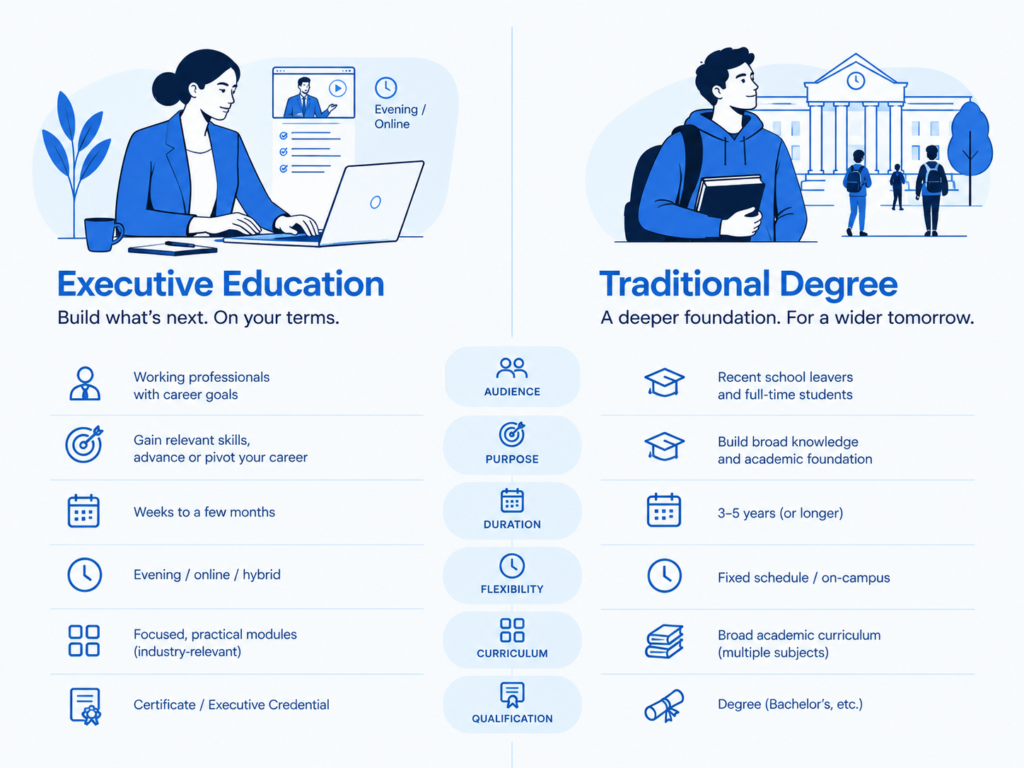
The two forms of education can complement each other, but they solve different problems.
| Factor | Executive Education | Traditional Degree |
| Primary audience | Working professionals | Students and professionals |
| Main purpose | Targeted professional development | Broader academic qualification |
| Duration | Often shorter | Usually longer |
| Flexibility | Often designed around work | Varies by programme |
| Curriculum | Focused on specific skills or subjects | Broader structured curriculum |
| Credential | Certificate or programme credential | Degree |
| Work experience | Often expected | Requirement vary |
Neither is automatically better. Someone seeking a recognised academic qualification for a particular career or further study may need a degree. Someone who needs focused development in leadership, finance or strategy may find a shorter professional programme more aligned with the immediate goal.
The important point is not to treat an executive programme as a substitute for a degree when it is not one.
What Types of Executive Programmes Are Available?
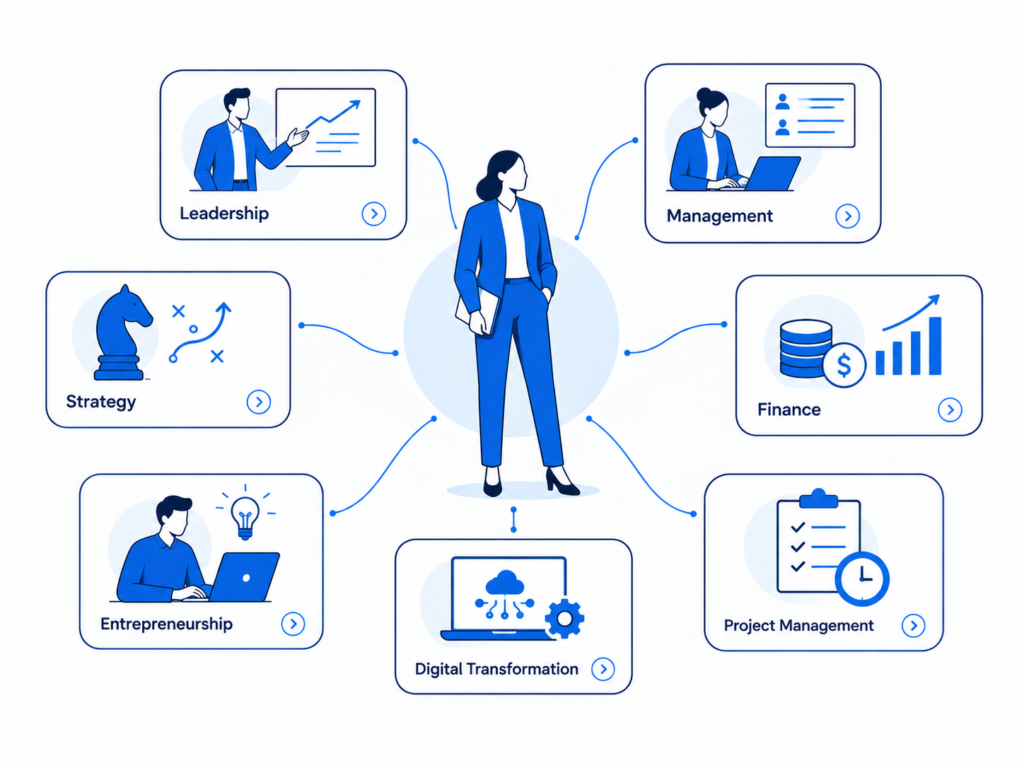
There is no single format. Depending on the provider, an executive programme for professionals might include:
- Executive certificates: Structured programmes focused on a defined business or professional area.
- Leadership development courses: Designed around leadership, communication, decision-making and managing people.
- Management programmes: Cover areas such as operations, organisational management and performance.
- Business strategy programmes: Focus on strategic thinking, competitive positioning and business decision-making.
- Finance programmes: Suitable for professionals who need stronger financial literacy or managerial finance skills.
- Entrepreneurship programmes: Explore business models, growth, innovation and venture management.
- Digital transformation programmes: Examine how technology can change processes, products and organisations.
- Project management programmes: Develop capabilities for planning, executing and managing complex projects.
- Industry-specific programmes: Designed around the needs of particular sectors.
Programme names differ between universities, business schools and training providers, so prospective learners should look beyond the title.
Read More: Online MBA in Nigeria: How to Choose the Right Program for Your Career
Who Should Consider Executive Education?
The New Manager
You have recently moved from being an individual contributor to managing people. Your technical expertise may be strong, but leading a team requires a different set of capabilities. A leadership development course can provide structured learning around delegation, communication, motivation, conflict and decision-making.
The Mid-Career Professional
You have several years of experience but want broader business knowledge without committing to another full degree. A focused programme in strategy, finance, management or another relevant discipline can help fill specific gaps.
The Entrepreneur
Running a business requires more than expertise in the product or service being sold. Entrepreneurs may benefit from structured learning in finance, operations, strategy, marketing or organisational leadership.
The Specialist Moving Into Leadership
Technical specialists often encounter a different challenge when they become managers. Knowing how to do the work is not the same as knowing how to lead the people doing it. Executive learning can help bridge that transition.
The Executive Preparing for the Next Role
Senior professionals may use an executive programme to deepen their understanding of a particular area before taking on broader responsibilities.
How Long Does Executive Education Take?
There is no standard duration.
A short course for working professionals might take several days or weeks. Certificate programmes can run for several weeks or months, while more intensive executive programmes may extend across several months.
Delivery can also vary. Options may include:
- Fully online learning
- Face-to-face classes
- Hybrid delivery
- Evening or weekend sessions
- Modular programmes
Duration should not be considered separately from workload. A programme lasting eight weeks could demand significantly more time each week than one lasting six months with a lighter schedule.
The better question is: Can I realistically complete this programme alongside my current responsibilities?
What Is the Career Value of an Executive Certificate?
An executive certificate can demonstrate that a professional has deliberately undertaken structured development in a particular area. Its usefulness, however, depends on the context.
A certificate does not automatically guarantee a promotion, salary increase or new job. Its practical value is stronger when the knowledge acquired is relevant to the person’s responsibilities and can be demonstrated through better decisions, stronger work or new capabilities.
The provider also matters. Prospective learners should investigate the institution, faculty, curriculum, assessment methods and reputation rather than choosing solely because a certificate carries an impressive-sounding title.
Accreditation can be another useful quality indicator, particularly when evaluating business schools. AACSB describes accreditation as a rigorous process involving self-evaluation and peer review, with attention to areas including curriculum, learning outcomes and continuous improvement.
Most importantly, an executive certificate should not be presented as academically equivalent to a master’s degree. One is generally a professional credential; the other is an academic qualification with different entry requirements, curriculum structures and recognition.
Read More: Professional Certifications That Actually Pay Off: A 2026 Career Guide
How to Choose the Right Executive Programme
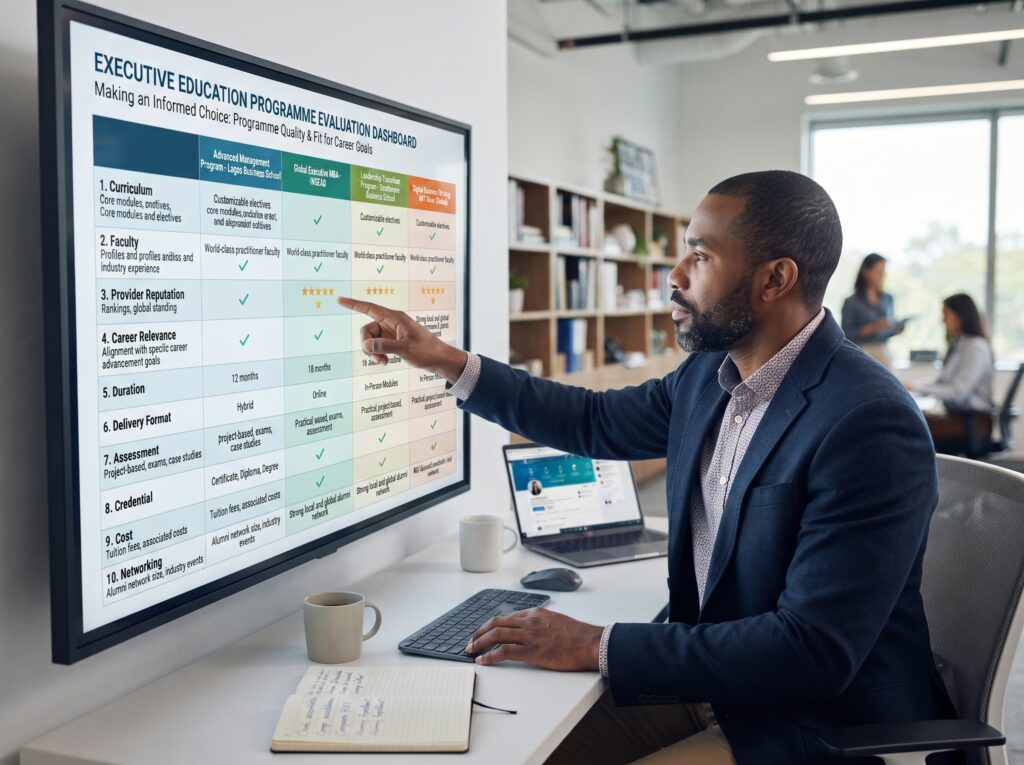
Before paying a fee, ask:
- What specific skill gap am I trying to solve?
Start with the problem, not the programme title.
- Does the curriculum match my goal?
Read the modules carefully. A course marketed around leadership should actually teach leadership-related capabilities.
- Who teaches it?
Look at the faculty’s academic and professional experience.
- Who is the programme designed for?
A programme for senior executives may not be appropriate for someone in the early stages of their career.
- What is the workload?
Check teaching hours, assignments, assessments and independent study.
- What is the delivery format?
Consider whether online, hybrid, evening or weekend learning fits your schedule.
- What credential will I receive?
Understand precisely whether it is a certificate of completion, an executive certificate, a diploma or an academic qualification.
- What will it cost in total?
Look beyond tuition to materials, examinations, travel and other potential expenses.
- Is there meaningful peer learning?
For professionals, interaction with people facing different business challenges can be an important part of the experience.
- Are the provider’s claims clear and verifiable?
Be cautious about vague promises of guaranteed promotions, salary increases or employment outcomes.
Read More: Micro-Credentials: What They Are and How They Boost Your Career
Learning Without Putting Your Career on Hold
The appeal of professional education is not difficult to understand. A full degree may be the right decision for one person, while a focused programme may make more sense for another.
The real opportunity is to treat learning as a strategic decision rather than simply collecting another credential. Identify the capability you need, find a programme that genuinely addresses it, investigate the provider and understand exactly what qualification you will receive.
For professionals who want to keep developing without stepping away from their careers, executive education can provide a practical middle ground between informal self-learning and a long-term academic qualification.
If you are ready to explore professional learning options, browse the resources available from EduTech Business, including its education blog and contact page.
Executive Education FAQs
- Is executive education the same as an MBA?
No. An MBA is a postgraduate academic degree with a broader curriculum and formal degree requirements. Executive education is a wider category of professional learning that can include short courses, executive certificates and specialised programmes. Some executive programmes may complement an MBA, but they are not automatically equivalent to one.
- Who is eligible for executive education?
Requirements vary. Many programmes are designed for people with professional experience, while others may accept learners with less experience. Check the specific entry requirements of the provider.
- How long does an executive programme take?
It can range from several days or weeks to several months, depending on the subject, intensity and format.
- Can executive education help with career progression?
It can support professional development by helping someone acquire relevant knowledge and demonstrate structured learning. However, career progression also depends on factors such as performance, experience, available opportunities and organisational requirements.
- Can I study while working full-time?
Often, yes. Many programmes are deliberately structured around professional schedules through online, evening, weekend or modular delivery. The workload still needs to be assessed realistically.