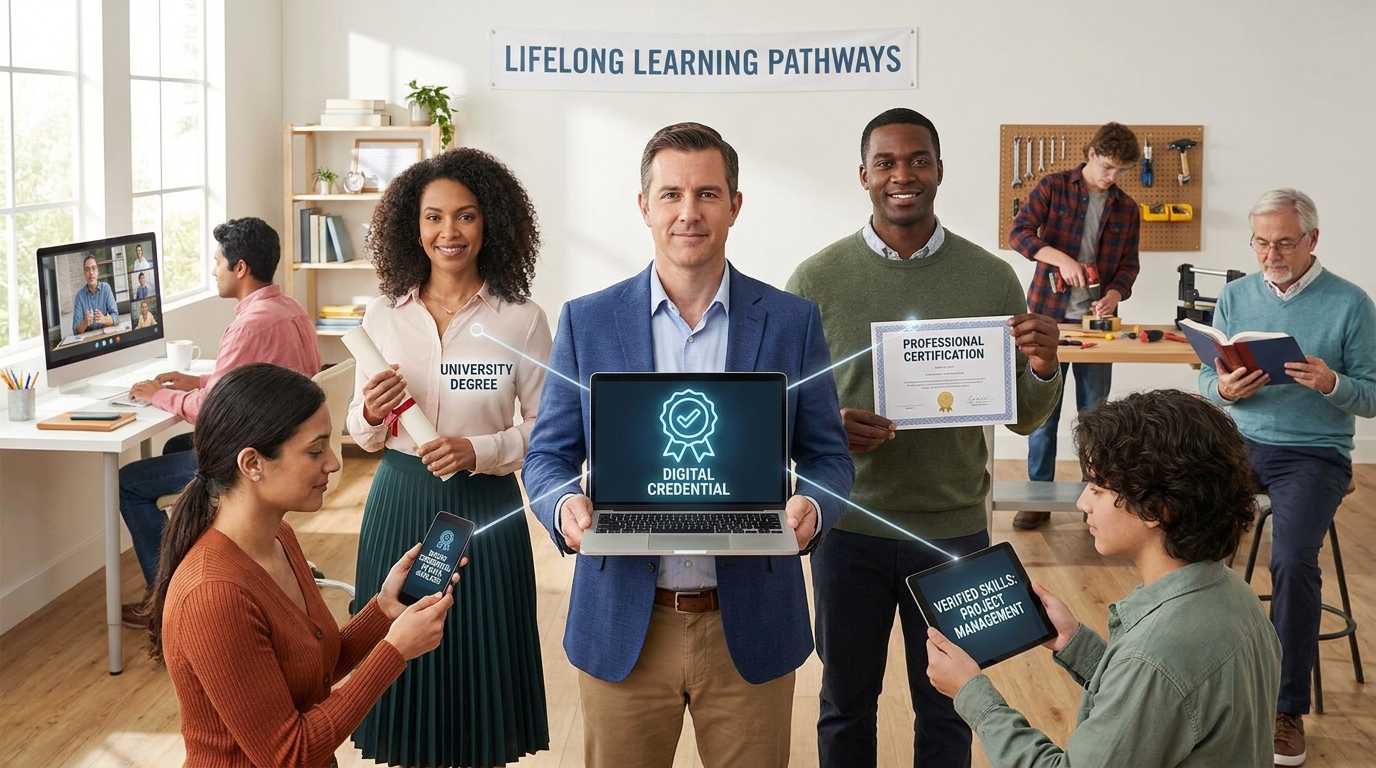
Micro-credentials are reshaping how people learn, work and get hired, offering a faster, more focused alternative to years of formal study. For students juggling deadlines, graduates hunting for that first job and professionals eyeing a career pivot, this shift matters more than most headlines let on.
A decade ago, career progression followed a fairly linear script: get the degree, gain experience, wait for promotion. That script has loosened. Employers now want proof that candidates can actually do the job, not just that they attended the right institution. Micro-credentials sit squarely inside this shift, offering a way to demonstrate specific, verifiable skills without committing years and significant tuition to another full qualification. They do not replace a degree. Instead, they sharpen it, filling gaps that formal education often leaves open.
Read More: Professional Certification vs Degree: Which One Actually Advances Your Career?
What Are Micro-Credentials?
A micro-credential is a focused, short-form qualification that certifies a specific skill or competency, typically following an assessed course, project or examination. Where a degree spans years and covers broad academic ground, a micro-credential is deliberately narrow: one skill, one outcome, one badge to show for it.
UNESCO’s working definition describes a micro-credential as a record of focused learning that verifies what a learner knows or can do, assessed against clearly defined standards and awarded by a trusted provider. Crucially, UNESCO notes it can have stand-alone value or contribute to a larger qualification later on.
What tends to characterise a micro-credential:
- A tightly scoped learning outcome, often a single skill or tool
- A short delivery window, from a few hours to several weeks
- An assessment component, rather than mere attendance
- A digital credential that can be shared and verified online
- Direct relevance to a current industry need
It is worth being honest that the exact structure and recognition of micro-credentials still vary considerably between providers. A micro-credential from a globally recognised body carries different weight to one from an obscure platform, so the issuer matters as much as the content.
Micro-Credentials, Certificates and Degrees: How They Differ
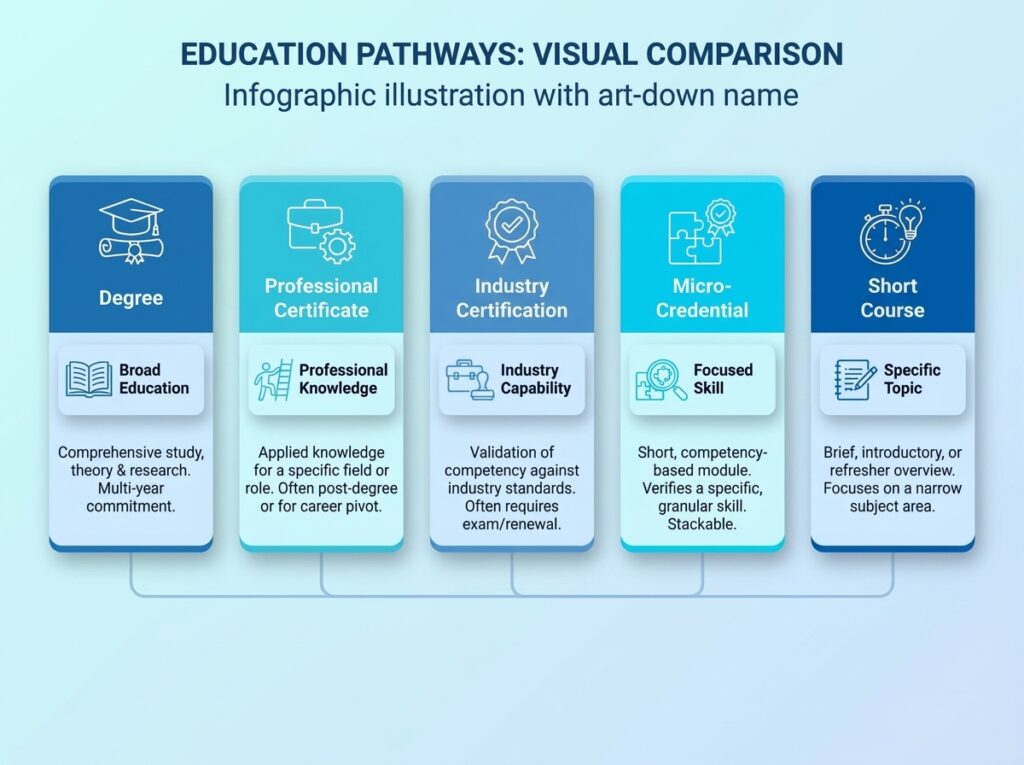
Confusion around terminology is common, partly because institutions use these words loosely. A simple way to separate them:
| Option | Primary Purpose | Typical Scope |
| Degree | Broad academic education | Broad |
| Professional certificate | Build knowledge in a subject | Moderate |
| Industry certification | Validate professional capability | Specific |
| Micro-credential | Demonstrate a focused skill | Narrow |
| Short course | Learn a specific topic | Varies |
A professional certificate vs degree comparison usually comes down to depth and time: a degree builds broad reasoning across a discipline over years, while a certificate or micro-credential proves you can execute a specific task well, often in weeks. Industry certifications, such as those from professional bodies, sit closer to certifications in scope but usually demand renewal and formal examination. None of these categories is strictly interchangeable, and providers do not always use the terms consistently, so it pays to check what is actually being assessed before assuming equivalence.
Read More: Highest Paying Jobs in Nigeria: Top Careers and the Degrees That Can Get You There
Why Employers Are Paying Closer Attention to Skills
Skills-based hiring has moved from buzzword to genuine practice. LinkedIn’s Future of Recruiting research found that job postings omitting degree requirements rose noticeably between 2019 and 2022, with technology, financial services, and hospitality among the sectors dropping degree requirements fastest. Separately, LinkedIn’s Economic Graph research shows that shifting hiring searches from job titles to specific skills widens the pool of eligible candidates considerably, including strong gains among workers without a university degree.
Behind this is a genuine skills gap. The World Economic Forum’s Future of Jobs Report 2025 found that close to 39 per cent of workers’ core skills are expected to change by 2030, with a majority of the global workforce needing some form of reskilling in that period. Technology, automation and artificial intelligence are accelerating this pace, and traditional curricula often cannot keep up.
This is precisely where micro-credentials earn their relevance: they let learners demonstrate a current, verified skill rather than simply listing one on a CV.
How Micro-Credentials Can Boost Your Career

Used well, micro-credentials offer several practical advantages:
- Targeted skill-building. You focus on exactly what a role or project demands, rather than a broad curriculum.
- Demonstrated continuous learning. A recent, relevant micro-credential signals that you are actively keeping pace with your field.
- A stronger CV. Verified skills sit alongside experience, giving recruiters something concrete to assess.
- Career exploration. A short, lower-cost credential lets you test interest in a new field before committing further.
- Complementing existing qualifications. A degree holder can use micro-credentials to specialise or catch up with newer tools and methods.
It would be misleading to suggest a micro-credential automatically leads to a job offer or a pay rise. What it does is add verifiable evidence of capability, which matters more as employers lean further into skills-based hiring.
Digital Badges for Career Growth: How They Work
Most micro-credentials are issued as digital badges: small, verifiable digital files that display the skill covered, the issuing organisation and often the assessment method behind it. These can be shared on professional profiles such as LinkedIn or embedded in a digital portfolio.
Read More: Online MBA in Nigeria: How to Choose the Right Program for Your Career
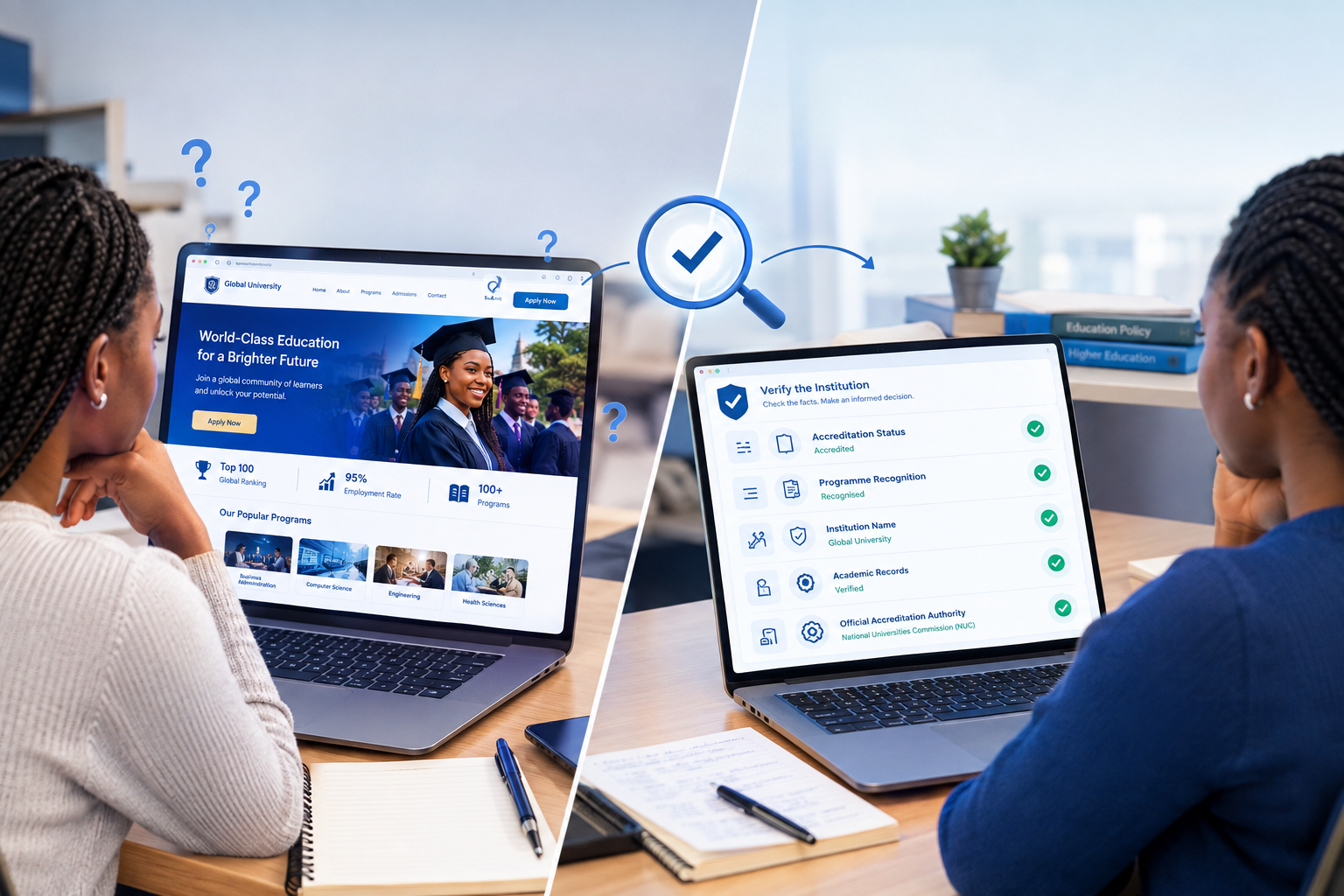
The distinction worth noting is between a badge that simply confirms attendance and one that reflects genuine, assessed skill. A credible digital badge should let anyone verify, usually through a link or metadata, who issued it and what was actually tested. Issuer credibility matters here: a badge from an established, industry-respected provider carries far more weight with employers than one from an unfamiliar platform with no visible quality assurance.
Stackable Credentials and Lifelong Learning
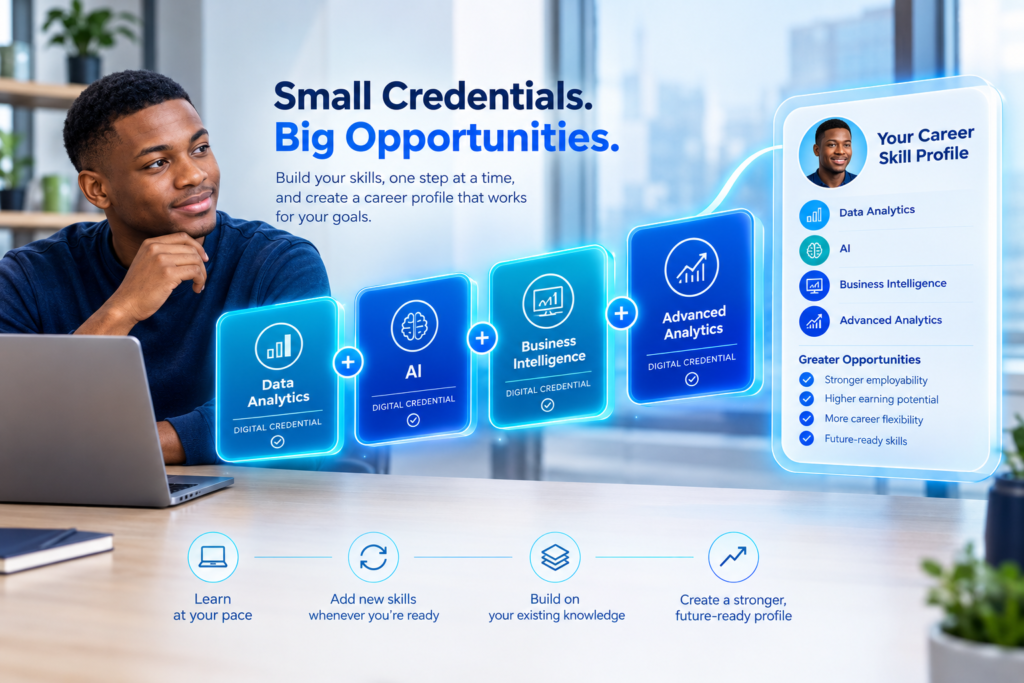
Stackable credentials refer to smaller, individual micro-credentials that can be combined over time to build towards a larger qualification or a defined specialisation. Rather than treating each course as an isolated event, learners accumulate related credentials that, together, tell a coherent story about their expertise.
Not every micro-credential is automatically stackable. Whether one contributes to a broader qualification depends entirely on how the issuing institution has structured it, so it is worth checking this before enrolling if your goal is a defined pathway rather than a single skill. Where stacking works well, it supports genuinely flexible, lifelong learning: professionals can build a specialisation gradually, around a full-time job, rather than pausing a career for a lengthy programme.
How to Choose a Credible Micro-Credential
With so many providers now offering micro-credentials, quality varies widely. Before enrolling, it helps to check:
- Who issues the credential, and how established are they in the field?
- Are the learning outcomes clearly defined before you start?
- Is there a genuine assessment, not just course completion?
- Can the credential be independently verified online?
- Is it relevant to the specific career or role you are targeting?
- What does it actually cost, including any renewal fees?
Are micro-credentials worth it? Generally, yes, provided the issuer is credible and the skill maps directly to a career goal. A credential that ticks these boxes tends to hold up well under employer scrutiny; one that does not may add little beyond personal satisfaction.
Degree, Micro-Credential, or Both?
A degree still makes sense for entering regulated professions, building a broad academic foundation, or meeting requirements for further study. A micro-credential is generally more useful for targeted skill development, exploring a new field, or updating an existing skill set without pausing a career.
For many learners, the strongest pathway is not one or the other but a sequence: degree, professional certification, targeted micro-credentials, and demonstrated experience, layered deliberately over time. This combination increasingly defines what a strong, current CV looks like.
Micro-Credentials and Career Change
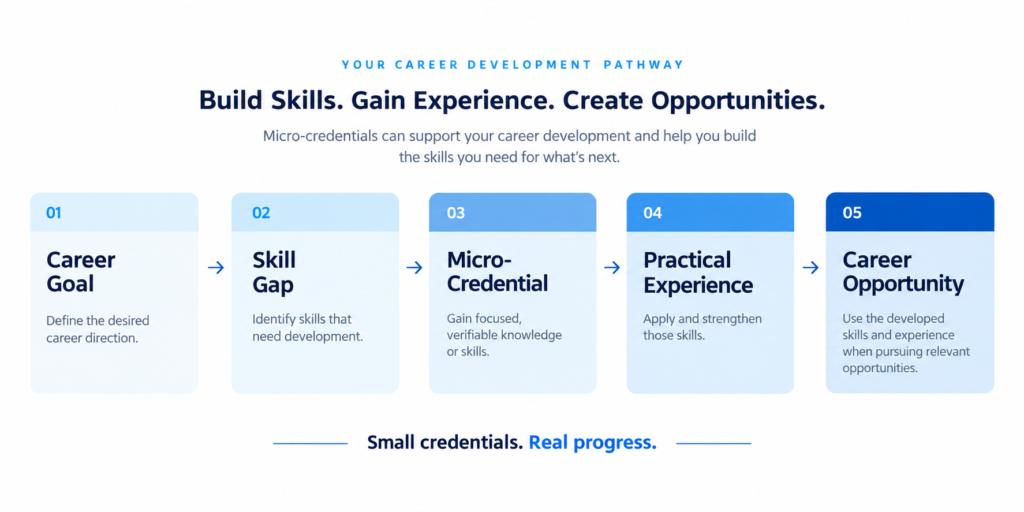
For career changers, a practical pathway often looks like this: identify the target role, map the skills it demands, compare that against your existing skill set, then close the gap with a focused micro-credential or industry certification before applying. Combining a credential with a small personal project or portfolio piece tends to carry more weight with employers than the credential alone, since it shows applied capability rather than theoretical exposure.
Read More: Tech Career Without a Degree: What You Actually Need to Get Hired
How EduTech Business Supports This Journey
At EduTech Business, we help learners across Nigeria and beyond navigate this exact decision, comparing degrees, professional certifications and skills-based programmes against real career goals. Through partners such as Ingryd Academy, learners can access internationally recognised tech certifications alongside flexible degree pathways for those still weighing an online bachelor’s degree or returning to school as adults. Explore current certification programmes or read more on our blog.
The Future of Micro-Credentials
Skills-based hiring, digital credentials and stackable learning are converging into a broader shift: learners increasingly build portfolio-style education profiles rather than relying on a single qualification to carry an entire career. As AI reshapes job requirements faster than most curricula can adapt, continuous, verifiable skill-building looks set to become less of an alternative path and more of a standard expectation.
Frequently Asked Questions
Do employers recognise micro-credentials? Recognition varies by issuer and industry. Credentials from established, industry-respected providers tend to carry real weight; lesser-known platforms may not.
Are micro-credentials better than degrees? Not necessarily better, simply different. Degrees build broad academic and professional foundations; micro-credentials demonstrate narrow, current skills.
What are stackable credentials? Smaller credentials that can be combined over time to build towards a larger qualification or specialisation, where the issuing institution supports that pathway.
Can micro-credentials help with a career change? Yes, particularly when paired with a project or portfolio piece that demonstrates the skill in practice, not just the certificate.
Whether you are looking to advance your career, explore a new field or strengthen your existing qualifications, the right credential can help you build a more focused learning pathway. Speak with an EduTech Business advisor to explore career-focused education and certification options suited to your goals.