Every admissions season, thousands of prospective students browsing EduTech Business search for flexible ways to earn a degree without giving up a job, a business, or family responsibilities. Somewhere in that search, “distance learning” and “online learning” get used as though they mean the same thing, and that mix-up has real consequences. Pick the wrong format, and you might end up with a schedule that clashes with your work hours, or a programme that assumes internet access you don’t have.
The confusion is understandable. Both formats let you study away from a physical classroom, both have grown rapidly as universities digitise their offerings, and both get marketed under similar language. But distance learning vs online learning is not a semantic debate. The two terms describe genuinely different delivery models, with different demands on your time, your technology, and your self-discipline. This guide breaks down what each one actually involves, compares them side by side, and helps you work out which pathway fits your life right now.
Read More: Online Bachelor’s Degree: A Complete Guide for Working Adults
What Is Distance Learning?
Distance learning, sometimes called open and distance learning, is a study model built around separation: the student and the institution are apart in place, and often in time too. According to UNESCO’s glossary on open and distance learning, the approach is specifically designed to remove barriers to access such as finances, prior learning, age, work, or family commitments, which is why it has historically appealed to working adults and career changers.
In practice, what distance learning usually looks like is a mix of study formats rather than one single delivery channel. A typical programme might combine:
- Printed or downloadable course modules that you work through independently
- A virtual learning platform for submitting assignments and accessing recorded lectures
- Scheduled contact sessions or residential periods where you meet lecturers in person
- Periodic in-person examinations at an approved study centre
This blended structure means distance learning is not always fully online. Many Nigerian universities still require occasional physical attendance for practicals, orientation, or exams, even though the bulk of the coursework happens remotely. That periodic contact is not a shortcoming; it is often the feature that helps learners stay accountable, since a scheduled residential period or contact session gives you a fixed point to work towards rather than an open-ended deadline that is easy to postpone.
Distance learning also tends to differ from traditional classroom education in how content is paced. Rather than following a lecturer through a fixed weekly timetable, you typically work through modules at a pace agreed with the institution, submitting assignments ahead of contact sessions. This is part of why it appeals to people juggling a job or a business: the structure exists, but it bends around your calendar.
Accredited distance learning in Nigeria is regulated by the National Universities Commission, which maintains an official list of approved distance learning centres, so checking a university’s NUC status before enrolling is a non-negotiable first step. Enrolling in an unaccredited centre, however convenient it looks, risks leaving you with a certificate that employers and other universities will not recognise.
What Is Online Learning?
Online learning is a narrower, more technology-dependent category. Here, nearly everything, from lectures to assessments to peer discussion, happens through a digital learning management system (LMS). There is no assumption of periodic physical contact; the entire academic relationship is mediated through the internet.
A typical online learning environment includes:
- Live virtual classrooms or webinars with real-time interaction
- Recorded lectures you can revisit on your own schedule
- Discussion boards and group projects hosted on the LMS
- Digital assessments, quizzes, and auto-graded coursework
Because everything runs through a platform, online learning vs distance education comes down largely to technology dependence. You need a stable internet connection, a capable device, and enough digital literacy to navigate the LMS confidently. Global platforms such as Coursera and edX popularised this model internationally, and Nigerian universities have increasingly adopted similar LMS-driven structures for their own online degree programmes.
The trade-off is worth being honest about. Online learning removes the need to travel for contact sessions, which matters if you live far from a study centre or outside Nigeria entirely. But it also puts more of the responsibility for consistency on you: there is no residential period forcing a reset, so if you fall behind, nobody chases you until an assignment deadline arrives. That is not a reason to avoid it, but it is a reason to be realistic about whether you can sustain independent study without external structure.
Distance Learning vs Online Learning: Key Differences
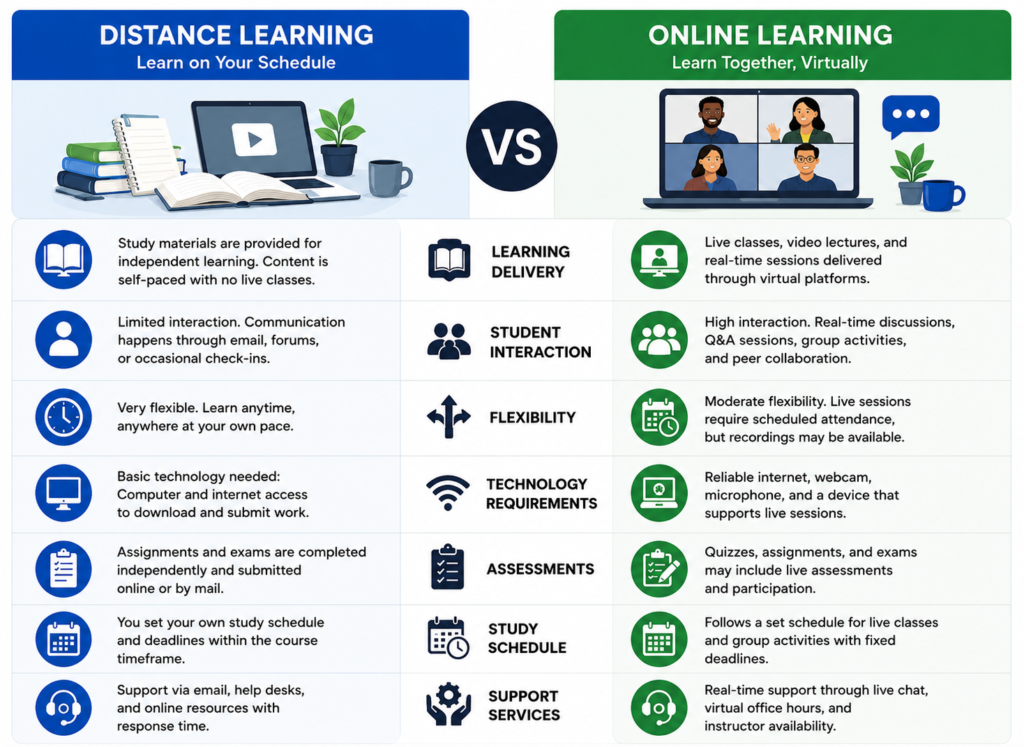
The clearest way to see the distance learning vs online learning divide is side by side.
| Factor | Distance Learning | Online Learning |
| Learning delivery | Blend of print, digital materials, and occasional face-to-face sessions | Almost entirely through a digital LMS |
| Student interaction | Periodic contact sessions, plus virtual support | Continuous virtual interaction via forums, chat, video |
| Flexibility | High, but structured around contact session dates | Very high, largely self-paced |
| Technology requirements | Moderate; some materials can be offline | High; constant internet access needed |
| Assessments | Often in-person exams at study centres | Mostly digital, sometimes with remote proctoring |
| Study schedule | Semi-fixed, built around residential periods | Flexible, learner sets most of the pace |
| Best suited learners | Those wanting structure with flexibility | Those confident with independent, tech-based study |
| Support services | Physical study centres plus online helpdesk | Entirely virtual student support |
Understanding these distinctions matters because the two formats suit different kinds of discipline. Distance learning gives you scheduled touchpoints that can keep you accountable, while online learning demands that you build your own structure.
Read More: Online Courses: How to Choose the Right Program for Career Growth in Nigeria
Which Learning Option Is Right for You?
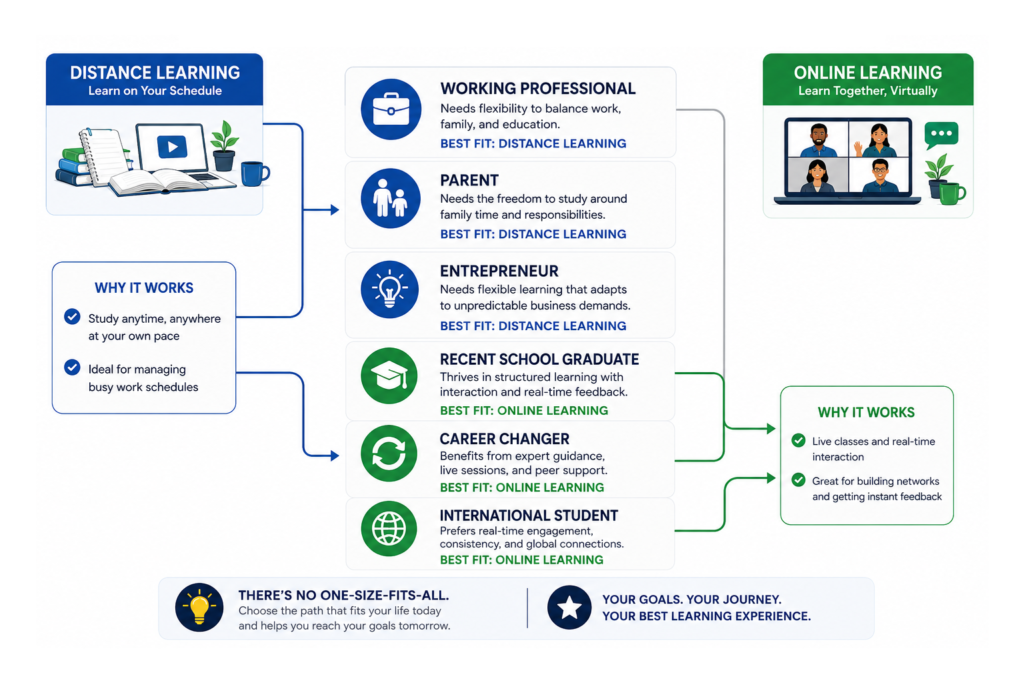
There is no universally “better” choice between distance learning and online learning; it depends on your circumstances, your learning style, and how much structure you need to stay consistent.
- Working professionals often do well with online learning because of its flexible pacing, though those who value scheduled accountability may prefer distance learning’s contact sessions.
- Parents balancing childcare typically benefit from the self-paced nature of online learning, provided they have reliable internet at home.
- Recent school graduates may find distance learning’s periodic in-person sessions helpful for building study discipline before transitioning to fully independent learning.
- Entrepreneurs managing unpredictable schedules tend to favour online learning for its round-the-clock accessibility.
- Career changers studying alongside a full-time job often prefer distance learning programmes that combine evening or weekend contact sessions with remote study.
- International learners and those in areas with unstable internet may find distance learning’s offline materials more practical than a fully online format.
If you are still unsure, consider your access to consistent internet, your comfort with self-directed study, and whether you value the accountability of in-person contact sessions. If self-paced study has fallen apart for you before without a firm deadline in view, the periodic structure of distance learning may be the safer bet.
These remote study programmes are designed to widen access, not to force everyone into the same mould, so match the format to how you actually work. It also helps to ask a prospective institution directly how much of the programme happens online versus in person, since some universities blur the marketing language more than their actual delivery justifies.
Are Both Qualifications Recognised?
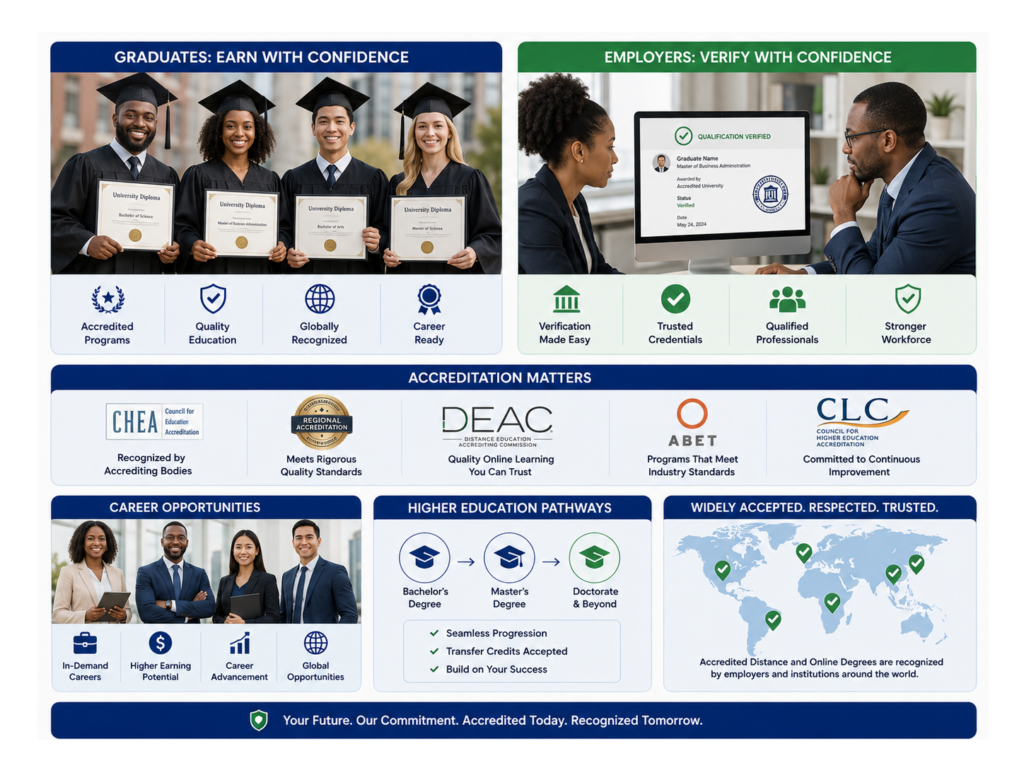
This is arguably the question that matters most, and the honest answer is that accreditation, not study format, determines recognition. A distance learning degree from an NUC-accredited institution carries the same weight as one earned through online learning at another NUC-accredited institution. Employers and graduate schools scrutinise whether the awarding university and programme are properly accredited, not whether classes happened on campus or through a screen.
For employer acceptance and professional recognition, verify a university’s standing through recognised bodies. In Nigeria, that means checking the National Universities Commission’s list of approved institutions and distance learning centres. For comparing international online degree programmes, resources like QS Top Universities can help you gauge institutional reputation before applying. Progression to further study, such as a master’s after a distance-learned bachelor’s degree, is generally smooth as long as the originating institution and programme were accredited throughout your studies. The lesson is simple: choose the institution’s accreditation status first, and let the study format follow from there.
Choosing an Accredited Flexible Learning Provider
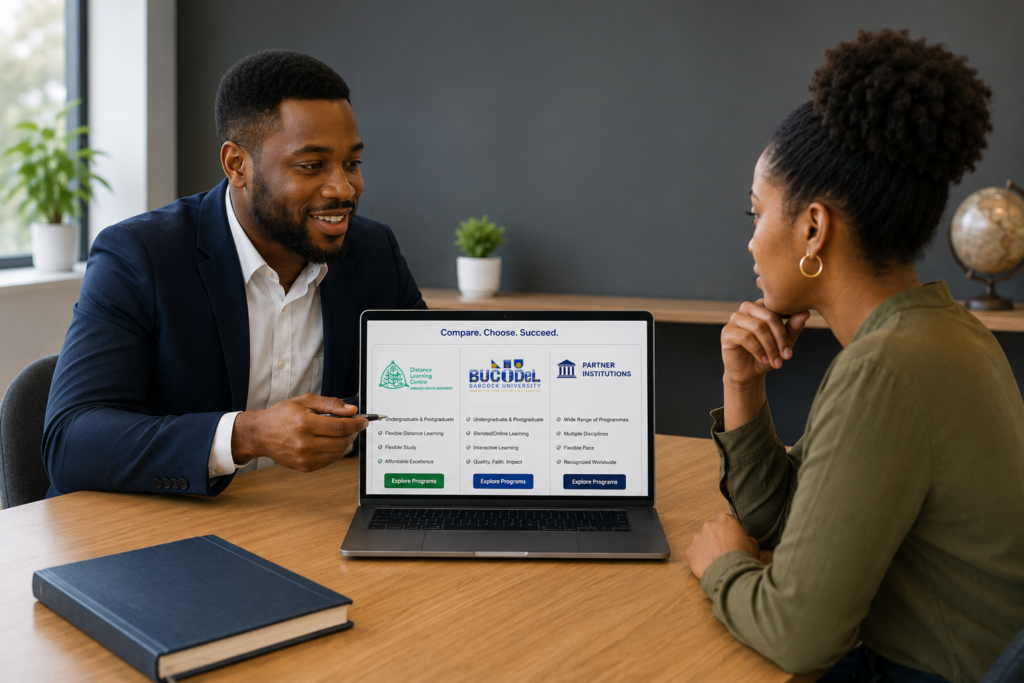
Once you understand the distinction, the next step is finding a provider with genuinely earned accreditation, not just a flexibility claim in its marketing. Two examples worth knowing are the Ahmadu Bello University Distance Learning Centre, which began operations in 2016 and has since expanded to around 21 NUC-approved academic programmes across undergraduate and postgraduate levels, and Babcock University’s Centre for Open Distance and e-Learning (BUCODeL), which delivers ICT-supported open and distance learning with structured learner support across a range of disciplines.
Both are examples of accredited distance learning done properly: clear NUC approval, defined programme structures, and genuine learner support rather than a login page and little else. This is where an education advisor helps. EduTech Business partners with institutions like these to help students compare programmes, verify accreditation, and match study formats to individual circumstances. If you’re weighing a related route, our blog also covers online bachelor’s degrees and online MBA options.
Making Your Decision
Distance learning and online learning both open doors that a rigid, on-campus timetable would otherwise keep shut, but they open different doors. Distance learning suits people who want flexibility without giving up occasional in-person contact, while online learning suits those comfortable managing their entire academic life through a screen. Neither is inherently more prestigious than the other; what determines the value of your eventual degree is the accreditation of the institution that awards it.
Before you commit, confirm the university’s NUC approval, understand how the course will actually be delivered week to week, and be honest about how much structure you need. Getting this right early saves you from switching programmes midway, which costs time and money.
Not sure which learning option fits your lifestyle and career goals? Speak with an EduTech Business advisor to compare accredited distance learning and online programmes from trusted university partners and choose the pathway that’s right for you. Get in touch or explore our partner institutions.
Frequently Asked Questions
Is distance learning better than online learning? Neither is universally better. Distance learning suits learners who want occasional in-person contact and structure, while online learning suits those who prefer fully self-paced, digital-first study. The right choice depends on your circumstances and the accreditation of the institution, not the format itself.
Can I work while studying? Yes. Both formats are designed for study while working, with evening, weekend, or self-paced schedules built around learners who have jobs, businesses, or families.
Are online degrees recognised? Online degrees are recognised when they come from an accredited institution. In Nigeria, confirm that the awarding university and specific programme appear on the NUC’s approved list.
Is distance learning fully online? Not always. Most distance learning combines digital materials with periodic in-person contact sessions or exams, unlike fully online learning, which rarely requires physical attendance.
Which learning option is more flexible? Online learning is generally more flexible day to day since it is largely self-paced, though distance learning still offers considerable flexibility around its scheduled contact sessions.
Which universities offer distance learning programmes? Several NUC-accredited Nigerian universities offer distance learning, including Ahmadu Bello University (through its Distance Learning Centre) and Babcock University (through BUCODeL). Check the NUC’s official list for the full range of approved institutions.