
Tuition fees at Nigerian universities have climbed steadily in recent years, and once you add accommodation, textbooks, and daily upkeep, the true cost of a degree can feel completely out of reach for many families. It’s the single biggest reason capable students delay admission, drop out mid-programme, or abandon postgraduate ambitions altogether. Yet cost doesn’t have to be the deciding factor it often becomes, because a genuine funding ecosystem already exists for those who know where to look, and yes, financial aid to study in Nigeria is available through legitimate, verifiable channels rather than rumour or guesswork.
Student grants in Nigeria are more widely available than most applicants realise, spanning government initiatives, university-administered funds, corporate sponsorships, and international scholarship bodies. The challenge isn’t a shortage of opportunities; it’s that grants, scholarships, bursaries, and loans get lumped together so often that students struggle to tell them apart, let alone know which one actually fits their situation.
This guide breaks down every legitimate funding route, explains who qualifies for what, and shows you how to avoid the mistakes that quietly disqualify strong applicants every year.
Read More: Federal Government Scholarship 2026: Eligibility, Courses, and How to Apply
What Are Student Grants?
A grant is money awarded to a student to cover education costs that does not need to be repaid, typically given based on financial need, a specific field of study, or a defined project or research area. It differs from three other terms people often use interchangeably:
- Scholarships are usually merit-based, awarded for strong academic performance, leadership, or talent, though some blend merit with financial need.
- Bursaries tend to be smaller, one-off awards, often administered by state governments or institutions to help cover a specific gap, such as a single semester’s fees.
- Student loans, such as the federal government’s Nigerian Education Loan Fund, provide upfront funding that must eventually be repaid, usually interest-free but not free of obligation.
The overlap causes real confusion, particularly for first-time applicants comparing education grants Nigeria programmes against scholarship listings that use similar language. The safest approach is to read each opportunity’s actual terms rather than relying on its label: if repayment is mentioned anywhere in the fine print, you’re looking at a loan, not a grant.
Types of Student Grants Available in Nigeria
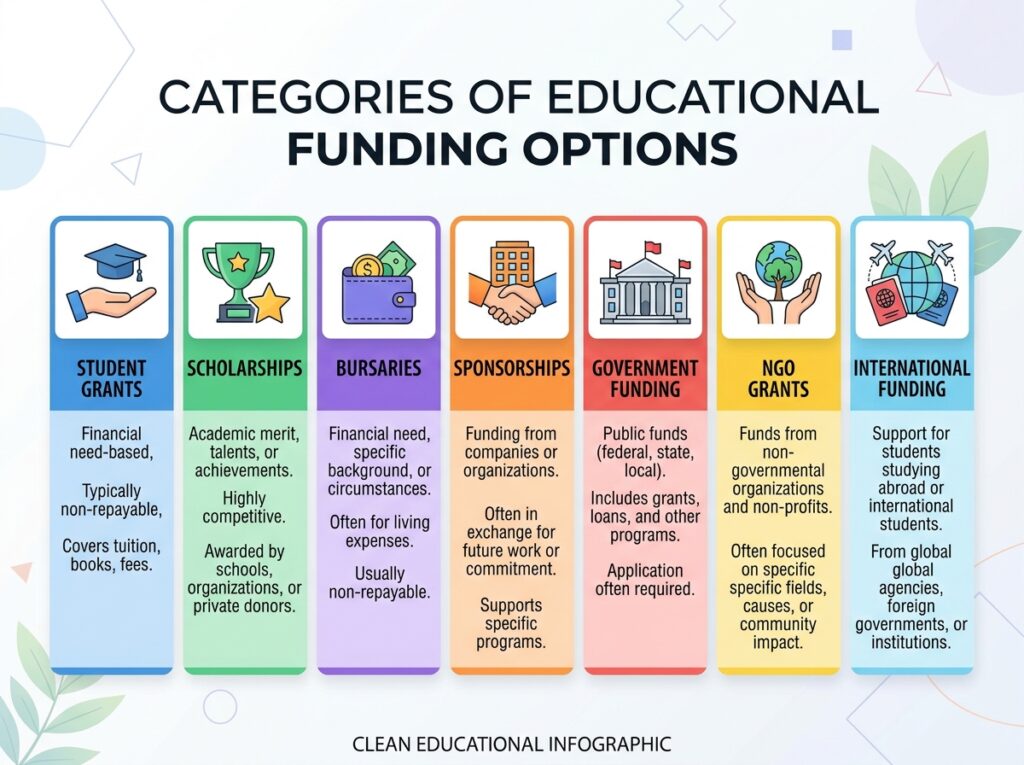
Funding sources generally fall into five broad categories, each with a different application process and set of expectations.
Government grants. Federal and state government agencies fund a range of programmes, from tertiary institution support through TETFund to state-specific bursary schemes that vary by year and budget allocation. TETFund’s Academic Staff Training and Development intervention, for instance, funds postgraduate study for academic staff at accredited Nigerian institutions, illustrating how targeted much of this study funding Nigeria offers actually is. It’s worth distinguishing this from the Nigerian Education Loan Fund (NELFUND), the federal government’s interest-free student loan scheme for undergraduates at public universities, polytechnics, and colleges of education. NELFUND is genuinely useful, but it is a loan, not a grant, since the amount borrowed is repayable once the graduate secures employment.
Private organisations. Foundations and philanthropic bodies run their own scholarship and grant schemes, often tied to a specific cause, region, or field such as STEM or the arts.
Corporate sponsorships. Many companies, particularly in banking, telecoms, and oil and gas, fund education sponsorship schemes for students studying subjects relevant to their industry, sometimes with a guaranteed interview or internship attached upon graduation.
NGO funding. Non-governmental organisations frequently offer smaller, targeted grants aimed at underserved groups, first-generation university students, or students in specific states or regions.
International grants. Bodies such as the Commonwealth Scholarship Commission fund postgraduate study abroad for students from eligible Commonwealth countries, including Nigeria. Commonwealth Master’s Scholarships typically require at least an upper second class (2:1) first degree, cover tuition in full, and include a monthly living allowance for the scholar’s time in the UK, alongside travel costs.
Who Can Apply for Student Grants in Nigeria?

Eligibility varies significantly by scheme, but most funding falls into recognisable categories:
- Undergraduate students pursuing full-time study at an accredited institution, often required to demonstrate financial need or maintain a minimum grade average. Most undergraduate scholarships Nigeria schemes also expect proof of admission and a valid means of identification before an application is even considered.
- Postgraduate students applying for research-linked or field-specific postgraduate funding Nigeria schemes, which frequently prioritise fields tied to national development goals.
- Working professionals returning to study, particularly through employer-linked or industry-specific sponsorships.
- Distance and online learners, who are increasingly eligible for many grant and scholarship schemes, provided their institution and programme are properly accredited.
- Students demonstrating financial need, a common criterion for both government and NGO-administered grants.
- Students with strong academic merit, which remains the primary criterion for most scholarships, even where a financial-need component also applies.
Where Can Nigerian Students Find Grants?
Rather than searching randomly, focus your research on a handful of reliable channels:
- Federal Government initiatives, tracked through the Federal Ministry of Education, which regularly publishes calls for national and international scholarship schemes, including the Commonwealth Scholarship and Fellowship Plan.
- State governments, many of which run their own bursary and scholarship boards for indigenes of the state, with deadlines and criteria that change yearly, so it pays to check your state’s official channels each academic session rather than relying on last year’s information.
- International organisations, including UNESCO and bilateral scholarship commissions, which fund study both within Nigeria and abroad, often with a focus on fields tied to development priorities such as education, health, and technology.
- University-administered funding, since many institutions hold their own endowment or donor-funded grants that never get advertised outside the school itself, meaning a quick visit to your institution’s financial aid or student affairs office can surface options a general web search never will.
- Partner institution guidance, where an education advisor familiar with current schemes can flag opportunities you’d otherwise miss entirely, particularly ones with narrow or short application windows.
Common Mistakes That Cause Grant Rejections

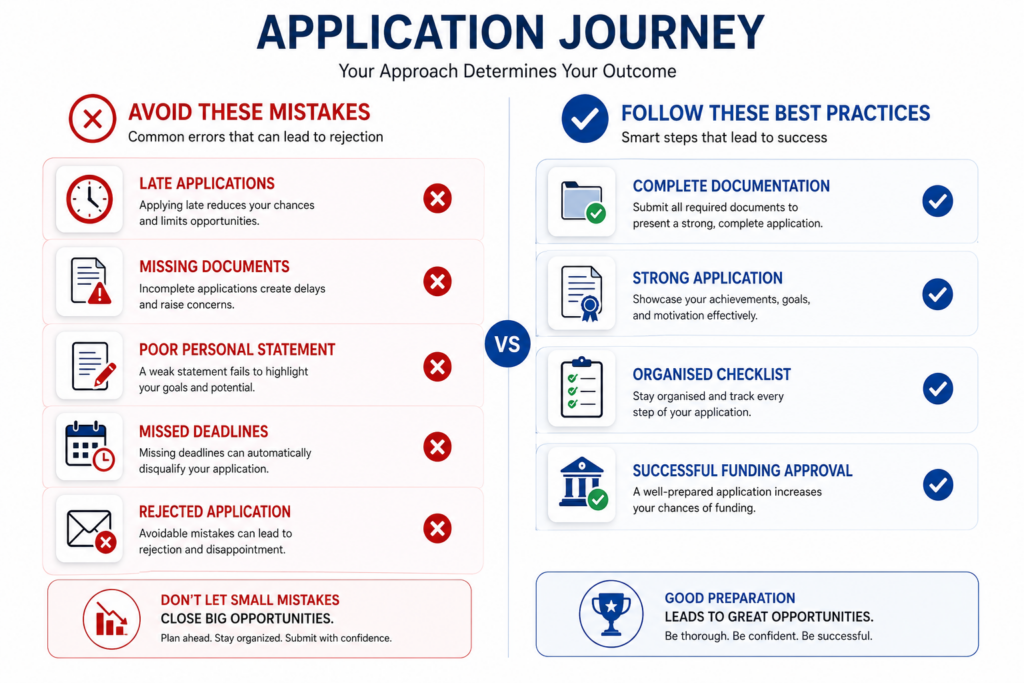
Even strong candidates get rejected, usually for avoidable reasons rather than a lack of merit. Reviewers see the same errors repeated year after year, and most of them have nothing to do with a student’s actual academic ability:
- Submitting applications after the deadline, or right at the wire with no room for technical issues.
- Leaving sections of the form incomplete, assuming reviewers will follow up for missing details.
- Failing to attach required documents, such as academic transcripts, recommendation letters, or proof of admission.
- Submitting generic personal statements that could apply to any applicant, rather than addressing the specific programme’s criteria.
- Applying to schemes without checking eligibility first, wasting time on opportunities that were never a fit.
- Losing track of multiple deadlines across different applications, particularly when juggling several scholarships Nigeria programmes at once.
Read More: Student Emergency Funds in Nigeria: Support for Financial Hardship
Tips to Improve Your Chances
A handful of habits consistently separate successful applicants from the rest, and none of them require exceptional resources, just consistency and planning well ahead of each deadline:
- Apply early. Many strong candidates lose out simply because a scheme closed before they finished preparing.
- Prepare your documents in advance. Transcripts, admission letters, and reference letters can take weeks to obtain.
- Write a genuinely specific personal statement. Reviewers can tell within a paragraph whether a statement was written for this scheme or copied from another one.
- Apply to multiple opportunities. Treating one grant application as your only chance adds unnecessary pressure and limits your odds.
- Keep records organised, including deadlines, required documents, and each scheme’s specific eligibility criteria, so nothing slips through unnoticed.
Education Options That Reduce Financial Pressure
Funding isn’t the only lever available. Choosing a more flexible study format can lower the overall cost of a degree considerably. Distance learning centres such as ABU Distance Learning Centre and Babcock University’s BUCODeL let students study without relocating or resigning from paid work, cutting out accommodation costs and lost income entirely, which is often the largest hidden expense in a traditional degree. Professional certifications offer a similar advantage: a shorter, targeted qualification can build employability at a fraction of a full degree’s cost, while keeping a longer academic pathway open for later.
None of this replaces financial aid Nigeria schemes outright, but combining a lower-cost study format with even a partial grant can make the difference between finishing a programme and abandoning it halfway. A student who secures a modest bursary while studying through an accredited distance learning centre, for instance, may end up covering their full tuition cost, even where the grant alone would only have made a small dent in a full-time residential programme’s fees.
How EduTech Business Supports Students
Navigating government schemes, university-specific funds, and international scholarships at the same time is genuinely difficult without guidance, particularly when criteria and deadlines shift from year to year and rarely get announced through a single, central channel. EduTech Business works with students to match them with accredited partner universities, advise on funding options relevant to their programme and background, and support the practical side of admission, from document preparation to application tracking. Rather than treating funding as an afterthought, the goal is to build it into the admission conversation from the start, so students aren’t left scrambling to find money after they’ve already been accepted. If you’re weighing up study routes alongside funding, our guides on admission without JAMB and the online MBA in Nigeria cover related decisions worth reading alongside this one.
Don’t let finances stop your education. Speak with an EduTech Business advisor to explore funding options and accredited study routes that fit your circumstances.
Frequently Asked Questions
What are student grants? Student grants are funds awarded to cover education costs that do not require repayment, typically based on financial need, field of study, or a specific project. They differ from loans, which must eventually be repaid.
Do grants need repayment? No. Genuine grants do not require repayment, which is what distinguishes them from student loans such as NELFUND. Always read a scheme’s terms carefully, since some programmes described informally as “grants” are actually conditional loans.
Who qualifies for student grants in Nigeria? Eligibility depends on the specific scheme, but common criteria include financial need, academic merit, enrolment at an accredited institution, and sometimes a specific field of study or state of origin.
Can online students receive grants? Yes, provided their institution and programme are properly accredited. Distance learners at recognised centres such as ABU DLC or Babcock’s BUCODeL are generally eligible for the same grants and scholarships as full-time, on-campus students.
Are grants different from scholarships? Yes. Grants are typically need-based and don’t require repayment, while scholarships are usually merit-based, though many schemes blend both criteria. Reading the specific terms of each opportunity is the only reliable way to tell them apart.
Where can I apply for student grants in Nigeria? Start with the Federal Ministry of Education’s announcements, state government scholarship boards, university financial aid offices, and international bodies like the Commonwealth Scholarship Commission, and confirm each scheme’s eligibility before applying.



2 Responses
Thank for this important discussion and advice
I want a loan to assist my education