“I have a degree, so why am I still struggling?” If you have said this or heard someone close to you say it, you are not alone. It is one of the most common and most painful questions in Nigerian career conversations right now. Graduates with first and second-class results are sending hundreds of applications and hearing nothing back. Meanwhile, some people without degrees are landing roles in tech companies, fintech firms, and digital agencies. The experience is disorienting, and it deserves an honest explanation.
The tension at the heart of the skills vs degree in Nigeria’s job market debate is real, but it is not binary. Degrees have not become worthless; they have become insufficient on their own. A report by the Jobberman Foundation found that six out of ten Nigerian graduates lack the skills necessary for available jobs, even as employers in technology, fintech, and data analytics cannot find qualified candidates to fill open roles. The gap is not between education and ignorance; it is between academic knowledge and applied, demonstrable capability.
Read More: How to Build a Strong Student Portfolio Before University
What Nigerian Employers Actually Look For
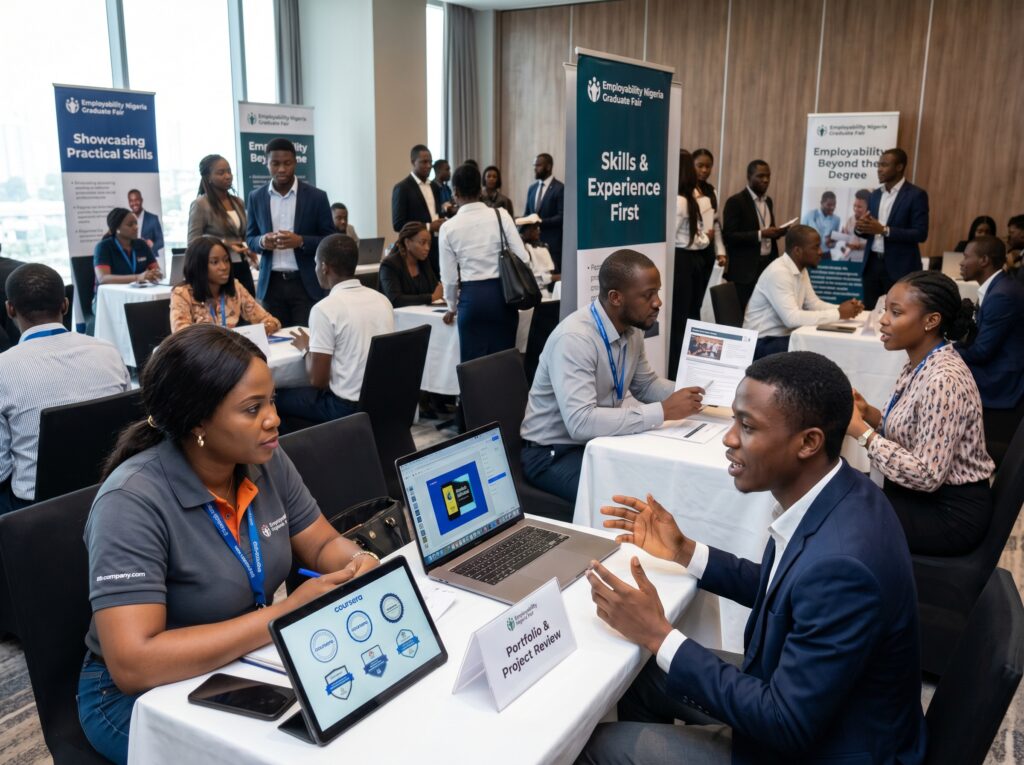
Hiring managers in Nigeria’s most competitive sectors are not scanning CVs for degree classifications first. They are asking a more direct question: can this person do the job?
In technology, fintech, digital marketing, data analytics, and consulting, the evaluation criteria have shifted. Practical capability, communication, adaptability, and relevant credentials now matter more than the prestige of an institution alone. A software developer with a GitHub portfolio showing three real projects stands out far more than one who lists a Computer Science degree with no visible output. A marketing hire who can walk through a campaign they built and its results gets shortlisted faster than one who scores top marks in a marketing theory course.
Individuals with postgraduate or post-secondary degrees actually face some of the highest unemployment rates in Nigeria, around 9%, compared to 6.9% for secondary-educated persons. This is not an argument against education. It is a clear signal that the type and application of education matter enormously.
Employers increasingly evaluate:
- Technical and digital skills relevant to the specific role
- Communication and problem-solving ability
- Portfolio work, case studies, or freelance experience
- Certifications from credible professional bodies
- Demonstrated adaptability and willingness to learn
Where Degrees Still Matter

A balanced view of the skills vs degree debate in the Nigerian job market means acknowledging where formal qualifications remain non-negotiable. This matters because the answer is not to abandon degree programmes; it is to understand their place.
In medicine, law, engineering, and pharmacy, licensure requirements mean no amount of self-taught skill substitutes for the degree. In accounting and finance, professional certification pathways such as ICAN and ACCA typically require a university degree as a prerequisite. In government and public service, entry-level and senior positions are formally structured around academic qualifications. For anyone with ambitions of postgraduate study abroad, a degree remains the baseline requirement for admission.
Beyond regulatory contexts, a degree still signals something meaningful to employers: the capacity to commit to a structured programme, follow through over several years, and meet academic standards. In senior leadership and management tracks, particularly in larger organisations, formal credentials still carry weight in promotion decisions.
The degree remains a credibility document. It opens doors, particularly early in a career and in international contexts. What it can no longer do on its own is close deals. For that, skills are required.
Read More: LinkedIn Profile for Freshers
The Winning Combination: Degree Plus Skills Credential

This is where the skills vs degree debate in the Nigerian job market moves from diagnosis to solution. The candidates consistently getting hired in competitive Nigerian industries are not purely self-taught coders or purely theory-trained graduates. They are people who hold both.
Consider the practical impact of these combinations:
- ABU DLC degree in Business Administration + a Google Data Analytics certification: Positions someone for roles in business intelligence, e-commerce analytics, or corporate strategy.
- Computer Science degree + a Cybersecurity certification: Opens pathways into one of Africa’s fastest-growing professional fields, with strong remote work potential.
- Accounting degree + Digital Marketing skills: Equips professionals for financial marketing roles in fintech and banking, where both disciplines are increasingly converging.
The World Economic Forum’s Future of Jobs Report 2025 projects that 170 million new jobs will be created globally by 2030, with the fastest-growing roles concentrated in technology, data, and green energy. The common factor across these roles is that they require both structured educational foundations and practical, up-to-date technical skills. Neither alone is enough.
For Nigerian graduates, combining credentials creates real advantages: broader employability, stronger salary negotiating positions, faster hiring timelines, and greater adaptability when job markets shift.
Programmes That Help You Build Both

The good news for Nigerian students and professionals is that accessing this combination has become significantly more achievable through flexible online learning options.
EduTech Business partners with credible, NUC-approved institutions to help learners access structured degree programmes alongside career-focused certifications. Key options include:
ABU Distance Learning Centre (ABU DLC): One of Nigeria’s most established distance learning centres, offering undergraduate and postgraduate programmes across business, administration, and the sciences. Students can study fully online while simultaneously pursuing professional certifications in their chosen field.
Babcock University BUCODEL: Offers NUC-accredited online degrees in Computer Science and Accounting, designed for working learners who want academic credibility with flexible scheduling.
Ingryd Academy: Focused on practical technology skills, including data analytics, software development, and cloud computing, providing certifications that complement degree programmes.
I-Con Business School: Offers business-focused professional programmes suited to career advancement in management, entrepreneurship, and financial services.
The critical point about these options is not that they are convenient. It is that they are designed with employability as the outcome, not simply certification as the goal.
How to Build Your Personal Education Stack
Rather than choosing between a degree and skills development, the most career-ready Nigerian graduates are building what might be called a personal education stack: a deliberate combination of qualifications, credentials, and experience assembled over time.
Here is a practical framework:
- Choose your core degree programme aligned with your long-term career direction, whether through traditional campus study or an NUC-approved distance learning route.
- Identify one high-income skill relevant to your field: data analysis, digital marketing, software development, UX design, or cybersecurity are among the strongest options in Nigeria’s current job market.
- Build portfolio projects that demonstrate the skill in action. These do not need to be paid work; personal projects, volunteer work, and open-source contributions all count.
- Gain practical experience through internships, freelance work, or contract roles as early as possible in your degree programme, not after graduation.
- Update your skills annually. The WEF estimates that 44% of workers’ core skills will need to change by 2030. A one-time qualification is not a career strategy.
The question worth asking yourself right now is not just: what does my degree qualify me for? It is: what skill makes me employable beyond my certificate?
The Future of Employability in Nigeria
The trajectory of Nigeria’s job market points clearly in one direction: continuous learners will consistently outcompete one-time graduates. Nigeria produces approximately 600,000 graduates annually, and that number grows each year. The credential alone is no longer a differentiator.
AI is already reshaping entry-level roles in writing, data entry, customer service, and administrative work. Remote work is expanding the talent pools that Nigerian professionals compete in, both domestically and internationally. Project-based hiring, where employers evaluate specific past work rather than formal qualifications, is becoming more common in technology and creative industries. Lifelong learning is no longer a professional virtue; it is a career requirement.
The graduates and professionals who will thrive in this environment are those who treat education as an ongoing process, not a phase of life that ends at convocation. A degree is a starting point. Skills are what you build on top of it. The most employable people in Nigeria are those who understand exactly that.
How EduTech Business Supports Your Career Path
Navigating the options available, from degree programmes to professional certifications to online learning pathways, can feel overwhelming without the right guidance. EduTech Business exists to remove that confusion. By connecting students with NUC-approved degree programmes and career-focused certification partners, EduTech Business helps learners build the combined credential profile that employers in Nigeria’s most competitive sectors are looking for.
Whether you are just starting out and choosing your first programme, or a working professional looking to add a qualification that advances your career, the EduTech Business blog and advisory team can help you find the right combination.
Frequently Asked Questions
Are degrees still worth it in Nigeria? Yes, but not on their own. Degrees provide credibility, open doors in regulated professions, and remain necessary for postgraduate pathways. The issue is that a degree alone no longer guarantees employment in competitive industries.
What do employers value more: skills or degrees? In technology, fintech, digital marketing, and data analytics, demonstrable skills and portfolio work often carry more immediate weight. In law, medicine, engineering, and government, formal qualifications remain non-negotiable. The strongest candidates present both.
Can certifications help me get a better job? Certifications from credible bodies, especially in technology and business, can significantly improve your employability and salary potential. They work best when paired with a degree or substantial practical experience.
How can students combine skills and university education? Enrol in a flexible NUC-approved degree programme, such as those offered through ABU DLC or Babcock BUCODEL, and pursue professional certifications or skills training in parallel. Use internships and freelance opportunities to build a portfolio while still studying.
Ready to find the right combination for your goals?
Talk to an EduTech Business advisor. Find the right mix of degree programmes and career-focused certifications built for long-term success.