Every year, hundreds of thousands of students compete for places at universities worldwide. UCAS alone manages nearly three million applications annually, and that competition is only intensifying. Strong grades are necessary, but they are no longer sufficient on their own. Admissions officers at selective institutions are asking a deeper question: who is this student beyond their transcript? A well-crafted student portfolio is how you answer that question compellingly, and building one early can be the difference between an application that gets noticed and one that gets overlooked.
The students who build the strongest portfolio for university applications are those who begin long before they ever open an application form. They document their journey, their growth, and their passions over time, and by the time applications open, they have a rich body of evidence to draw from. This guide walks you through exactly what a student portfolio is, what it should contain, and how to start building one that genuinely strengthens your candidacy.
Read More: What Students Should Prepare Before Applying to Universities
Why a Student Portfolio Matters

Universities now adopt a holistic review process, assessing extracurricular involvement, leadership roles, personal statements, and recommendations alongside academic results. When two applicants have similar grades, something else tips the scales: evidence of character, initiative, and real-world engagement. That is precisely what a strong student portfolio provides.
Attributes such as self-discipline and persistence significantly affect education, the labour market, and life outcomes, which is partly why universities care so much about seeing those qualities demonstrated. An academic portfolio gives admissions officers tangible proof, not just your word for it.
What Is a Student Portfolio?

A student portfolio is a curated, organised collection of your academic work, achievements, and experiences. Think of it as your personal evidence file, a document that shows what you have done, what you have learned, and who you are becoming. It differs from a CV or résumé in one important way: rather than listing activities, it demonstrates them. Instead of writing “participated in science club,” a portfolio includes the project you completed, the award you won, or the write-up you produced.
There are several types of portfolios worth knowing about:
- Academic portfolios showcase coursework, research projects, essays, and subject-specific achievements.
- Creative portfolios are used by students applying to art, design, architecture, or media programmes, featuring original creative work.
- Professional portfolios highlight skills, certifications, internship experience, and career-relevant accomplishments.
Many students benefit from combining elements of all three, depending on their chosen course. The key point is that a portfolio is curated, not comprehensive. You choose what goes in.
Read More: How to Choose the Right Career Before Choosing a Degree
Key Elements to Include in a Student Portfolio

Knowing what to put in a student’s achievements portfolio is where many students get stuck. Here is a practical breakdown of the sections that matter most.
Academic achievements: Include high-scoring assignments, commendations from teachers, or subject prizes. If you produced research you are proud of, include it with a brief explanation of what you investigated and what you found.
Projects and personal work: Independent projects signal initiative. This could be a coding project, a business idea you developed, an essay you wrote outside of class, or a science experiment you conducted on your own. Admissions officers value students who seek out other ways to engage, such as taking online courses, participating in regional programmes, or starting a project, as proactive initiatives often stand out.
Certificates and awards: Short courses completed through platforms like Coursera count. Competition placements and recognition at any level, local, national, or international, all deserve a place in your portfolio.
Volunteer work and community involvement: Community service demonstrates that you care about something beyond yourself. Consistent involvement in one cause is more impressive than a scattershot list of one-off events.
Leadership roles: Prefect positions, club leadership, team captaincy, or organising a school initiative all show that you can take responsibility and motivate others. Even informal leadership counts if you can explain the impact it had.
Each element strengthens your application by turning abstract claims into concrete evidence.
How to Start Building Your Portfolio Early
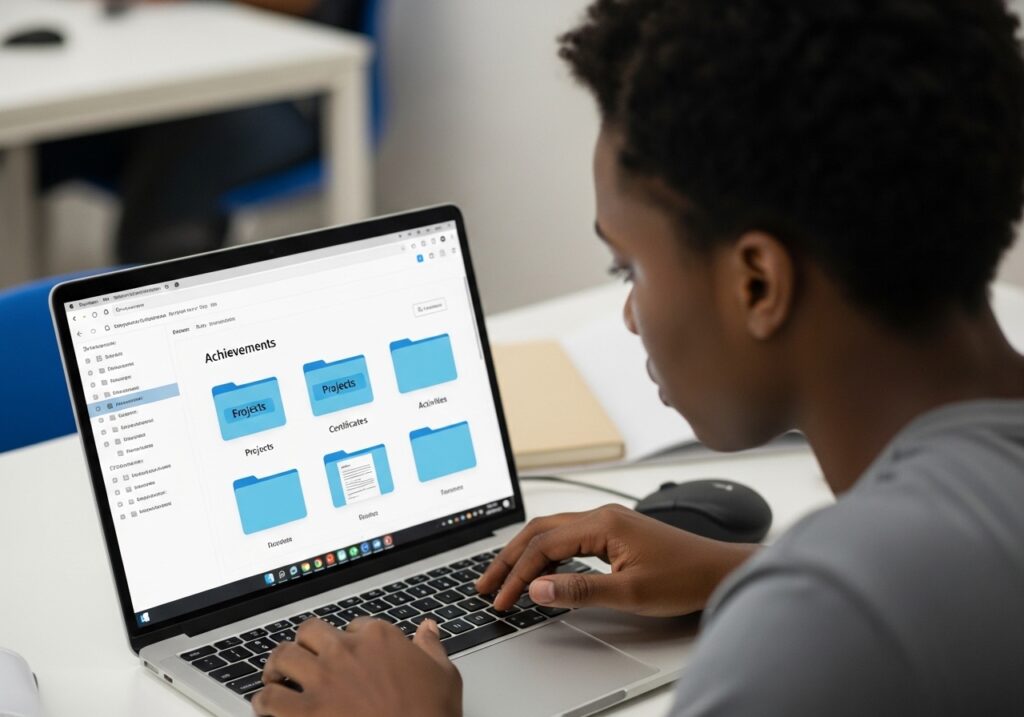
The earlier you start, the richer your portfolio becomes. Here are four practical ways to begin:
- Enter competitions. Subject Olympiads, essay contests, debating championships, and entrepreneurship competitions all generate achievements worth documenting. Even participation, with a strong reflection on what you learned, adds value.
- Take short online courses. Platforms like Coursera and others offer free and paid courses across virtually every subject area. Completing a course in data analysis, creative writing, or public health shows academic curiosity outside the classroom.
- Join clubs or community initiatives. Whether it is a robotics club at school or a youth leadership programme in your community, sustained involvement builds a track record.
- Create personal projects. Start a blog, build an app, run a small social enterprise, or conduct independent research on a topic that interests you. These projects demonstrate that you are driven by genuine curiosity, not just the desire to impress an admissions panel.
Read More: 5 Mistakes Students Make When Applying for Online Degrees and How to Avoid Them
Organising Your Portfolio for University Applications

Structure matters. A disorganised portfolio undermines the work you have put into building it.
Use clear sections: Divide your portfolio into categories: academic work, extracurricular activities, certificates, leadership, and community involvement. Each section should include a brief introduction explaining what it contains and why it is relevant to your chosen course.
Digital is usually best: Most universities now accept or prefer digital submissions. Tools like Google Sites, Notion, or a well-formatted PDF give you flexibility and allow you to include hyperlinks and supporting documents.
Keep it focused: Quality beats quantity. Depth of commitment matters more than a long list of activities; showing consistency and growth over time says a lot about discipline and motivation. Choose your best ten to fifteen pieces of evidence rather than trying to include everything.
Annotate your work: A brief note explaining each item, what it is, why you included it, and what you learned, transforms a collection of documents into a compelling narrative about your development.
Common Mistakes Students Make

Even motivated students make avoidable errors. Watch out for these:
- Including irrelevant material. Everything should connect to the story you are telling about yourself and your interest in your chosen field.
- Providing no proof. Claiming you led a project without any supporting evidence carries little weight. Attach certificates, photographs, or links wherever possible.
- Overloading the reader. A portfolio stuffed with every piece of work you have produced is exhausting to review. Be ruthless about curation.
- Poor formatting. Inconsistent fonts and unclear structure signal a lack of care. Presentation reflects how seriously you take your own work.
- Waiting too late. A portfolio built in a rush, three weeks before a deadline, looks exactly like what it is.
How EduTech Business Helps Students Strengthen Their Applications
Building a strong student portfolio is far easier with expert guidance. At EduTech Business, we work with students from secondary school through to university entry, helping them identify their strengths, document their achievements, and present their profiles compellingly.
Our advisors provide personalised support on building an academic portfolio, selecting relevant extracurricular activities, preparing for scholarship applications, and navigating international admissions processes. We partner with leading local and international institutions to ensure students understand exactly what each programme is looking for and how to position themselves accordingly.
Whether you are at the beginning of your secondary school journey or in the final stretch before applications open, there is no better time to start than now. Explore our resources on the EduTech Business blog or reach out to our team directly to learn how we can help you build an application that truly stands out.