An online bachelor’s degree lets you earn a degree online without stepping away from your job, your income, or the responsibilities waiting for you at home. For a growing number of working adults, it has become the most realistic route back into higher education, and often the only one that fits their calendar.
A decade ago, going back to school meant choosing between a paycheque and a lecture hall. That trade-off has largely disappeared. Today, an online bachelor’s degree allows you to study for a degree while working full time, raising a family, or running a business, using the same laptop you already rely on for everything else. Whether you left secondary school years ago without finishing a first degree, or you already hold a diploma and want to build on it, the option to earn a degree online now exists at a scale that simply was not available a generation ago. This guide walks you through what these programmes actually involve, who they suit, what they cost in time and effort, and how to choose one that will hold up in the job market rather than gather dust on a CV.
Read More: How Employers View Online Degrees in 2026
Why More Adults Are Choosing Online Bachelor’s Degrees
The shift towards a flexible bachelor’s degree is not a passing trend; it reflects how work, family life, and ambition have all changed shape over the past few years. Career advancement increasingly depends on formal qualifications that many professionals postponed earlier in life, whether because of finances, family responsibilities, or simply not being ready at eighteen to commit to four years on a campus.
A few forces are driving demand for online undergraduate programmes across Nigeria and beyond:
- Career pressure. Promotions and lateral moves increasingly require a first degree, especially in banking, telecoms, logistics, and the public sector.
- Flexibility. Recorded lectures, downloadable materials, and asynchronous assignments mean you can study at eleven at night once the children are asleep, or during a lull between meetings.
- Rising acceptance among employers. The 2025 GMAC Corporate Recruiters Survey found that 57% of technology recruiters now place equal value on graduates of online or hybrid programmes compared with those who studied entirely in person, a meaningful shift from just a few years ago, when online study still carried a stigma in many hiring circles.
For Nigerian professionals in particular, balancing work and study has become closer to the norm than the exception, and an online bachelor’s degree removes the geographic barrier that once made continuing education impossible for anyone outside a handful of major cities. You no longer need to relocate to Zaria, Ilishan-Remo, or Lagos to earn a qualification from a respected institution based there.
A flexible bachelor’s degree also removes much of the guilt that once came with studying “for yourself” while everyone else depended on you; the schedule bends around your life instead of demanding you bend around it. There is also a quieter, more personal driver behind this shift. Many working adults carry a sense of unfinished business from earlier in life, a degree they postponed for financial reasons, a family emergency, or simply bad timing. The ability to earn a degree online, on their own terms and without giving up the income they now depend on, has turned that unfinished business into something achievable rather than a permanent regret.
What Is an Online Bachelor’s Degree?
An online bachelor’s degree is an undergraduate qualification delivered primarily, or entirely, through digital platforms rather than physical classrooms. You still complete the same number of credit units as a campus-based student, sit the same categories of assessments, and receive a certificate that, when the institution is properly accredited, carries the same academic weight as one earned on campus.
Learning under this model typically combines several elements working together:
- Recorded and occasionally live sessions, delivered through a learning management system you can access from a phone, tablet, or laptop.
- Written assignments, quizzes, and proctored examinations, used for continuous and final assessment in roughly the same proportions as traditional degrees.
- Occasional physical contact sessions, depending on the institution’s specific model and the demands of practical subjects such as the sciences.
In Nigeria, an accredited online degree must be approved by the National Universities Commission (NUC), which sets minimum academic standards for open and distance learning centres and reviews them periodically. Duration generally mirrors traditional study, typically four years for direct entry candidates and somewhat shorter for those transferring credits from a diploma or HND, though genuinely self-paced formats can extend this timeline if a student needs more room to breathe. It is worth remembering that “online” describes the delivery method, not a lower academic standard; the underlying degree classification, credit requirements, and examination rigour are set by the same accreditation framework that governs campus-based study.
Read More: Can You Work Full-Time While Studying? What Students Should Know
Who Should Consider an Online Bachelor’s Degree?
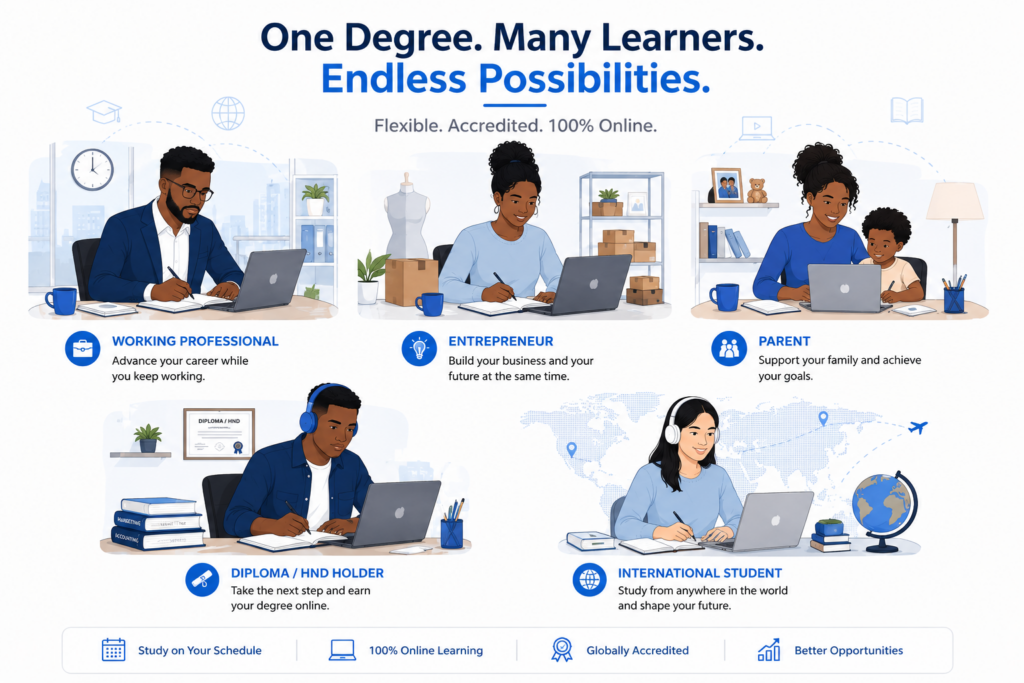
This format suits a far wider range of people than the stereotypical image of a busy executive squeezing in coursework between flights. It is worth considering if you are:
- A working professional seeking a promotion, a pay rise, or eligibility for a role that specifies a degree as a minimum requirement.
- A career changer moving into a field, such as technology, project management, or healthcare administration, where a fresh undergraduate degree online opens doors that experience alone cannot.
- A parent who cannot commit to fixed lecture timetables built around a traditional academic calendar.
- An entrepreneur who needs credentials to win contracts, attract partnerships, or reassure investors that the business has capable leadership behind it.
- A diploma or HND holder looking to convert existing credits into a full accredited online degree rather than starting from scratch.
- An international student who wants a Nigerian-recognised qualification without the cost and disruption of relocating.
What unites these groups is a need for structure that adapts to their existing lives, rather than lives that must be rearranged around a rigid institution.
Benefits of Studying While Working
Choosing to study for a degree while working is demanding, but the advantages are substantial once the programme is well matched to your circumstances and your temperament as a learner.
- Flexible schedules. Most online undergraduate programmes allow you to complete coursework across evenings, weekends, or whatever windows your job leaves open, rather than around a fixed nine-to-five timetable.
- Immediate application of learning. A module on management, data analysis, or communication can often be applied at work the same week it is taught, which reinforces retention far more effectively than theory learned in isolation.
- Reduced career interruption. You keep your salary, your seniority, and your professional network intact while studying, rather than pausing your career for three or four years to sit in a classroom.
- Income stability. Unlike full-time residential study, you are not trading years of earnings for a certificate; the two run in parallel, which matters enormously if you have dependants relying on that income.
- Faster career progression. Many employers tie promotions or salary bands directly to degree completion, so finishing an online bachelor’s degree sooner rather than later has a direct financial payoff.
The trade-off is that this path demands genuine discipline, which is precisely why choosing the right programme and support structure matters so much before you commit. A degree earned while juggling a full workload also tends to signal something specific to employers: that you can manage competing priorities under real pressure, a quality that no amount of classroom theory can teach on its own.
How to Choose the Right Online Bachelor’s Programme
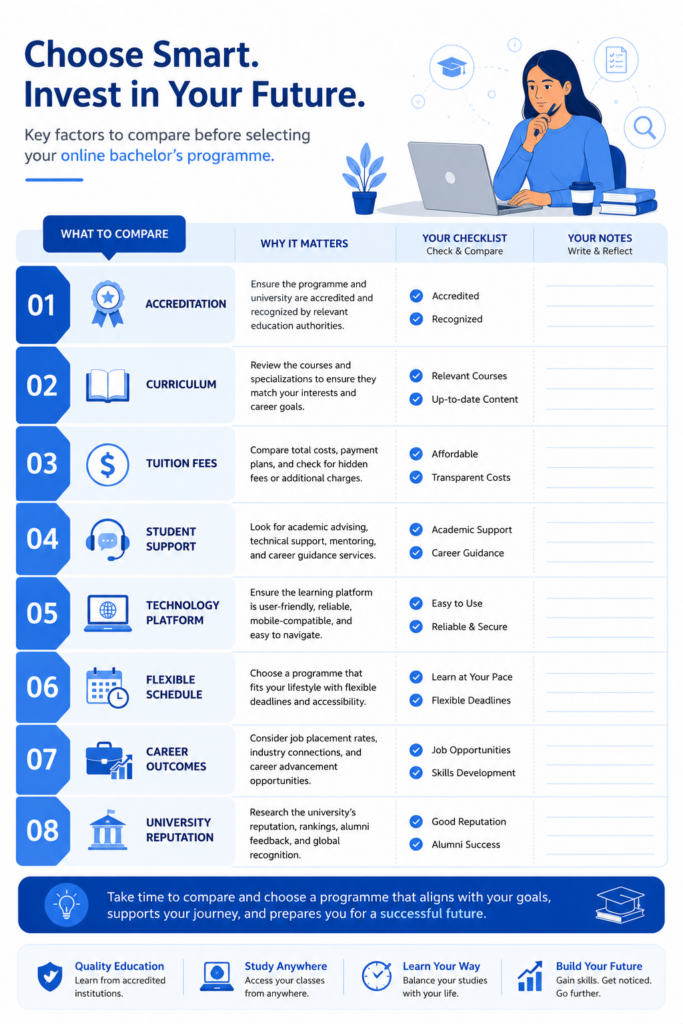
Not all online undergraduate programmes are equal, and the wrong choice can cost you time, money, and career credibility, sometimes all three at once. Evaluate any option against these criteria before you enrol.
- Accreditation. Confirm that the NUC, or an equivalent recognised body abroad, approves both the institution and the specific programme. This single factor determines whether employers and professional bodies alike will respect your qualification.
- Curriculum. Does the syllabus align with current industry needs, or does it read as though it has not been updated in a decade?
- Faculty. Are lecturers active practitioners or researchers, and are they genuinely accessible when you have questions outside scheduled sessions?
- Student support. Is there dedicated academic advising, responsive technical support, and career counselling built into the programme, or are you left to figure things out alone?
- Tuition and payment structure. Are instalment plans available, and are there hidden costs for materials, resits, or examinations that only appear after enrolment?
- Technology platform. Is the learning portal stable, mobile-friendly, and easy to navigate on the kind of internet connection you actually have?
- Flexibility. Can you pause a semester if work demands intensify, without losing your place or your accumulated credits?
- Career outcomes. What do graduates typically go on to do, and does the institution actually track and publish this information?
Quick decision checklist
- Is the programme NUC-accredited, or accredited by an equivalent body?
- Does the curriculum genuinely match my career goals?
- Can I comfortably afford the tuition, including any hidden costs?
- Does the platform work reliably on my devices and internet connection?
- Is there real human support available when I get stuck?
Common Challenges and How to Overcome Them
Every online undergraduate degree journey includes friction points, and pretending otherwise does nobody any favours. The difference between finishing and quietly dropping out usually comes down to preparation rather than intelligence or motivation alone.
- Time management: Block study time in your calendar as you would a client meeting, and defend it with the same seriousness.
- Motivation: Join or form a small study group with coursemates; accountability to other people is often stronger than accountability to yourself.
- Internet access: Download materials in advance wherever the platform allows it, so a bad network day does not derail your week.
- Balancing responsibilities: Communicate your study schedule clearly to family, colleagues, or a partner so expectations are set rather than assumed.
- Study planning: Break each module into weekly targets rather than facing the whole semester as one intimidating block.
None of these challenges is unique to Nigerian learners, but local realities, such as inconsistent power supply and data costs, make planning ahead especially important rather than optional. A student who builds in buffer time for network outages, and who treats the first few weeks of a semester as a chance to establish routines rather than rush ahead, tends to finish stronger than one who assumes everything will run smoothly by default.
Online Bachelor’s Degree vs Traditional Degree
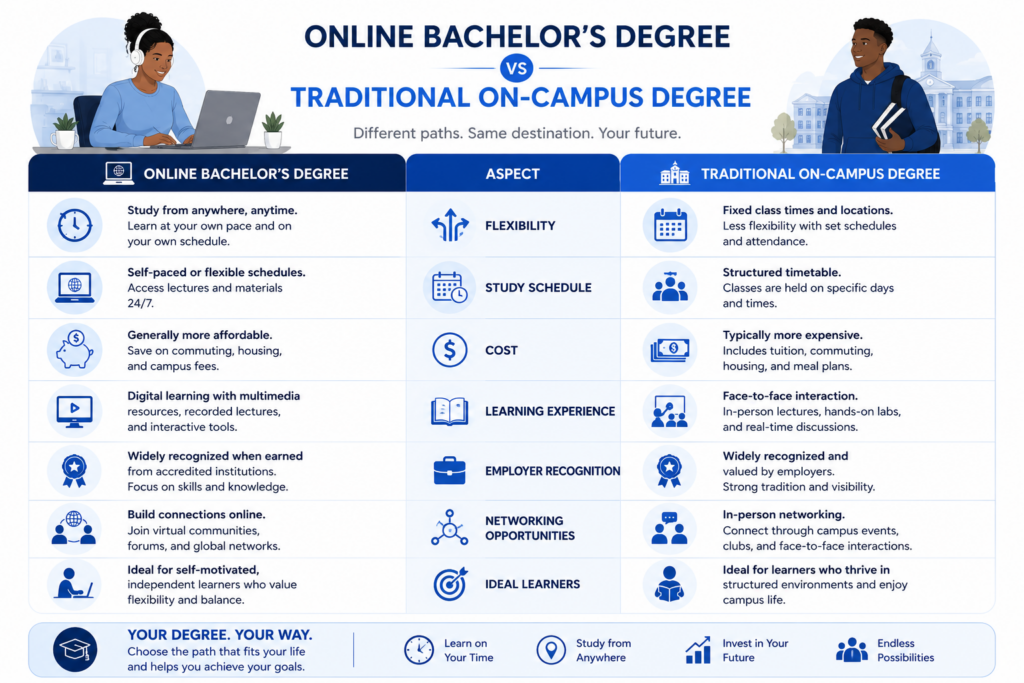
| Factor | Online Bachelor’s Degree | Traditional Degree |
| Flexibility | High: study fits around work and family | Low: built around a fixed timetable |
| Cost | Often lower: no relocation or accommodation | Higher: includes housing and daily transport |
| Learning experience | Self-directed and digital-first | Structured and delivered in person |
| Networking | Virtual cohorts and alumni communities | Face-to-face campus life and societies |
| Employer recognition | Growing steadily, strongest when accredited | Long-established and rarely questioned |
| Ideal learner | Working adults, parents, and career changers | School leavers and full-time students |
Both paths can lead to strong outcomes; the right one depends on your current obligations and learning style, not on which is objectively superior on paper. If you are already earning a living and supporting others, the flexibility of an online format is rarely a downgrade; it is simply a different route to the same destination.
How EduTech Business Helps You Choose the Right Programme
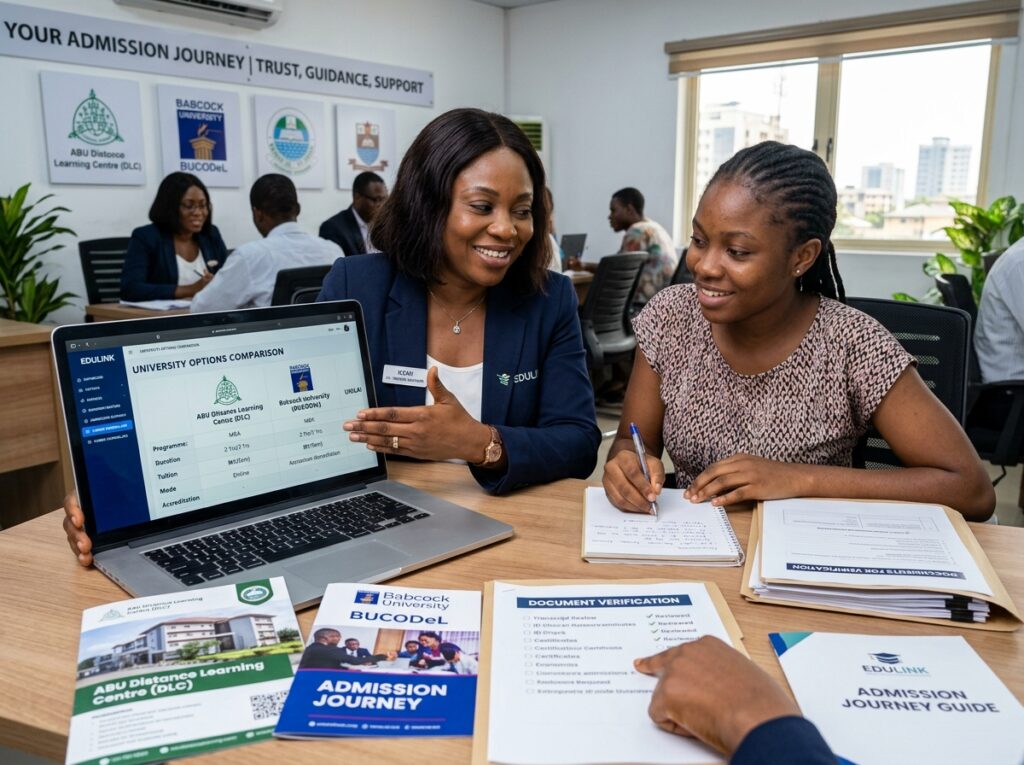
Choosing among the many online undergraduate programmes now available can feel overwhelming, particularly when institutions market themselves aggressively, and the marketing does not always match the substance behind it. EduTech Business exists to simplify that decision for you, drawing on direct relationships with accredited institutions rather than relying solely on what each university’s own admissions page chooses to highlight.
We help prospective students compare accredited options, including established distance learning centres such as ABU Distance Learning Centre and Babcock University’s BUCODeL, against their career goals, budget, and available study time. Our support includes:
- Programme comparison across accreditation status, cost, and curriculum relevance.
- Admissions guidance to identify the right entry route given your existing qualifications.
- Document support for applications, transcripts, and credit transfers.
- Career counselling to align your choice of an accredited online degree with your five-year plan rather than a generic checklist.
- Ongoing student assistance throughout your studies, not just at the point of enrolment.
You can explore further guidance on our blog, review our current partner institutions, or read related coverage on choosing online courses if you are still deciding between a short course and a full undergraduate degree online.
Frequently Asked Questions
Is an online bachelor’s degree recognised? Yes, provided it is awarded by an institution and programme accredited by the NUC in Nigeria, or an equivalent recognised body elsewhere, and this is the single detail worth verifying before you pay any fees.
Can I study while working full-time? Yes. Most online undergraduate programmes are deliberately designed around asynchronous learning so that you can study while working full-time without requesting leave.
How long does an online bachelor’s degree take? Typically four years for direct entry students, though credit transfers or self-paced formats can shorten or occasionally extend this depending on your circumstances.
Is an online bachelor’s degree cheaper? Usually, yes, since you avoid relocation, accommodation, and daily transport costs, although tuition itself still varies considerably by institution and programme.
Which online bachelor’s degree is best? The best programme is the one that is properly accredited, fits your budget, and matches your career direction, not necessarily the option with the loudest advertising.
Ready to earn your bachelor’s degree without putting your career on hold? Speak with an EduTech Business advisor to compare accredited online undergraduate programmes and find the best option for your career goals.