Every year, hundreds of thousands of Nigerian families celebrate JAMB results, admission letters, and acceptance fees. The excitement is real. But so is the financial shock that tends to follow. Most students enter university having budgeted for tuition alone, only to discover that tuition is often the smallest line item in a much longer list of expenses. The cost of university education in Nigeria, when calculated honestly from admission to graduation, stretches far beyond what most students and parents anticipate.
This guide breaks down exactly what that cost looks like, across federal, state, and private institutions and what you can do to plan and fund it without drowning financially.
Read More: How to Choose the Right Nigerian University: A Student’s Guide to Admission Success
Why the Cost of University Education in Nigeria Is More Than Just Tuition
Nigeria’s higher education landscape is wide. At one end, federal universities charge undergraduate tuition of between ₦50,000 and ₦200,000 per session for most programmes. At the other end, private universities like Wigwe University charge as much as ₦12 million per year, while top private schools like Nile University charge between ₦2.8 million and ₦6.5 million, depending on the faculty.
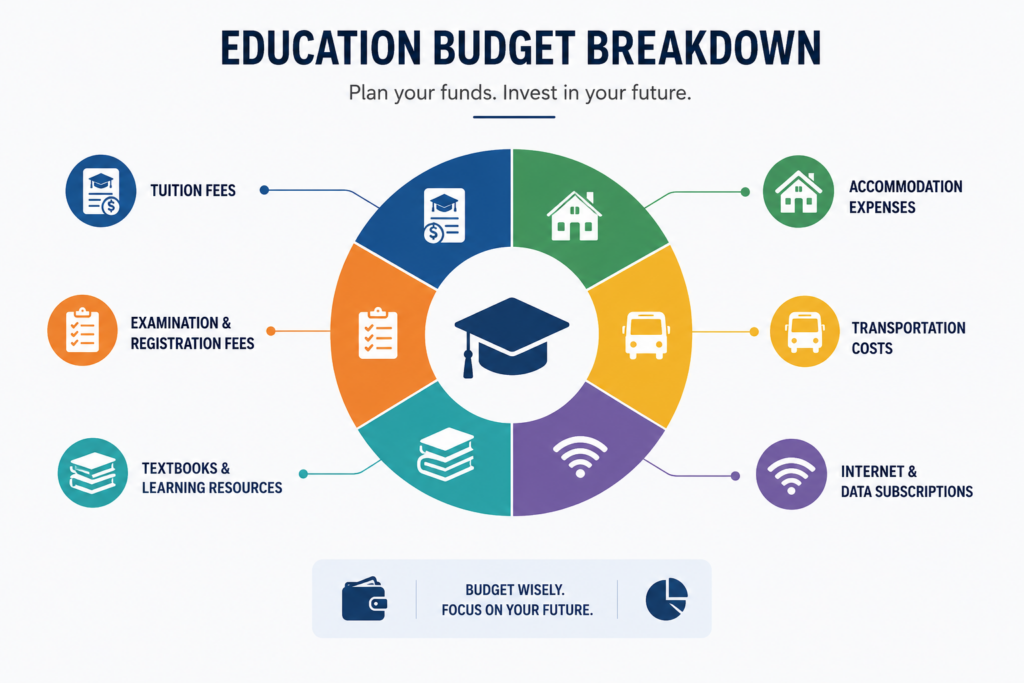
But tuition is only one part of the equation. A student at a federal university paying ₦150,000 in tuition could easily spend ten times that amount when all expenses are added up. Here is what the full picture actually includes:
- Accommodation: On-campus hostels in federal universities range from ₦30,000 (UI) to ₦100,000 (UNILAG) per session. Private off-campus rooms, however, now cost between ₦450,000 and ₦1.2 million annually in major university towns, driven by inflation and severe housing shortages.
- Feeding: A realistic monthly food budget for a student living off campus is between ₦30,000 and ₦60,000, depending on location.
- Transportation: Daily commutes, inter-city travel for exams, and trips home add up quickly, often ₦15,000 to ₦30,000 per month in cities like Lagos or Abuja.
- Internet and data: With most academic resources now online, monthly data costs range from ₦5,000 to ₦20,000, depending on usage.
- Textbooks and handouts: Printed course materials can cost ₦20,000 to ₦80,000 per session for science and professional courses.
- Registration and acceptance fees, examination fees, project costs, and graduation dues compound the total further.
For a student enrolled in a four-year programme at a federal university in Lagos, the realistic total cost from admission to graduation, including accommodation, feeding, transport, materials, and sundry fees, can comfortably exceed ₦3 million, even where tuition itself is under ₦200,000.
Read More: How to Write a Strong Personal Statement for University Applications
Comparing Campus, Part-Time, and Online Education Costs
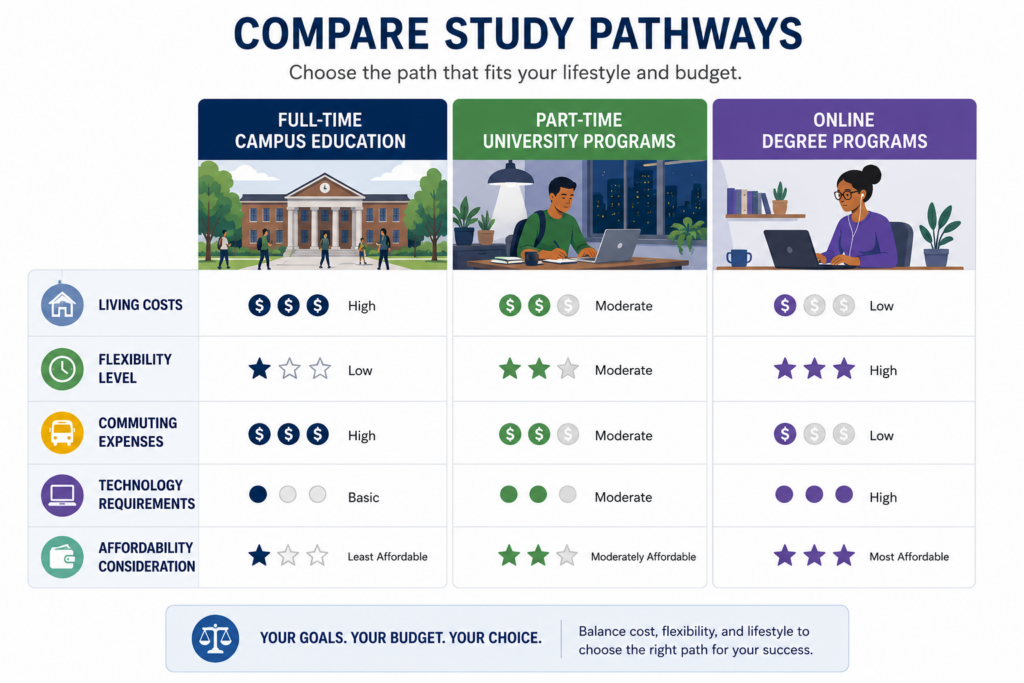
Understanding the cost of university education in Nigeria requires comparing learning modes side by side, because the same qualification can carry very different price tags depending on how you pursue it.
| Study Mode | Tuition Range | Living Costs | Flexibility | Hidden Expenses | Ideal Student Type |
| Full-time Campus | ₦50,000–₦6.5m/session | Very high | Low | Accommodation, feeding, transport | School leavers; full-time learners |
| Part-time Distance | ₦80,000–₦500,000/session | Moderate | High | Exam travel, materials | Working adults; parents |
| Fully Online | ₦50,000–₦400,000/session | Low | Very high | Data, device, online exam costs | Remote learners; professionals |
Full-time campus programmes carry the heaviest cost burden: accommodation, daily feeding, transportation, and the social cost of not earning while studying.
Part-time and hybrid programmes allow students to remain employed and reduce living expenses significantly, though exam centre travel and material costs still apply.
Fully online programmes offer the most cost-efficient path, especially for working professionals. However, reliable internet access and a functional laptop are non-negotiable prerequisites, and both have costs.
Partner Institution Fee Overview

EduTech Business works with a select group of accredited Nigerian institutions offering flexible, affordable learning pathways. Here is an overview of each.
ABU Distance Learning Centre (ABU DLC): Ahmadu Bello University’s Distance Learning Centre makes university education accessible to working Nigerians who cannot commit to a full-time campus experience. Programmes are structured for flexibility, with competitive fees well below mainstream private university tuition. It is particularly well-suited to professionals seeking undergraduate and postgraduate qualifications alongside employment.
Babcock University CODEL (BUCODEL): Babcock’s Centre for Open and Distance e-Learning offers online postgraduate and undergraduate programmes from one of Nigeria’s most respected private universities. The online model significantly reduces the cost burden compared to on-campus Babcock tuition (which can reach ₦3 million per session for some programmes), while preserving access to Babcock’s academic standards and credentials.
Ingryd Academy: For students focused on tech careers rather than traditional degrees, Ingryd Academy offers certification-led programmes in software development, data, and cloud skills. These short-form, career-focused programmes are typically far more affordable than a four-year degree and often deliver faster employment outcomes in Nigeria’s growing tech sector.
Corona College: Specialising in professional education pathways, Corona College focuses on practical, applied learning for working adults, with a curriculum designed to bridge academic knowledge and workplace readiness.
Fees vary across programmes and academic sessions. Students are encouraged to confirm the latest fee details directly with advisors before enrolment.
Hidden Costs Students Rarely Plan For

This is the section most pre-enrolment guides skip entirely. The cost of university education in Nigeria includes a long tail of recurring and one-off expenses that quietly drain family finances throughout a student’s academic years.
Some of the most commonly overlooked costs include:
- Monthly internet subscriptions for online coursework and research
- Laptop or device upgrades, especially when a system bought in year one fails by year three
- Exam centre travel costs for students on distance learning programmes
- Project and thesis printing, binding, and submission fees in the final year
- Professional certification fees, particularly for engineering, law, medicine, and accounting students
- Graduation and convocation fees, which can reach ₦50,000 to ₦150,000 at some institutions
- Alumni association dues and faculty levies are imposed throughout the degree
The pattern is consistent: students budget for tuition, but the financial pressure comes from everything around it. Good financial planning matters as much as good admission planning.
Read More: Top Government and Private Grants for Nigerian Students and How to Apply Successfully
How Nigerian Students Can Fund Their University Education
The encouraging reality is that more funding routes exist today than most students realise. Many students now successfully combine multiple sources to cover the full cost of university education in Nigeria.
Scholarships and institutional grants: Federal and state governments, oil companies (Shell, Chevron, NNPC), and foundations (Jim Ovia, Tony Elumelu) offer merit and need-based scholarships for Nigerian undergraduates and postgraduates. EduTech Business’s grants guide is a useful starting point for identifying live opportunities.
The Nigerian Education Loan Fund (NELFUND): The Nigerian Government signed the Student Loan Act into law in 2024. By the end of the 2023/2024 academic session, NELFUND had disbursed over ₦22.7 billion to 215,514 students enrolled in public tertiary institutions. Applications are processed digitally, and repayment begins after graduation and employment.
Employer sponsorship: Many Nigerian companies, particularly in banking, telecoms, and oil and gas, sponsor employees pursuing postgraduate programmes. If you are already employed, it is worth raising this with your HR department before self-funding.
Flexible payment plans: Several institutions, including many online and part-time programmes, allow instalment payments across a session rather than requiring fees upfront.
Freelancing and remote work: Nigeria’s growing community of remote workers, developers, writers, designers, and virtual assistants demonstrates that earning while studying is genuinely achievable. Digital skills learned even in passing (through courses like those at Ingryd Academy) can fund a degree while building a parallel career.
Family education planning: For younger students, long-term savings vehicles and structured family contributions remain the most stable foundation, particularly when supplemented by scholarships.
Is University Education Still Worth the Investment?
Honestly, it depends. The World Economic Forum and UNESCO consistently show that tertiary education correlates with higher lifetime earnings, professional mobility, and entrepreneurial capacity. In Nigeria, a degree still opens doors that remain shut without one.
However, not all degrees create equal outcomes. A student who graduates with a strong vocational or tech credential from a shorter programme may enter the workforce two years earlier and at a competitive salary, while a peer with a four-year degree in a low-demand field spends months job-hunting. The more useful question is not “should I get a degree?” but “does this specific programme improve my long-term earning potential?”
The right programme, delivered by the right institution, with manageable cost: that is the combination worth pursuing.
How EduTech Business Can Help
EduTech Business exists precisely to close the information gap that makes university decisions so stressful. The platform helps students and families compare universities, understand the real cost of university education in Nigeria, explore flexible and online learning options, and evaluate affordable pathways across trusted partner institutions.
Whether you are choosing between a federal university, an online degree, or a professional certification, the goal is the same: making a well-informed decision, not just a hopeful one. Browse the EduTech Business blog for updated guides, or speak directly with an advisor.
Compare the real cost of degree programmes with EduTech Business. Speak with an advisor today and discover affordable pathways across trusted university partners.
Frequently Asked Questions
What is the average cost of university education in Nigeria? Federal universities charge ₦50,000 to ₦200,000 per session in tuition, while private universities range from ₦500,000 to over ₦6 million. When accommodation, feeding, transport, and materials are included, the four-year total typically falls between ₦2 million and ₦15 million, depending on the institution type and location.
Are online degree programmes cheaper in Nigeria? Generally, yes. Online programmes eliminate accommodation and daily transport costs, which are often the largest non-tuition expenses. Platforms like ABU DLC and Babcock CODEL offer recognised qualifications at significantly lower total costs than equivalent full-time campus programmes.
What hidden costs should university students expect? Beyond tuition, students should budget for accommodation, feeding, data and internet subscriptions, device maintenance, project costs, exam fees, and graduation charges. These often add up to more than tuition itself.
How can students fund university education in Nigeria? Options include merit and need-based scholarships, the federal government’s NELFUND student loan scheme, employer sponsorship for postgraduate study, institutional instalment payment plans, and income from freelancing or part-time remote work.
Is online education more affordable than campus learning? Yes, in most cases. Online students avoid the costs of relocation and daily campus living. The main additional costs are reliable internet access and a functional device, both of which are manageable compared to full campus living expenses.