Choosing an online university in Nigeria has never been more confusing. The number of accredited distance learning programmes has grown sharply in recent years, and for good reason: the National Universities Commission (NUC) currently approves only about 700,000 university places annually, against roughly two million applicants seeking admission. That gap has driven a genuine expansion of online and open distance learning options, each with its own structure, cost, and career outcomes. For working professionals, HND holders seeking a degree of conversion, or anyone who cannot attend a traditional campus, the stakes in getting this decision right are high.
This is where most prospective students get stuck. A quick search produces a long list of institutions, comparison sites that rarely go deep enough, and marketing pages that tell you everything except what you need to know. This guide cuts through that noise. It offers an honest, research-based ABU DLC online degree review, along with a close look at private alternatives, so you can decide based on what truly matters for your career and your life.
Read More: Direct Entry Admission: How It Works for Students
ABU DLC Online Degree Review: What You Actually Get
Ahmadu Bello University’s Distance Learning Centre (ABU DLC) is one of Nigeria’s most established distance learning operations. It runs under the banner of a federal university that has been a cornerstone of Nigerian higher education since 1962. As of July 2024, the NUC approved four additional programmes for ABU DLC, bringing its total to 21 accredited academic programmes, including B.Sc. Mass Communication, Bachelor of Library and Information Science, Master’s in Accounting, and Master’s in Disaster and Risk Management. The centre had only six programmes as recently as 2020, which reflects considerable recent growth.
Strengths of ABU DLC:
- Strong federal university brand with national recognition
- NUC-accredited, meaning degrees are legally valid for employment, NYSC mobilisation, and postgraduate applications
- Generally lower tuition than private online alternatives
- Flexible intake sessions (including a May session for 2025/2026)
- Direct entry pathway for ND, HND, and diploma holders
Limitations to consider:
- Programme catalogue, while growing, remains narrower than some private competitors
- Student support infrastructure is still maturing relative to dedicated online-first institutions
- Technology platform and learner experience can vary depending on the programme and cohort
For a student who prioritises cost and the weight of a federal university name, ABU DLC represents genuine value. The honest caveat is that wider programme variety and a smoother digital experience may require looking elsewhere.
Quick Comparison: Online Universities in Nigeria at a Glance
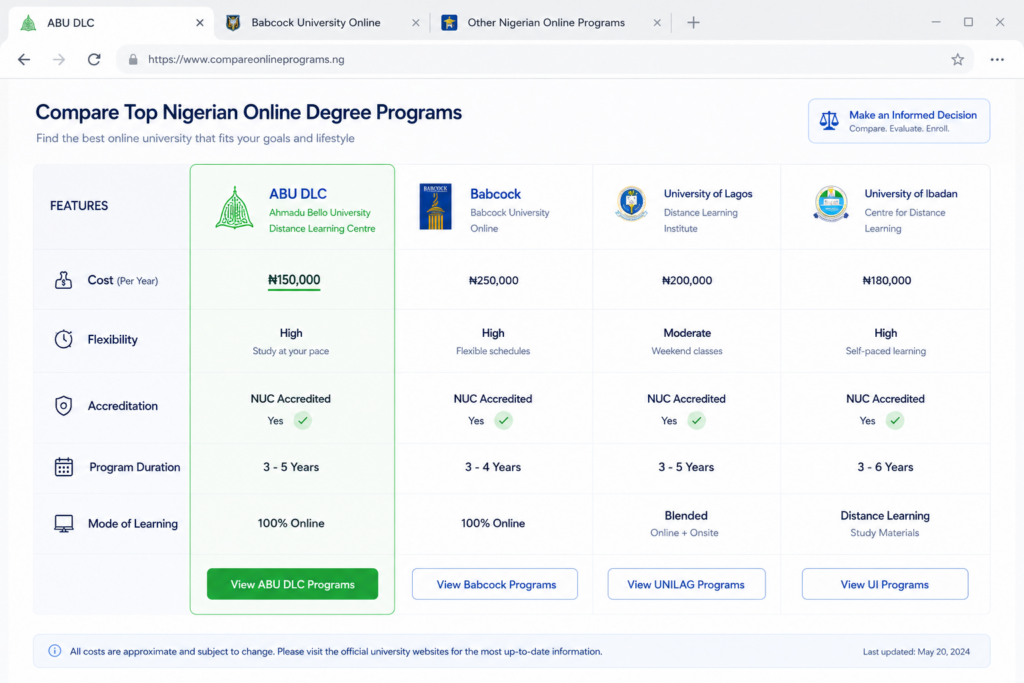
| Institution | Accreditation | Programme Types | Flexibility | Relative Cost | Career Support |
| ABU DLC | NUC (Federal University) | Undergrad, PGD, Masters | High | Low–Moderate | Developing |
| Babcock CODEL | NUC + AAA (Private) | Undergrad, MBA | High | Moderate–High | Strong |
| Iconic Open University | NUC (Private) | Undergrad, Postgrad | High | Moderate | Developing |
| NOUN | NUC (Federal Open University) | Undergrad, Postgrad, Diploma | Very High | Low | Moderate |
| Nexford University | Internationally accredited | MBA, BBA, MS programmes | Very High | Moderate | Very Strong |
Private Online Universities: A Closer Look

Babcock University CODEL
Babcock University’s Centre for Open Distance and e-Learning (CODEL) operates under dual accreditation: NUC recognition in Nigeria and the Accrediting Association of Seventh-day Adventist Schools, Colleges, and Universities (AAA) internationally. This gives its degrees a recognition profile that extends beyond Nigeria’s borders. Current offerings include B.Sc. Accounting, B.Sc. Computer Science and an MBA programme. Student testimonials highlight the ability to work full-time while completing postgraduate study, which speaks directly to the working-professional market.
The trade-off is cost. Babcock’s private university fees are higher than ABU DLC, and its programme range, while growing, is still selective. However, for students targeting roles in finance, accounting, or tech, the professional body accreditations (ICAN, CITN, ACCA) that Babcock’s on-campus programmes carry add significant employer-facing credibility.
Iconic Open University (I-Con)
Based in Sokoto State, Iconic Open University is a newer NUC-licensed private institution offering programmes across Allied Health Sciences, Computing Sciences, Management, and Social and Media Sciences. Its model is student-centred and adaptable, which suits learners with unpredictable schedules. It is still building its employer recognition track record, which is worth factoring in if you are targeting roles in highly structured sectors.
Skill-Based Options: Ingryd Academy
For students whose primary goal is tech employment rather than a formal degree, platforms like Ingryd Academy offer structured, skills-first training in software development and related fields. This is not a university degree, but for a specific slice of the workforce, a demonstrable skill portfolio often opens doors faster than a certificate. Consider this route if your career goal is immediate employment in the tech sector, and pair it with a degree programme later if needed.
Read More: What Students Should Prepare Before Applying to Universities
Key Differences That Actually Matter
The comparison table above gives you the broad picture, but five factors tend to determine which institution suits a given student.
Cost vs. outcome: ABU DLC is among the most affordable NUC-accredited options. But cost alone is a poor guide. A slightly higher-cost programme with stronger employer recognition and career support may deliver a better return over five years than the cheapest option.
Accreditation depth: All NUC-accredited programmes carry the same legal weight for employment and NYSC purposes. However, professional body endorsements (ICAN for accounting, COREN for engineering) matter in specific fields and vary significantly between institutions.
Employer perception: Research from Edugist confirms that ODL degrees from NUC-approved universities are legally recognised for employment. The nuance is that employer perception still varies by sector: business and IT roles show higher acceptance, while certain regulated professions maintain stricter on-campus requirements.
Support systems: Dedicated online-first institutions like Babcock CODEL and Nexford have invested more heavily in learner support infrastructure, including academic advisers, career coaches, and digital platforms designed specifically for remote study. ABU DLC is improving in this area, but is not yet at the same level.
Programme fit: No single institution wins across all disciplines. ABU DLC is strong in management, library science, and social sciences. Babcock CODEL leads in accounting and business. Nexford dominates for internationally recognised MBA and data analytics credentials.
ABU DLC Online Degree Review: How to Choose the Right Option

Use this five-point framework before you pay any application fee.
- Define your career goal first. A vague aspiration to “get a degree” leads to poor institution choices. Identify the specific role or industry you are targeting, then work backwards to which qualification and institution employers in that sector recognise.
- Check your budget honestly. Include not just tuition, but exam fees, study materials, internet costs, and the opportunity cost of study time. ABU DLC’s lower tuition becomes less relevant if connectivity challenges in your area interrupt your learning.
- Audit your weekly schedule. If you have fewer than ten to fifteen free hours per week, you need a programme with truly asynchronous delivery and flexible deadlines, not one that merely calls itself flexible.
- Verify accreditation independently. Cross-check any institution’s claims against the NUC’s officially approved distance learning list before applying.
- Ask about career outcomes. Reputable institutions publish graduate employment data or, at a minimum, provide references from alumni. If an institution cannot tell you where its graduates work, that is informative in itself.
Common Mistakes Students Make
Many students who come to EduTech Business for guidance have already made one of these avoidable errors.
- Choosing on price alone. The cheapest option may cost more in the long run if the degree is not recognised in your target industry or if weak support means you take twice as long to complete.
- Not checking programme-specific accreditation. A university may be NUC-accredited in general, while a specific programme is still pending approval. Always verify the exact programme, not just the institution.
- Ignoring the learning format. A programme that requires physical attendance for exams every semester is not fully online. Clarify this before you enrol, particularly if you live far from a study centre.
- Overlooking postgraduate implications. If you plan to pursue a master’s degree in the future, check that your chosen undergraduate institution and class of degree will meet the entry requirements of your target postgraduate programme.
How EduTech Business Helps You Choose
EduTech Business works directly with partner institutions, including ABU DLC and Babcock CODEL, to provide prospective students with programme comparison support, personalised guidance, and end-to-end admission assistance. The team can match your career goal, schedule, and budget to the right programme, and connect you directly with the admission process, without the guesswork or risk of misinformation that comes from navigating multiple institution websites alone. Visit the blog for further guidance, or get in touch to speak with an adviser.
Frequently Asked Questions
Is an ABU DLC degree a recognised qualification?
Yes. ABU DLC is fully accredited by the NUC, and its degrees carry the same legal recognition as on-campus degrees from Ahmadu Bello University for employment, NYSC mobilisation (where applicable), and postgraduate study.
Which online university is best for working professionals?
It depends on your field. Babcock CODEL and Nexford offer stronger career-focused infrastructure and more flexible scheduling. ABU DLC is a sound choice for those prioritising cost and the federal university credential.
Are online degrees accepted by employers in Nigeria?
Increasingly, yes. Employer acceptance is improving, particularly in business, IT, and management roles. The most important factors are NUC accreditation, the reputation of the institution, and demonstrable skills. See this resource from Hillpad for a detailed overview of the current landscape.
How do I compare online degree options effectively?
Start with your career goal, not the institution. Then filter by accreditation, programme fit, cost, and learner support. Use the framework in this article or book a consultation with EduTech Business for personalised guidance. You can also explore global programme rankings at QS Top Universities for additional context on international recognition.