Introduction: Why Fake Online Universities Increased in 2025–2026
The number of fake online universities Nigeria students encountered in 2025–2026 grew rapidly as more people turned to online education. With thousands of Nigerians searching for flexible, remote-friendly programs, scammers saw an opportunity to create cloned university websites, fake accreditation pages, and misleading social media ads promising “fast admission,” “no requirements,” or “instant certificates.”
Because of this rise, it became more important than ever for applicants to understand how to separate real online universities from fake online universities Nigeria, using simple verification steps before paying any application fee or submitting documents. In this guide, you’ll learn the exact checks to perform to ensure you only apply to accredited, legitimate institutions offering real degrees recognized in Nigeria and abroad.
How Fake Online Universities Trick Students
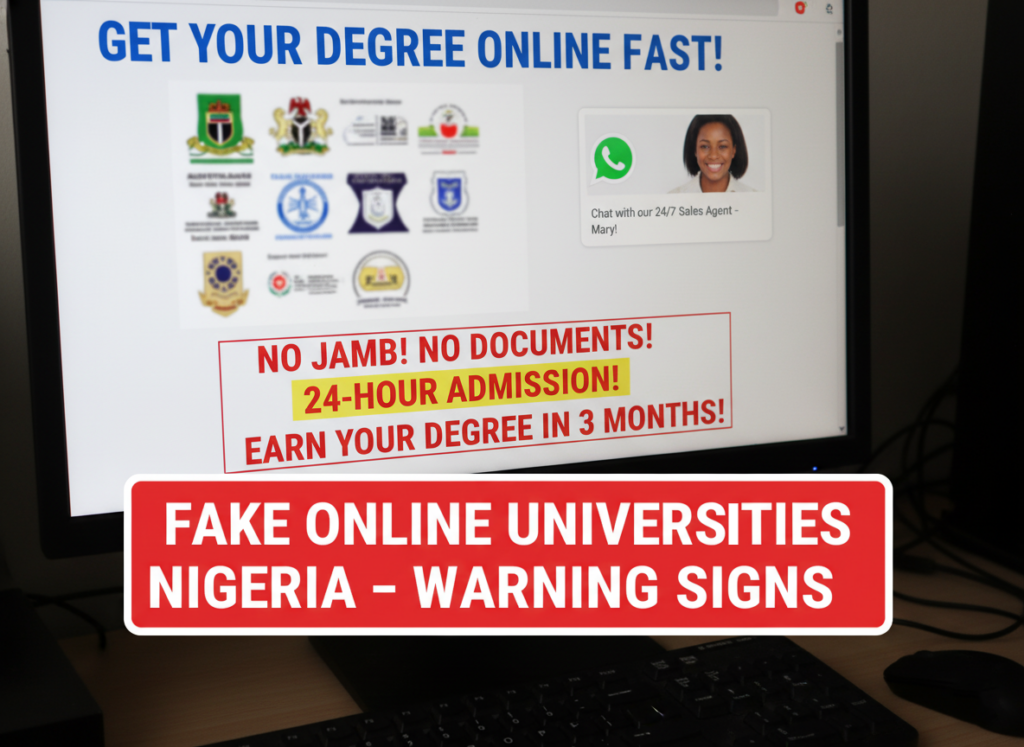
Fake universities are becoming more sophisticated. Many use AI-generated websites that look modern at first glance. Others run aggressive WhatsApp campaigns using paid agents. Some even display forged accreditation badges.
Here are the most common tricks used by fake online universities Nigeria operators:
Copied Accreditation Logos
Scam universities frequently copy and paste logos from the National Universities Commission (NUC) to appear legitimate. However, none of these so-called schools appear on the real NUC list, which you can check via the official accreditation page.
Fake WhatsApp or Telegram “Admissions Officers”
Students often receive unsolicited messages claiming they can get “direct entry,” “guaranteed admission,” or “fast-track results.” Real universities never process admission through WhatsApp agents.
Suspiciously Cheap Tuition Fees
While online learning is generally affordable, fake schools advertise extremely low fees like “₦25,000 per semester” to trap victims. Real universities have structured, transparent fees published on official portals.
Unrealistic Program Promises
Any university promising:
- instant admission,
- same-day certificates, or
- shortcuts bypassing accreditation
…is fake.
Simple Checks You Can Do Before Applying
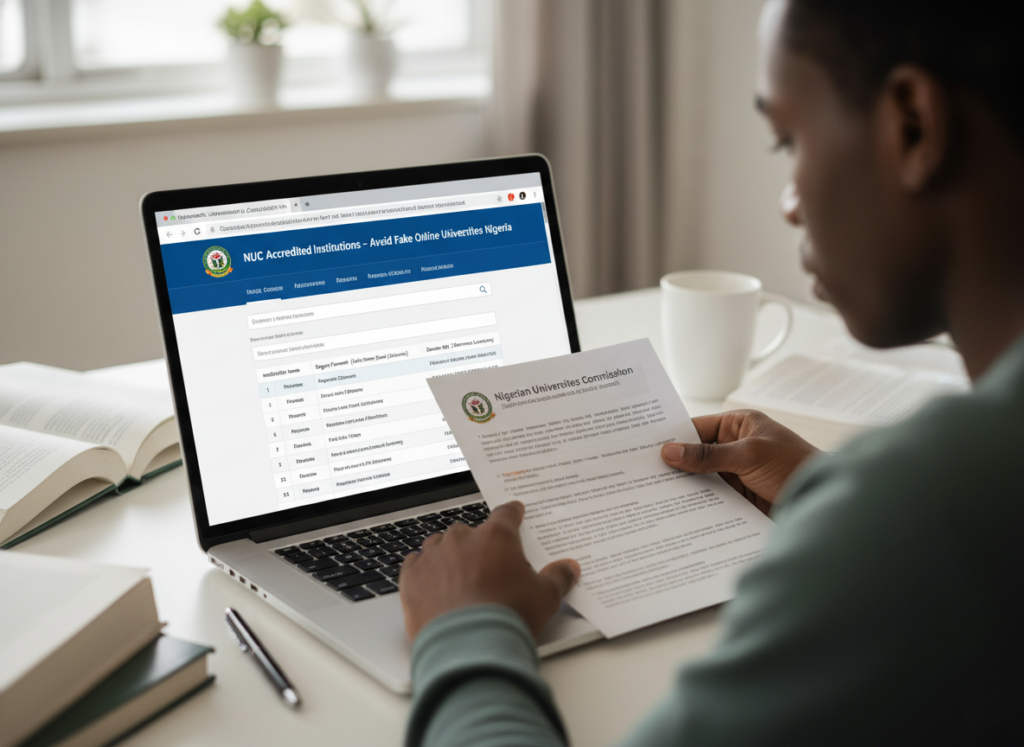
Before you apply to any online school, run these checks. This process works for both Nigerian and foreign universities and helps protect students from fake online universities Nigeria operations.
Check 1: Verify Accreditation
Accreditation should always be the first step.
Search the school on the official NUC Accreditation List.
You should confirm:
- The university’s name is listed
- The programs they offer online are recognized
- Their physical campus is documented
If a university is not on the NUC list, it is fake.
Check 2: Confirm Website Credibility
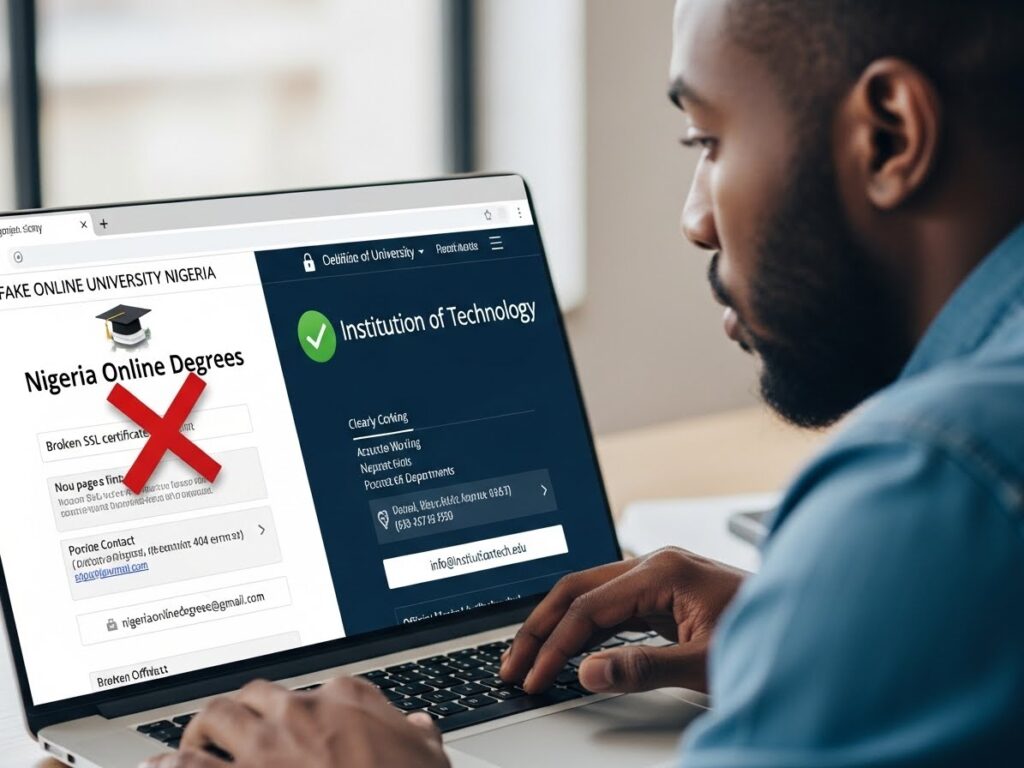
Many fake university websites look professional, but with careful inspection, you’ll notice flaws. Perform these checks:
- SSL Certificate — The URL must start with https://
- Functional Pages — Visit their About, Contact, Programs, and FAQ pages
- Real Email Address — Legitimate schools use official domains (e.g., @abudlc.edu.ng)
- Active Portal System — Real universities use structured student portals
- Correct Grammar & Professional Layout — Scam websites often have poor writing
A real university also provides accessible support pages. For instance, the verified ABU Distance Learning Centre portal has working pages, downloadable brochures, and authentic faculty listings.
Check 3: Confirm Office or Campus Existence
Fake schools often list fake addresses.
To confirm a school’s location:
- Search the campus on Google Maps
- Check images, reviews, and street views
- Look for local news or NUC references about the institution
If you cannot trace the address, the university is fake.
Check 4: Check Reviews, Student Groups & LinkedIn Profiles
Legitimate universities always have:
- Real student communities
- Alumni groups
- Graduate profiles on LinkedIn
Search for the university name on LinkedIn. If you find no real graduates, only stock images or fake testimonials, that’s a major red flag.
Review real student conversations on trusted platforms, not random WhatsApp or Facebook groups where fake online universities Nigeria scams usually operate.
Check 5: Check Recognition in Other Countries
If the online university claims to be based abroad:
- Search it on government registries of the country it claims to operate in
- Verify with the Ministry of Education in that country
- Check global scholarship and accreditation listings such as the UNESCO scholarship page.
If there is no trace of the school, it is fake.
Real Online Universities You Can Trust (Nigeria Examples)
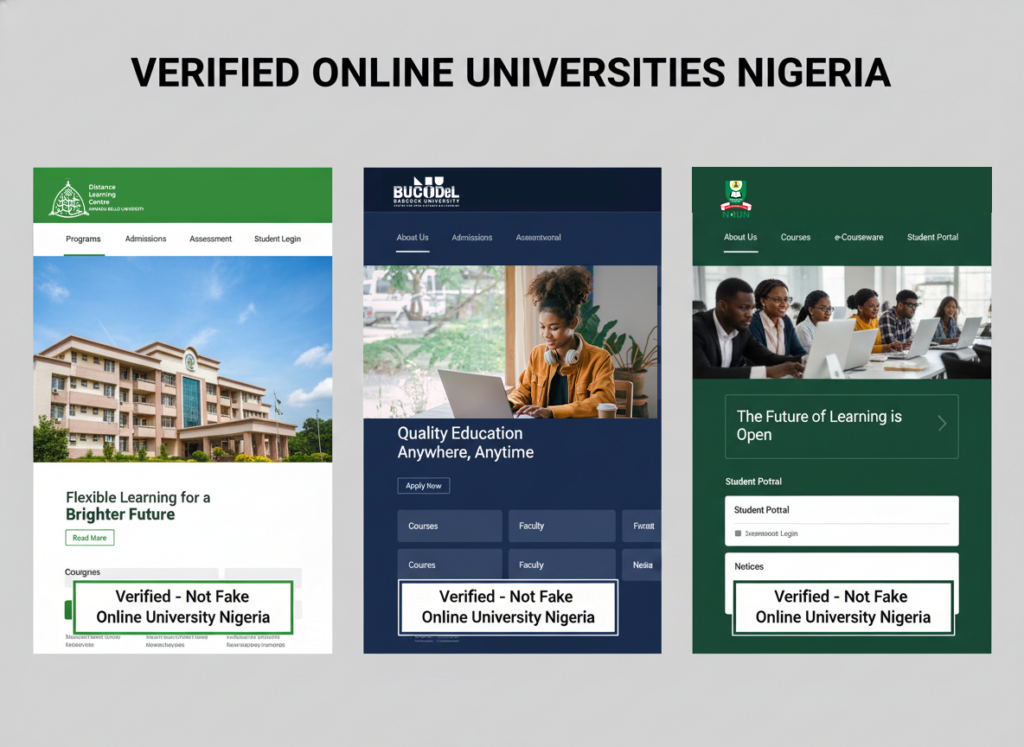
To help reduce confusion, here are verified and trusted online universities in Nigeria. These institutions are recognized by the NUC, offer legitimate digital programs, and have structured admission processes.
Ahmadu Bello University’s DLC is one of the most reputable online degree providers in Nigeria. It offers accredited programs in fields like Business, Public Administration, and Education.
Babcock University runs a well-recognized online learning system with strict quality control, verified lecturers, and clear student support channels.
National Open University of Nigeria (NOUN)
NOUN is the largest open and distance learning institution in West Africa, fully listed on the NUC website and recognized both locally and internationally.
These institutions:
- Appear in the official NUC accreditation list
- Use secure portals and structured admission systems
- Provide verifiable campus information
- Offer direct support via official emails and call lines
This ensures applicants avoid fake online universities Nigeria scams completely.
What a Genuine Online Admission Journey Looks Like
A real online university follows a clear and transparent admission process. Here is what a trustworthy pathway typically looks like:
Step-by-Step (Green Flags)
- Inquiry – You contact the school through the official website, e.g., the EduTech Business homepage
- Program Selection – You receive guidance to choose the right course, often through verified blog resources like “Choosing the Best Online University in Nigeria” on https://edutechbusiness.net/blog
- Portal Registration – You create an account on the official student portal
- Document Upload – You upload WAEC/NECO, ID, passport photograph, transcripts (for postgraduate programs)
- Application Fee Payment – Paid ONLY through the university portal
- Admission Review
- Official Email Confirmation — From the school’s domain
- Onboarding — You receive login details, course materials, and support
- Student Support — You can contact them directly through verified pages like https://edutechbusiness.net/contact/
Red Flags Showing a Fake University
- They ask you to pay into a personal bank account
- They use Gmail or Yahoo emails
- The “admissions officer” can’t spell
- They call themselves a “world university” with no address
- They promise instant admission
Conclusion
As online education expands in Nigeria, so do the operations of fake online universities Nigeria scammers. However, with proper verification steps; checking accreditation, websites, physical addresses, student reviews, and global recognition, you can avoid falling victim.
Choosing trusted institutions such as ABU DLC, Babcock Distance Learning, and NOUN ensures you receive a real, accredited degree that is recognized both locally and internationally.
For guidance, program selection, and safe application support, you can always visit the EduTech Business homepage or explore detailed resources on the blog and also contact us.
Written by Adebambo Fisher
Intern, Branding, Marketing & Communications