In today’s fast-paced world, part-time degree programs in Nigeria are gaining traction as a practical solution for working professionals, parents, and individuals seeking career advancement without pausing their lives. These programs are designed to offer flexible study options in Nigeria, allowing students to juggle academics with work or personal responsibilities.
If you’re considering going back to school but can’t commit to a full-time schedule, this guide outlines everything you need to know about part-time degree programs in Nigeria, from benefits and challenges to finding credible institutions.
Why Part-Time Degree Programs in Nigeria Are Rising
There’s a growing need for education formats that accommodate adult learners, and part-time degree programs in Nigeria fill that gap perfectly.
What’s fueling the rise?
- Economic pressure: Many students cannot afford to stop working to study full-time.
- Career progression: Employees want to upskill while retaining their jobs.
- Access to education: More universities are adopting flexible study options in Nigeria to reach a broader demographic.
These programs are especially appealing in urban centres where evening degree Nigeria options allow students to attend lectures after work or take part in work-study programs Nigeria, combining job experience with classroom knowledge.
Benefits: Flexibility, Cost, and Professional Balance

Part-time degree programs in Nigeria come with a set of advantages that make them an attractive choice:
- Flexible scheduling: Classes are often held on weekends or evenings.
- Cost-effective: Tuition fees are typically spread over more semesters, making them easier to manage.
- Work-study balance: Students don’t need to quit their jobs, helping them finance their education.
- Practical experience: What you learn in class can be immediately applied on the job.
For many, these programs are a pathway to better jobs, promotions, or even complete career shifts.
What to Check: Accreditation, Workload, and Legitimacy
Before enrolling in any program, make sure it’s legitimate and sustainable for your lifestyle.
Key things to verify:
- Accreditation: Ensure the course is approved by the National Universities Commission (NUC) and recognized by relevant professional bodies.
- Delivery mode: Is the program delivered through weekend classes, online, or a hybrid format?
- Assessment structure: Confirm the frequency and format of tests, assignments, and exams.
- Support services: Are there accessible academic advisers, libraries, or career counsellors?
Choosing from accredited part-time courses whether they’re structured as distance learning Nigeria or weekend-based evening degree Nigeria protects you from wasting time and money on unrecognized certificates.
Part-Time vs. Full-Time vs. Distance Learning
Here’s a quick comparison to help you decide which option suits you best:
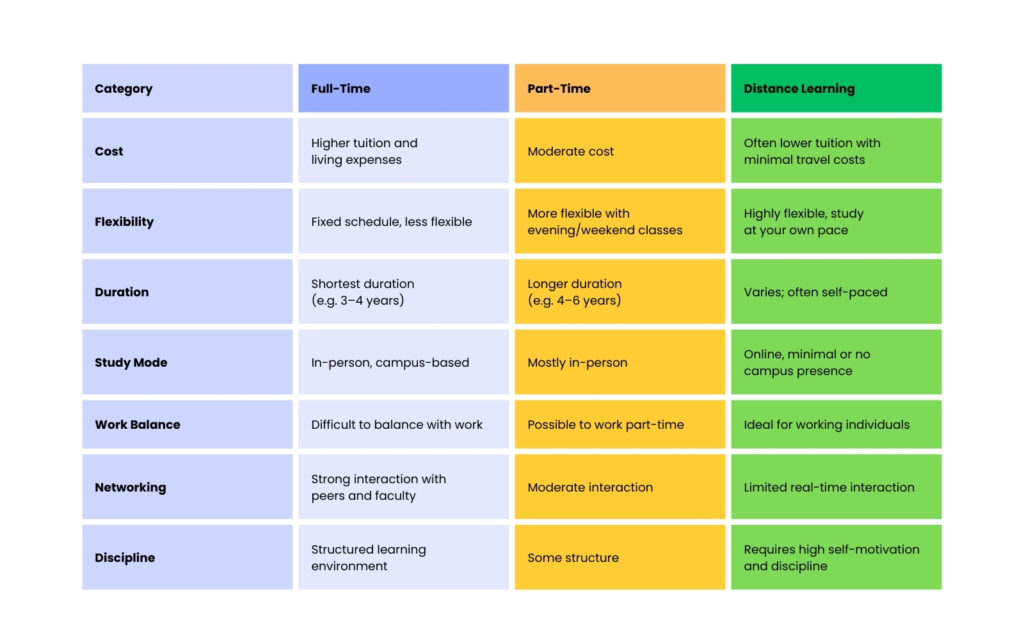
| Feature | Part-Time Degree | Full-Time Degree | Distance Learning Nigeria |
| Duration | 4–6 years | 3–4 years | Varies (Flexible) |
| Cost per Semester | Lower (but over longer period) | Higher (concentrated timeframe) | Moderate |
| Attendance Mode | Weekend/Evening classes | Daily campus lectures | Online modules |
| Suitable for Workers | ✅ | ❌ | ✅ |
| Interaction with Lecturers | Moderate | High | Low to moderate |
Each mode has its pros and cons, but if you’re working or raising a family, a part-time degree program in Nigeria may be your best bet.
Challenges to Prepare For
While these programs offer flexibility, they also demand a high level of discipline and planning.
Common challenges include:
- Time management: Balancing work, family, and studies can be overwhelming.
- Limited campus access: Some resources may only be available during weekday hours.
- Mental fatigue: Juggling responsibilities can lead to burnout if not managed properly.
Consider building a weekly schedule, joining a study group, or setting academic goals to stay on track. Despite these hurdles, many still succeed through commitment and resilience.
High-Demand Fields with Part-Time Options
Several disciplines offer accredited part-time courses tailored to Nigeria’s current job market. These courses often overlap with evening degree Nigeria and distance learning Nigeria formats to improve accessibility:
- Business Administration: Great for professionals seeking leadership roles.
- Education: Ideal for teachers and school administrators looking to move up.
- Public Administration: Suitable for civil servants aiming for promotion.
- Computer Science & ICT: Increasingly in demand due to tech sector growth.
Universities across Nigeria now offer work-study programs Nigeria that support learners seeking flexible study options Nigeria while still maintaining their jobs or businesses. These offerings often include distance learning Nigeria and weekend programs that promote broader access to education.
Where to Find Legitimate Programs?

Finding trustworthy and recognized programs can be tricky, but platforms like EduTech Business simplify the process. We connect students with credible institutions offering part-time degree programs in Nigeria, both online and in hybrid formats.
You can also cross-check schools and programs on JAMB and the NUC’s database to ensure they are authorized to run such programs.
These resources can guide your decision and offer deep insight into program formats and outcomes.
Tips for Choosing the Right Program
Here are some practical tips to guide your decision-making process:
- Review course content: Does it align with your career goals?
- Consider location: If physical attendance is required, how far is the campus?
- Ask about class size: Smaller groups often provide better support.
- Plan finances: Check tuition fees, instalment plans, and scholarship opportunities.
Be wary of programs that promise unrealistic outcomes or have vague admission criteria. A genuine program will provide clear, detailed information upfront.
Part-Time Programs and Career Advancement
One of the most compelling reasons to pursue part-time degree programs in Nigeria is their role in career development. Many employers value the dedication and discipline it takes to study part-time.
Graduates often report:
- Promotions at their current jobs
- Easier transitions into new industries
- Increased earning potential
- A more versatile professional network
If you’re already in the workforce, a part-time degree allows you to grow while applying knowledge directly in your field creating a strong feedback loop between theory and practice.
Common Myths About Part-Time Degree Programs
Despite their growing popularity, many misconceptions still surround part-time degree programs in Nigeria. Here are some common myths and the truths behind them:
Myth 1: Part-time degrees are less respected than full-time degrees.
Truth: As long as the program is accredited by the NUC, employers value the degree equally. In fact, many employers appreciate the dedication it takes to earn a degree while working.
Myth 2: Only people who couldn’t get into full-time programs go part-time.
Truth: Many part-time students are professionals with strong academic backgrounds who simply need a more flexible study option.
Myth 3: Part-time programs are not rigorous.
Truth: Most accredited part-time courses follow the same curriculum and assessment standards as their full-time counterparts.
Myth 4: You can’t access university resources as a part-time student.
Truth: While access might be limited during weekdays, most schools offer digital libraries, weekend consultations, and online academic support.
Myth 5: Employers won’t recognize a part-time degree.
Truth: What matters most to employers is the quality and accreditation of the degree not whether it was earned part-time or full-time.
Breaking these myths can help more learners make confident, informed decisions about their education.
Final Thoughts: Is a Part-Time Degree Right for You?
If you’re self-driven, organized, and motivated to learn without giving up your current responsibilities, part-time degree programs in Nigeria offer a life-changing opportunity. They combine the benefits of formal education with the flexibility needed in today’s dynamic world.
Whether you’re aiming to grow within your current job, switch careers, or finally earn that degree, a part-time program might be the key to unlocking your potential.
Get Started with Edutech Business
At Edutech Business, we help students find flexible study options in Nigeria that align with their goals, lifestyle, and budget. Our platform is designed to streamline your search and connect you with accredited institutions.
Empower your future, choose education that fits your life.
Written by Adebambo Fisher
Intern, Branding, Marketing & Communications